A Shot in the Dark

Questions linger in the death of mafia associate and former federal informant  Jesse Stoneking, who allegedly committed suicide in Surprise, Ariz. in January 2003.

By C.D. Stelzer Screen Shot 2015-02-14 at 6.08.05 PM
The end came in the desert with a single gunshot. Not a solidarity death, as implied by the
St. Louis Post-Dispatchbut one well attended. A death witnessed and documented, leaving little room for speculation. A simple suicide or so it would seem.
On Sunday Jan. 19, 2003, at 9:45 p.m. Mountain Standard Time, a man identified as Jesse Lee McBride shot himself with a .38-caliber revolver,while seated behind the wheel of a blue1995 Ford Crown Victoria on the outskirts of Surprise, Ariz., according to local police reports. The victim died approximately an hour later at a nearby hospital. Law enforcement authorities closed the case, after a routine investigation. Though the Arizona press ignored the incident, the news media in St. Louis later reported the true identity of the man as Jesse Eugene Stoneking, a 56-year old mobster, who gained fame here as a federal informant in the 1980s. 
Screen Shot 2015-02-14 at 6.08.56 PM
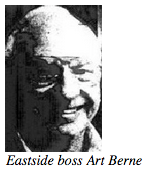
During his long criminal career, Stoneking put together a resume that ran the gamut from extortion to murder. By the late 1970s, he had become the top lieutenant of Eastside rackets boss Art Berne, who took his orders directly from the Chicago Outfit. But after being nabbed as the leader of an interstate car theft ring in 1981, Stoneking rolled over and became an FBI informant.
His undercover work for the bureau ultimately led to federal indictments and a string of convictions of St. Louis area organized crimefigures, including his boss. The mafia reportedly put a $100,000 bounty on his head.
Stoneking spent most of the next two decades running from his past.Despite Stoneking’s reputation and the FBI’s expressed interest in his death,municipal and county officials in Arizona, who had jurisdiction over the case, chose not to expand the inquiry.Their suicide ruling is based primarily on two eyewitness accounts, including one by a Maricopa County deputy.
For this reason among others, the Surprise police deemed Stoneking’s death an open-and-shut case. But however certain the cause of death may be, questions persist. In death, as in life, the truth about Jesse Stoneking remains elusive. 
Accounts vary. Discrepancies abound. Conclusions contradict. In this case, even the name of the victim is listed wrong on the medical examiner’s report. As a result, public understanding of the under-reported case has been limited by a combination of standard police procedures and the media’s failure to provide accurate, independent, follow-up coverage of breaking news.
Screen Shot 2015-02-14 at 6.09.11 PM
The men who were not there
The Post-Dispatch story on Stoneking’sdeath ran on Saturday, Jan. 25, 2003, six days after his suicide. Relying on a Surprise police spokesman’s account of the incident, staff writer Paul Hampel reported that Stoneking had shot himself in his car “in a desolate area on the edge of town.” Among the sparse details included in the story was that the former mobster operated an automobile repossession business and “lived alone” in Wickenburg, Ariz.
Hampel’s story sketched a solitary suicide on a lonely stretch of road at a remote location in the desert. But maps of the area show a different picture. The crime took place in sprawling Maricopa County, near the intersection of two well-traveled roads, which bordered residential developments and golf courses on three sides.
Screen Shot 2015-02-14 at 6.08.40 PM
More importantly, the police and medical examiner’s reports on the suicide show that Stoneking’s last act wasn’t carried out alone, but in the company of a longtime associate and a law enforcement official. Moreover, the car that Stoneking drove that night was registered in the name of his friend, as was the weapon that he allegedly used to kill himself.
The official police version of Stoneking’s death raises questions about the immediate actions taken by law enforcement officers, the methods used in the initial investigation and conclusions drawn afterwards.The following account is based on the reports of the first officers who arrived on the scene and a police interrogation of Stoneking’s friend.
At 9:05 p.m., the Maricopa County Sheriff’s Office dispatched Deputy J. Sprong to Loop 303 and Bell Road because of a report that there were large rocks in the roadway. Sprong reported that on his arrival he saw a Ford Crown Victoria driven by Stoneking on the side of the highway with its emergency flashers on. The deputy also reported that two other vehicles, a late model Toyota SUV and a tow truck, were parked 300 yards further down the road.
The tow truck driver advised the deputy that the SUV and the vehicle driven by Stoneking had flat tires from hitting rocks on the highway. The SUV driver gave the same story, according to the report, prompting Sprong to double back and remove the road hazards.
On his return, the SUV and the tow truck(identified as a flat-bed type in other police reports) had departed. Sprong then pulled behind the Ford to ask whether the driver needed assistance. At that point, the passenger, identified as Michael Laurella, got out of the car and walked back to the police vehicle. “I then heard a single gunshot from inside of the vehicle,” Sprong wrote.
Sprong says he then shined a flashlight through the back window and saw blood coming from the right side of the driver’s head. As he ordered Laurella to continue walking towards him, Surprise police officer R. Peck arrived on the scene. Sprong also reported that a third law enforcement officer from the Arizona Department of Public Safety also arrived at the scene about that time.The state officer, according to Sprong, watched Laurella as he and Peck approached the Ford from opposite sides.
“I approached the vehicle on the passenger side as the other Officer (Peck) was on the Driver’s side,”reported Sprong. “We noticed a black revolver pistol next to Jesse’s right leg on the seat. His right hand was on top of the gun. I noticed that Jesse was still breathing but did not respond to my commands. I then reached inside the vehicle and took the gun and secured it in my vehicle.”
Peck’s report of the incident is mostly the same as Sprong’s with exception of a rather subtle but possibly significant omission. He doesn’t mention the arrival of the Public Safety officer at the scene. In Peck’s account, he searches Laurella, Sprong then directs the passenger to stand behind the police vehicle, as Peck presumably returns to his squad car to request another officer. According to Peck: “I checked Michael Laurella for weapons and Deputy Sprong then had him step to the rear of his patrol car. I then requested another officer from dispatch. Deputy Sprong and I then checked on the driver with deputy Sprong advancing on the passenger side and myself on the driver side.”

The fact that Peck didn’t mention the arrival of the third officer in his report could be explained as a simple oversight. It is clear from Sprong’s version of events that he had requested additional back up. His account indicates that three law enforcement officers from different jurisdictions were on the scene only moments after the suicide occurred. But oddly, in his report, Sprong doesn’t identify either of the other officers by name. He does, however, repeatedly refer to the victim as “Jesse; ” and the witness, Laurella, as “Michael,” which in retrospect seems somewhat informal for a police report. 
Sgt. P.H. Riherd of the Surprise PoliceDepartment arrived next and advised Sprong that the shooting took place within the town’s jurisdiction. Sprong reported that he then turned the pistol over to her. Riherd also ordered Peck to close the road to traffic and set up warning flares. (Later, Peck was directed by another officer to drive Laurella home.) In the interim, emergency medical technicians arrived at the scene and Stoneking was taken by helicopter to a hospital in Phoenix, where he died.
By the time J.C. Vance, the investigating detective, arrived on the scene, an hour after the shooting, the body and the weapon had both been removed from the vehicle. Moreover, the first responding officers had been relieved of their duties by others, including Sgt. Riherd and officer G. L. Welch.
Vance reported that he received a call at10:15 p.m. from Sgt. D. Cuker, who wasat the scene, asking him to respond to a“possible homicide or suicide.”When Vance arrived, at 10:45, Welch’s patrol car was parked directly behind the Ford Crown Victoria and the weapon that Stoneking allegedly used to kill himself was on the trunk of the Ford.Laurella was seated in the back of Welch’s patrol car.
Botched
From these official accounts, the investigation appears to have been compromised from the outset. In the hour that it took the detective to arrive, the chain of custody on the weapon had changed two or three times. Two of the three witnesses, both law enforcement officers, had left the scene. And the body had been removed. 
There are other discrepancies. When Vance interrogated Laurella at the scene, Stoneking’s friend told the detective that two other vehicles had pulled over to side of the road with flat tires, not one as Sprong reported. According to Laurella’s account, the other cars were parked in front and behind his car. Laurella indicated that the tow truck driver fixed both of those vehicles’ flat tires.
Instead of also asking for assistance, however, Laurella says that Stoneking said that he preferred they fix their flat themselves.By the time deputy Sprong returned to the scene after clearing the rocks from the road, both of the other vehicles and the tow truck had departed, Laurella said.
During the meantime, nothing in the police reports show that Laurella or Stoneking made any effort to fix their own flat tire in the intervening 30 or 40minutes. They also declined to request assistance from the tow truck driver,according to Laurella’s account.
Instead, they remained seated inside the car. When Sprong pulled up behind them and activated his overhead emergency lights, Laurella said that Stoneking asked him to hold his glasses and then requested that he get out and tell the deputy that help was on the way.
Laurella said he was ten or 12 feet behind the car and had just begun to speak to the deputy when he heard the single gunshot come from inside the Crown Victoria. Laurella says he was then ordered to put his hands on the hood of the patrol car by the deputy. As stated in the other accounts, officer Peck arrived at the scene immediately after the gunshot was fired.
But according to detective Vance’s report, Laurella didn’t mention the unidentified state cop, who deputy Sprong says guarded Laurella while he and officer Peck checked on Stoneking. According to detective Vance’s report:“Laurella further indicated that at this time a Surprise police officer arrived on scene and he was secured in the back of the deputy’s patrol car, while the police approached his vehicle.” Laurella added that “he remained seated in the deputy’s patrol car while other police and medical personnel arrived on scene and treated his friend, Jesse.”Again, the differences in the accounts of the three witnesses could be an innocent oversight in the police reporting. It’s also possible that Laurella, under duress, may have not have recalled the arrival of the third police officer.
Less explainable, though, is how Laurella ended up in possession of Stoneking’s wallet. According to the detective’s report: “Laurella also indicated that he had McBride’s (Stoneking’s) wallet in his pocket as it was given to him by an officer.” 
If Laurella is to be believed, a police officer at a possible homicide scene removed personal effects from a victim,or, at least, from the inside of the vehicle where the shooting took place, and then handed them over to a potential suspect. An evidence technician, who arrived later, took photographs, but by then the crime scene had been disturbed more than once by police and the emergency medical crew. Swab tests of Laurella’shands showed no signs of gunpowder.
But contrary to the Post-Dispatch, story, the medical examiner’s report doesn’t indicate that similar tests were performed on Stoneking’s hands even though they had been bagged at the crime scene expressly for that purpose. Soot was found in the head wound, according to the medical examiner, but no powder tattooing was identified, which is often present when a gunshot is fired at close range. 
In addition, no autopsy was performed, according to the medical examiner’s report.  
The story that wasn’t there
Aside from the Post-Dispatch story that appeared nearly a week after his death,there has only been one reference to Stoneking that appeared in the newspaper since then, a nostalgic column by staffer Pat Gauen that ran in the Illinois zoned edition. A search of Lexis-Nexis database doesn’t show the Jan. 25, 2003 news story was even published. 
* During his interrogation at the scene, Laurella said he and Stoneking lived together in a mobile home in Wickenburg. The Post-Dispatch reported that Stoneking lived alone. 
* Laurella owned the Crown Vic that Stoneking was driving, according to the police reports. The Post-Dispatch reported that it was Stoneking’s car.
* Laurella and deputy Sprong were present at the time of Laurella’s death. The Post- Dispatch implied that
Stoneking died alone.
* The .38-caliber revolver that ended Stoneking’s life belonged to Laurella. The Post-Dispatch didn’t even mention Laurella’s name.
At least one working journalist in St.Louis knew better.
On Jan. 22, veteran TV newsman John Auble of KTVI-Channel 2 in St. Louis called detective Vance and said he believed that suicide victim Jesse McBride was actually Jesse Stoneking, a federal informant.
Vance contacted the U.S. Marshal’s office for confirmation. The next day the detective reported that he picked up the bullet from the medical examiner’s office along with photographs of the autopsy — the autopsy the medical examiner’s report indicates was never conducted. He also wrote that he retrieved a set of latent prints from the corpse and sent all the evidence to the state crime lab for analysis.
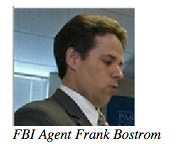
On Jan. 27, two days after the Post- Dispatch story ran, FBI agent Frank Brostrom of the St. Louis field office spoke with detective Vance by phone, advising him that he believed McBride was actually Stoneking. Brostrom requested that the Surprise police send him the crime scene photographs and a copy of the police report.
Vance’s police report is dated Jan. 27,2003. It bears no indication of the results of the state crime lab results on the evidence. A later supplemental report filed by detective Sgt. Y. Ybarra indicates that he had received the medical examiner’s final report on April17, 2003, nearly three month’s after Stoneking’s death. The report concludesthat Jesse McBride died of a self-inflicted gunshot wound to the head.Officially, Stoneking has never beendeclared dead. For the record, onlyMcBride pulled the trigger. In death, Jesse Stoneking had finally managed to escape his enemies on both sides of the law, including himself.
“They’re going to hit me someday.”
More than a decade before his death in the Arizona desert, Jesse Stoneking prophesized that he would die not by his own hand but as a result of a vengeful execution carried out by the Mafia.“I know they’re going to hit me someday,” Stoneking told former St. Louis Post-Dispatch reporter Ronald Lawrence in 1987.
Lawrence had reported on Stoneking’s career as a federal informant and over the years a bond developed between the two men.The trust that the newspaperman engendered prompted Stoneking to divulge aspects of his life that he had never revealed to anyone else. In 1987,Lawrence interviewed Stoneking over a two-day period at a motel in Central Illinois, which the now-retired reporter published as a magazine article two years later. 
After his usefulness as a federal informant in St. Louis had been expended, Stoneking briefly entered the federal witness protection program, but he chaffed under its constraints. He left the program and began his life on the run, often hiding out in small towns in rural Southern Illinois and Kentucky, using the pseudonym Jesse McBride.
Stoneking also spent stretches of time in Arizona, where he operated an automobile repossession business. During the intervening years, Lawrence met sporadically with Stoneking and began writing a biography of him. They sometimes had lunch at the Our Lady of the Snows Shrine near Belleville, Ill.
Later, they met clandestinely at a house in Chester, Ill. At that particular meeting, about a year-and-a-half before his death, Stoneking expressed apprehension about plans to return toArizona. Lawrence last saw Stoneking in 2001, when he visited him in Arizona. Stoneking’s fears had not subsided.
“He was paranoid,” says Lawrence.“Really paranoid at times. … His cover was blown.”There is little doubt that the police knew who he was. In the small town of Wickenburg, where he resided, Stoneking’s past was no secret. After his death, Surprise Police Department spokesman Scott Bailey, a Wickenburg native, told the St. Louis Post-Dispatch, “We’d see him driving around town and say, `There goes the Mafia guy.’”

The Road to Perdition
Jesse Stoneking wasn’t born a hardened criminal, but by adolescence he already had begun developing anti-social tendencies. At 14, the former choirboy was expelled from Catholic elementary school in St. Louis for bringing a pellet gun to class.
Soon a juvenile judge placed him on probation for a string of burglaries, which netted $20 in coins. After his parents’ bitter divorce, Stoneking lashed out by stealing a car and going on a joyride, earning him a three-year hitch in reform school, a virtual criminal training ground. In 1964, his prior juvenile record resulted in a stiff sentence, this time for the minor offense of under-age drinking. A St. Louis County judge ordered him to serve two months in jail and meted out a two-year probation.
By this early stage in his life, the dye had been cast. The rebellious youth, who had taken a few wrong turns, was now on the irreversible path of a career criminal. Stoneking adopted his grandfather, a one-time bank robber, as his role model. His commanding size and domineering attitude served his purposes well,eventually attracting the attention of Art Berne, the Eastside rackets boss, who recruited him into the Outfit. Within afew years, he had become Berne’s number one enforcer. Berne had inherited his criminal empire from the late Frank “Buster” Wortman. From the 1940s until his death in 1968, Wortman had reigned over prostitution, gambling and labor racketeering, including control over Pipefitters Local 562 in St. Louis. Wortman’s organization, which Berne took over, answered, in turn, to the Chicago Outfit, which by the late-1970s was controlled by Jackie Cerone and Joey Aiuppa.

Screen Shot 2015-02-14 at 6.09.56 PM
Stoneking earned and kept Berne’s loyalty by doing his bidding. On Oct. 22,1978, for instance, mob associate Donald Ellington was found dead in a remote area of Jefferson County, Mo. with two .38-caliber bullets in his head.Police arrested Stoneking as a suspect in the killing, but he was never charged. Rumors were that the dead man had incurred the mob boss’ wrath, in part due to the mistreatment of Berne’smistress, a prostitute. Stoneking allegedly carried out the vendetta on Berne’s orders. 
Stoneking’s prowess in the Outfit grew the next year, when he killed two men in a shootout at the Kracker Box tavern outside Collinsville, Ill. In September 1980, a jury convicted Stoneking of the murders, but St. Clair County Judge Stephen Kernan set aside the convictions, after the defense claimed new witnesses had come forward.
In a plea bargain, Stoneking later pleaded guilty to one count of involuntary manslaughter and received probation.Then-prosecuting attorney John Baracevic said he agreed to the deal because the prosecution lacked witnesses. Killing two men in St. Clair County, Illinois in1979 had netted Stoneking a lighter sentence than he received in St. Louis County for under-age drinking 15 years earlier.It appeared that Stoneking’s mob connections were taking care of him.
During these years, the mob provided him a series of well-paying, no-show jobs with the operating engineers, pipefitters and laborers unions. But when the feds busted him in 1981, his fortunes quickly changed. A federal grand jury in Benton, Ill.indicted Stoneking for operating a multi-state car theft ring. Stoneking pleaded guilty and received a three-year federal sentence.
 
Stoneking’s federal bust occurred in the wake of Anthony Giordano’s death. For decades, St. Louis’ Mafia boss, with the backing of the Chicago Outfit, had managed to cobble together an alliance of competing organized crime factions. After his death, a power struggle immediately developed, beginning with 
the September 1980 car bombing of Southside Syrian gangster Jimmy Michaels.
The loose alliance had come unraveled, allowing the FBI to make inroads into the previously impregnable inner sanctum of the mob’s hierarchy. Aging Mafia underboss John Vitale, who had ascended to the Mafia’s top post following Giordano death, became anFBI informant and falsely implicatedStoneking in the Michaels bombing.
Roll Over Test
His fingering left Stoneking feeling doubly betrayed. Berne had let him take the fall in the car theft bust and also not retaliated against Vitale’s accusations. Stoneking decided to roll over. In return for his early prison release, he, too, agreed to become an FBI informant. Between October 1982 and August1984, Stoneking secretly taped more than 130 conversations with Berne and dozens of other mobsters, including Matthew Trupiano, who had been installed as the St. Louis Mafia boss following Vitale’s death.
Screen Shot 2015-02-14 at 6.10.23 PM
As a result of Stoneking’s undercover work, Berne and Trupiano were indicted on federal charges in connection with a scheme to coerce protection payments from Eastside massage parlor kingpin Dennis W. Sonnenschein. At the time, Sonnenschein was a business partner of Nando Bartolotta, who had been inducted into the St. Louis Mafia with Trupiano. (Stoneking’s testimony would also help send Bartolotta to prison on unrelated charges.)
As recently as last year, Sonnenschein, the brothel operator, received a one-year prison sentence for not cooperating with a federal grand jury inquiry into the interstate promotion of prostitution by Eastside massage parlors that solicited business in the St. Louis Riverfront Times between 1994 and2000. Berne pleaded guilty to the extortion scheme and received a six-year sentence. Trupiano, on the other hand, went to trial and was acquitted of the same charges.
 Screen Shot 2015-02-14 at 6.10.10 PM
Evidence and testimony introduced at the 1986 trial provided details of mob plans that otherwise may have neve rbeen publicly revealed. For starters, FBI agent Terry L.Bohnemeier testified that Stoneking continued to receive $1,600 a month for his work as a federal informant. In return, Stoneking supplied the bureau with tapes of talks in which Berne and Trupiano discussed extorting money from Eastside topless club owners.
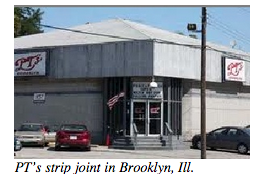
 According to the tapes, Trupiano intended to have Bartolotta, his soldier, pressure Sonnenschein into paying protection money out of profits that the two partners made from the Golden Girls topless club. Berne, on the other hand,wanted to bomb PT’s, a competing topless club in Centreville, as a means of convincing the owners to pay up. 
During a car trip to Chicago, Berneexpressed concerns about the risks of extorting money from “pimps” such as Sonnenschein:  “You watch, these pimps will spread it around who the Mafia is,”Berne warned Stoneking. “The G(government) will be there.” While he continued to voice his suspensions about the reliability of pimps, his top lieutenant sat next to him in the front seat wearing a wire.
In August 1984, Stoneking left St. Louisin the dead of night. He entered the witness protection program in Boston, but bolted after only a couple of weeks. Meanwhile, the Mafia had placed a$100,000 price tag on his head.
For the next two decades, while his estranged wife and children disappeared into the witness protection program, he remained at large hop-scotching across the country, living in small towns in three different states.
Stoneking remarried and made efforts to settle down, but glances in his rearview mirror always kept him moving. His last glance came in January 2003 onthe outskirts of Surprise, Ariz., when a squad car rolled up behind him as he sat on the shoulder of a highway behind the wheel of a friend’s disabled Ford Crown Victoria. With the emergency lights flashing in the desert night, he put a .38-caliber revolver to his temple and pulled the trigger. At least that’s the official version.Reporter Lawrence, Stoneking’s confidant, tends to believe it.
“I was pretty close to him,” says Lawrence, adding that Stoneking had turned reflective in his later years, often reading and quoting from the Bible. “He had changed. He didn’t like what he had did.”

The Last Joyride
If Jesse Stoneking had ended his life alone, pulling the trigger in the lonely desert night, as the
St. Louis Post- Dispatch implied, perhaps the subsequent investigation by Arizona police would have been more thorough.
Screen Shot 2015-02-14 at 6.10.39 PM
As a federal informer in the 1980s, Stoneking, after all, had been responsible for sending more than a score of St. Louis organized crime figures to prison. Legend has it that the Mafia placed a $100,000 bounty on his head. In the intervening years, he managed to escape at least one assassination attempt and suspected that others had plotted against him since then.
With the passage of time, his name fadedfrom the headlines, but Stoneking remained haunted by his past, moving from state to state, living under his assumed name. Nothing contained in the police reports indicates why Stoneking and Laurella had traveled from the mobile home they shared in Wickenburg, Ariz. to Surprise,a distance of more than 40 miles.The police reports show that the Crown Victoria was registered to Laurella, and the suicide weapon also belonged to him. 
At the crime scene, Laurella told the investigating detective that Stoneking had not exhibited any outward signs of depression in the last several days. He added that Stoneking had taken the gun from his dresser drawer without his knowledge.
Authorities impounded the car, but Laurella was not held for further questioning and was driven home by a Surprise police officer. As with many suicides, the cause, as well as the circumstances of the death, remain puzzling, and, in this case, pieces of the puzzle seem to be missing.According to the official record, two men in their 50s, both with checkered pasts, decide to go on a joyride in the desert on a winter’s night for no apparent reason. After having a flat tire, one of them blows his brains out, as if on cue, exactly at the moment when a law enforcement officer arrives on the scene.
St. Louis sources, with knowledge of Stoneking’s criminal career, don’tnecessarily question the suicide ruling. For years, Stoneking displayed paranoid tendencies, fits of fantasy and wild mood swings, they say. He claimed to have colon cancer. He struggled through two broken marriages, while grappling to come to terms with the heinous deeds of his earlier life. Those close to his story also say, however, that it is a life he may not have altogether given up.
In the mid-1980s, Stoneking, of his own volition, withdrew from the federal witness protection program, after only a couple weeks. But he, nonetheless, came back to the Midwest with a different name – Jesse Lee McBride and the credentials to prove it.
In later years, Stoneking, using his new identity, ran a Wickenburg automobile repossession firm, a marginally legitimate business that suited his past experience as a car thief. In retrospect, it seems apropos that Stoneking’s last images of life came from behind the wheel of a big sedan, watching a flatbed tow truck come and go, and, finally, seeing the glare of the squad car’s flashing lights in the rearview mirror.The possibility exists that, at the time of his death, Stoneking was still working both sides of the law. As veteran St.Louis reporter John Auble says, “it would have been hard to get out of that kind of work.”
Blow Out
Laurella and Stoneking left their trailer in Wickenburg at about 7:30 p.m.ostensibly to visit a friend who lived nearby. From there, Stoneking drove Laurella’s car southeast for the better part on an hour through Maricopa County on U.S. 60, reaching the outskirts of Surprise sometime after 9:00p.m. At that point, he hit a rock on Loop 303 just north of Bell Road and had a blow out. 
It is unclear when Laurella, the last person to see Stoneking alive, first came to know him. Both men were divorced,and their ex-wives and families lived in Wickenburg. Until a year or two earlier, Laurella’s family owned and operated a motel, cafe and gas station in the small town.But the two men’s interests extended beyond Wickenburg’s confines. Laurella and Stoneking not only shared the trailer, they had also resided at the same address in Chester, Ill. the previous year.

Blurred Lines
Since fleeing St. Louis in 1985, Stoneking had lived under the assumed identity of Jesse McBride. McBride’s Social Security number was issued between 1984 and 1985 in Hawaii.  But there is no proof that Stoneking, in the guise of McBride, had ever lived in such an exotic locale.
Instead, it appears that Stoneking, aka, McBride, lived briefly in South Portland, Maine, which is perhaps where he did his brief stint in the federal witness protection program and acquired his new name. A source with knowledge of Stoneking’s whereabouts during this period places him at another New England location —Boston.
At the time, the Boston field office of the FBI was notoriously corrupt. Congressional hearings in 2002 revealed that Boston FBI agents, including the late H. Paul Rico, had engaged in criminal activities with Boston organized crime informants for decades, including murders in five states from Massachusetts to California.
Screen Shot 2015-02-14 at 6.10.52 PM
Regardless of whether Stoneking had even an indirect knowledge of these nefarious activities, the twisted relationship of federal law enforcement and organized crime in Boston, which continued through the 1990s, is a clear indication that lines had been blurred.
Stoneking had cast himself into a world fraught with ambiguities and shaded with deceit. After returning to the Midwest, Stoneking lived his secret life in Paducah, Ky., Collinsville, Brookport and Chester, Ill. In the mid-1990s, he lived briefly in Black Canyon, Ariz. and more recently Phoenix and Wickenburg,where his second wife and children resided. Somehow he managed to provide for himself and his family. Whether he continued to bolster his income through crime or working as a federal informant remains uncertain.
There are signs that he had changed. He operated an apparent legitimate business. He took solace in reading and quoting the Bible. He stayedout of jail. Still, on the night that he died, Stoneking had decided to carry a gun.
At the time of his suicide, he had already outlived the two most prominent mobsters whom he had betrayed. Both St. Louis Mafia chief Matthew Trupiano and Eastside rackets boss Art Berne were dead. A third Mafioso, Nando Bartolotta, had been sent back to prison for bank robbery. Despite the changing of the guard, the Eastside sex trade, which Trupiano and Berne had sought to extort, still thrives.
Screen Shot 2015-02-14 at 6.11.10 PM
More recently, massage parlor kingpin Dennis W. Sonnenschein, one of their extortion targets and Bartolotta’s former partner, pleaded guilty in East St. Louis to an obstruction of justice charge for withholding knowledge of the Eastside prostitution rackets from a federal grand jury. Sonnenschein is now serving a one-year sentence and was ordered to pay$1.25 million in fines and restitution.The grand jury investigation centered on the solicitations of prostitution across state lines through ads placed in the St. Louis Riverfront Times from 1994 to2000. In 1998, New Times Inc. (nowVillage Voice Media) purchased the RFT.

Sonnenschein’s bust related to the Free Spirit massage parlor in Brooklyn, Ill.,which closed in 2000. But the brothel operator also held other business interests. His now-ex-wife Linda Sonnenschein, for example, was listed in 2002 as the registered agent of Platinum Inc. of Brooklyn, where the Platinum Club, a topless bar is located. Platinum Inc., in turn, owns and operates Boxers‘n’ Briefs, a gay dance club in Centreville, Ill., according to the city liquor license. Entertainment IllinoisInc. of Scottsdale, Ariz. owns the property where Boxers is located.
PT’s strip joint in Brooklyn, Ill.

Though Stoneking’s federal informant status seemingly ended with the federal sentencing of Berne, his former boss, in1986, there are hints that it continued. FBI reports on interviews conducted in June 1991, obtained through Freedom of Information Act, provide details on the St. Louis mob, including Berne and Trupiano’s activities. Though the name of the FBI informant who gave the information has been redacted, it is clear that the person had close ties to Berne in particular. Stoneking, of course, was Berne’s top lieutenant.

Screen Shot 2015-02-14 at 6.11.40 PM

The reports outline the hierarchy of St.Louis organized crime and spell out its control of certain labor unions, including Pipefitters Local 562 of which Berne was a member. Stoneking was also associated with the pipefitters and other unions during his criminal career. According to the FBI informant, control of Local 562 rested in the hands of the Chicago Outfit. The informant also stated that Berne had told him that Rallo Construction Co. handled financial and property transactions for the Chicago Outfit in St. Louis.

In 1991, Stoneking’s name surfaced again, during an investigation of then-St.Louis Teamster boss Bobby Sansone. A federal monitor overseeing the corrupt union had charged Sansone with not ousting Mafia member Nino Parrino from his position with Local 682. St.Louis political leaders, including then-Mayor Vincent C. Shoemehl Jr. the late St. Louis County Executive George“Buzz Westfall and former U.S. Sen.Thomas Eagleton weighed in on Sansone’s behalf, but he was,nevertheless, removed from office. The source of Parrino’s ties to Mafia had been a secretly recorded conversation taped by Stoneking. Five years after skipping town, Stoneking was still making waves.

In 2000, career criminal Richard Beck, who was seeking to cut a deal on a parole violation, asked to be interviewed by the FBI Agent Frank Brostrom of the St. Louis field office conducted the interview at the Franklin County jail in Union, Mo., where Beck was being held. Like Stoneking, the FBI initially suspected Beck may have been involved in St. Louis’ gang war in the early1980s.

Screen Shot 2015-02-14 at 6.11.26 PM

In many ways, Beck fit the profile better than Stoneking. He was a notorious bank extortionist and bomber. During his rambling recollections of his sordid career, Beck dropped the names of many criminal associates, including St. Louis mobsters John Vitale, Trupiano, Berne and Bartolotta. He told Brostrom that Trupiano and Bartolotta had been inducted into the Mafia during the same ceremony, which occurred at a St. Charles, Mo. pizzeria.

Beck’s efforts to belatedly cooperate with the FBI failed, and he will likely spend the rest of his life in federal prison. Last year, in a letter to an historical researcher, Beck wrote that “Stoneking was a pathological liar, who framed several guys to drum up some business for the FBI.” Beck referred to Stoneking as a “real slimeball,” and claimed that he had witnessed him beat his wife. “This guy is dead and where he belongs,” Beck added.

Among those who disagree is retired St. Louis Post-Dispatch reporter Ronald Lawrence, who maintains he, too, knew Stoneking well. Lawrence says he tested Stoneking’s veracity many times by asking him questions to which he already knew the answer. In each case, he says, Stoneking told the truth.

The real truth about Stoneking is still an open question, one that probably will never be answered. But there is little doubt that Jesse Lee McBride and Jesse Eugene Stoneking were one and the same person. Eight days after his suicide, FBI agent Brostrom, the same agent who interviewed Beck nearly three years earlier, called up a detective for the Surprise Police Department and told him as much. He then requested the latent prints, crime scene photos and police reports.

Phoenix Rising

donbolles

Thirty-eight years after a car bomb killed journalist Don Bolles, doubts remain as to who was responsible for the murder

 BY C.D. STELZER

first published in the Riverfront Times (St. Louis), June 11, 1997

By 11:30 a.m., as Don Bolles walked across the parking lot of the Clarendon Hotel in Phoenix, the temperature had already begun to climb to a high of 101 degrees that Tuesday — June 2, 1976.

Bolles, who had lived in the desert city for 14 years, was also accustomed to another kind of heat. As a journalist for the Arizona Republic , his reporting on local corruption had won him not only accolades but death threats. When he began backing his Datsun out of its parking space, six sticks of dynamite exploded directly below the driver’s seat. Bolles died 11 days later.

Witnesses at the bomb scene told police Bolles had remained conscious long enough to say: “They finally got me. The Mafia. Emprise. Find John (Harvey) Adamson.”

Ultimately, Adamson confessed to the murder. The former race dog breeder admitted luring the 47-year-old Bolles to the hotel under a pretense and then canceling the meeting. But the other two parties implicated by Bolles’ dying words were never thoroughly investigated by the Phoenix police even though the reporter was known to have provided congressional testimony in 1972 linking organized crime to Emprise, the Buffalo, N.Y. sports concessions conglomerate.

After more than 20 years, doubts still remain as to who instigated Bolles’ assassination. There is one certainty: the murder created a patron saint for a generation of otherwise iconoclastic investigative reporters. Martyrdom is not, however, the most lasting legacy that Bolles left. His work remains a guide into the unchartered underworld, a compass pointing beyond Phoenix to other cities, including St. Louis and Detroit.

Following Bolles’ death, more than 30 journalists from the then-newly formed Investigative Reporters and Editors (IRE) group arrived in Phoenix to carry out their late colleague’s work. The IRE will reconvene in Phoenix this week for the organization’s 20th annual conference. Among those expected to attend is retired Pulitzer-prize-winning reporter Bob Greene of Newsday , leader of the 1976 IRE team .

On their first visit, Greene and the other reporters spent a total of six months focusing their attention on corruption in Arizona. Their cumulative work resulted in a 23-part series — 100,000 words in length — which began running in newspapers nationwide on March 13, 1977.

“I still feel very proud to have been part of it, because I don’t think it is something that will ever be done again. says Jerry Uhrammer, who took a leave from the Eugene (Ore.) Guardian-Register to participate in the effort. “It was unique. We were all working with a common purpose,” says the recently retired 64-year-old reporter.

Members of the Arizona Project, as IRE dubbed it, agreed not to investigate the Bolles murder itself in deference to the ongoing police inquiry. Instead, the team chose to expose the kinds of corruption that garnered Bolles’ interest before his death. The laundry list included: land fraud, gambling, extortion, drug trafficking, prostitution and the exploitation of illegal aliens.

From the beginning, the project had critics. The New York Times and Washington Post opposed the idea, citing among other things a hesitancy to engage in “pool journalism.” Sen. Barry Goldwater, a target of the IRE team, likened the reporters to outside agitators and refused to be interviewed. Inside IRE itself, dissension centered on the team’s cooperative relationship with law enforcement agencies, including trading information with the FBI and the police.

Don Devereux, another Arizona Project reporter, feels the IRE team may have trusted the authorities too much. “We accepted very uncritically their scenario. In retrospect, we were very naive to get lead around. It really isn’t something that we should be running around congratulating ourselves about,” says Devereux of the IRE investigation.

Devereux, who still lives in Phoenix, joined the IRE team as a stringer for an alternative weekly in New Mexico. After the Arizona Project folded, he spent most of the next decade digging deeper into the Bolles case as a reporter for the Scottsdale (Ariz.) Progress. By 1980, his reporting helped spur the Arizona Supreme Court to reverse the original convictions of two of the men found guilty of the murder. In a subsequent retrial, one defendant was acquitted and the other sentenced again.

“My feeling is that both of those men were patsies in this case,” says the 63-year-old Devereux . “One guy is still in prison for the Bolles’ homicide, who I believed was framed. It perturbs some of us out here that that kind of miscarriage of justice can continue.

“The biggest disservice we did to Bolles was not paying more attention to him,” says Devereux. “His dying words were words we should have glommed onto a little more seriously, because when he was lying on the pavement he said: `Adamson, Emprise, Mafia. … Emprise was almost Bolles’ white whale. He was obsessed by them. …”

Emprise was, indeed, a big fish, with 162 subsidiaries in the United States and abroad, employing more than 70,000 people. Formed in 1915 by the Jacobs brothers of Buffalo, the concessions firm had expanded from selling peanuts at baseball games to an ownership role in professional sports. Some of Emprise’s partners in these far-flung ventures had long criminal records. In Detroit, for example, Emprise held a stake in the Hazel Park race track with known Mafia figures.

Bolles’ first brush with the Buffalo-based corporation came in 1969, after a group of independent Arizona race-dog breeders filed suit against Funk’s Greyhound Racing Circuit, alleging that the track operators were trying to put them out of business. The Funk family shared ownership in Arizona’s six dog tracks with Emprise and were indebted to their out-of-town partner.

Bolles found the Funks were influencing the Arizona Racing Commission. After exposing this in a series of stories, three racing commissioners were forced to resign. The Funks hired a private investigator to tap Bolles’ telephone, and obtain other confidential information. Both sides filed law suits: the Funks suing the Arizona Republic and Bolles for libel, and Bolles suing them for invasion of privacy. Despite the litigation, Bolles continued to speak out.

By the time he testified before the House Select Committee on Crime on May 16,1972, Bolles had been researching Emprise for three years. Asked by a congressman what he had discovered, Bolles answered:”We found there was a continual association with organized crime figures over a 35 year period.”

In late April 1972. only a few weeks before Bolles’ congressional appearance, a federal jury in Los Angeles had convicted Emprise and fined it $10,000 for concealing the Mafia’s ownership of the Frontier Hotel and Casino in Las Vegas. Mafia figures convicted along with the concessions firm included the late Anthony Giordano of St. Louis, and Anthony J. Zerilli of Detroit.

Although the case dates back a quarter of a century, the U.S. Attorney’s office in Detroit last year charged Zerilli and other surviving Detroit mobsters with a multi-count racketeering indictment that includes their illegal ownership of the Frontier and other casinos in Las Vegas.

The 1972 Emprise conviction led several states to initiate their own inquiries. In Illinois, the racing board subpoenaed financial records of Sportservice Inc., an Emprise subsidiary that operated concessions at Cahokia Downs race track. In Missouri, the state liquor-control supervisor examined Sportservice’s operations in St. Louis and Kansas City. But Emprise attorneys successfully defended the company against these charges except in Oregon, where the firm lost its liquor license.

Following its federal conviction, Emprise Corp. dissolved, and its many subsidiaries were placed under Delaware North Cos. Inc. The paper transfer, however, kept the assets of the privately-held corporation in the hands of Jeremy Jacobs, a son of one of the founders. During his reign, Jacobs has guarded the company’s reputation by suing detractors and hiring a former FBI agent as security director. The unrelenting litigious assault against former Rep. Sam Steiger of Arizona, the most outspoken of Emprise’s critics, eventually resulted in the congressman publicly expressing confidence in the concessions firm.

Delaware North continues to dominate sports concessions in several major league cities and owns numerous parimutuel horse and dog racing tracks. In Bolles’ home state, the company currently operates dog racing tracks under the name of Arizona Greyhound Racing Inc. It also holds the concession rights for the Phoenix Suns basketball team through Arizona Sportservice Inc. The corporation’s other interests range from ownership of the Boston Bruins hockey team to a lucrative concessions contract with the National Parks Service.

In St. Louis, Sportservice still holds the concessions contract at Busch Memorial Stadium, home of the baseball Cardinals. During this year’s Missouri legislative session, the Cardinals owners lobbied successfully for the creation of a sports authority that will examine the possibility of allowing the baseball club and Sportservice to divert millions of dollars in taxes into a special fund to pay for stadium upkeep. The sports authority is also expected to look into the potential for using the same tax abatement method as a financing mechanism for building a new ballpark sometime in the future.

This is not the first time Sportservice’s name has been mentioned in regard to the stadium or other professional sports facilities in St. Louis. The week before the Crime Committee heard Bolles’ testimony in 1972, it listened to Capt. Earl T. Halveland, then the commander of the intelligence unit of the St. Louis Police Department. Halveland told how the Emprise subsidiary originally helped finance Busch Memorial Stadium.

“Sportservice Inc. purchased the concession equipment that was installed in the stadium. This was reported to be a million dollars worth of equipment for the concession stands,” said Halveland. ” (In return,) they (Sportservice) received a 30-year contract for the concessions and guaranteed … Civic Center Redevelopment Corp. — which developed the stadium project — $400,000 (per year).” It doesn’t take a fiduciary to ascertain that the 30-year, $12 million guarantee provided a footing for the stadium’s financial structure.

One beneficiary of the Sportservice contract with Civic Center was Giordano, the St. Louis Mafia boss, who owned Automatic Cigarette Sales Co. Sportservice and its sister company, Missouri Sportservice, granted Automatic Cigarette Sales the rights to place cigarette vending machines not only at the stadium but at the municipally-owned Kiel Auditorium and the Arena, then home of the St. Louis Blues hockey team.

In 1967, Emprise lent Sid Salomon Jr., then the owner of the Arena and the Blues, $1.5 million, after Sportservice landed a 10-year concessions contract at the facility. When that contract expired, Sportservice played a hand in the complicated 1977 sale of the Arena to Ralston Purina Co., which had bought the Blues earlier that year. As a part of the $8.8 million Arena deal, Ralston paid off the mortgage holder and a partnership that included Sportservice. After Ralston acquired the Arena, it leased the building back to Dome Associates Inc., another company linked to the Buffalo-based sports concessions firm.

By 1977, Bolles was dead, but Sportservice’s liaisons in St. Louis and elsewhere still seemed to mimic the patterns he explained to the Crime Committee five years earlier. Bolles then recounted how he had traveled around the country rummaging through newspaper morgues in an effort to understand the scope of the Emprise empire. He described how Emprise loans locked professional sports franchises into unbreakable long-term contracts. He outlined how the Cleveland mob borrowed money from Sportservice dating back to 1937. He explained how Moe Dalitz, a leader of the Cleveland crime organization, reciprocated, lending Emprise $250,000 in 1958.

Bolles cautioned “that Emprise has … had a gradual shift from a concession to an ownership position in the tracks and elsewhere through the use of high-interest loans. … If they are in ownership positions, they … are in a position to effect the outcome of the contests. I just feel that it is absolutely essential, with millions of dollars changing hands on private bets and otherwise on every major sports contest in this nation, that we be absolutely assured of the fact that we have clean, honest sports.”

The reporter’s caveat dovetailed with Halveland’s testimony. The intelligence unit commander told the panel that St. Louis bookmakers — who were close associates of Giordano — received their daily sports betting line from Las Vegas “at one location formerly owned by Missouri Sportservice Inc.”

More important perhaps is Halveland’s theory on how Giordano bankrolled his own move into the Las Vegas gambling scene:

“A substantial sum of money was received by Giordano … in 1965 through the sale of property at 508 Market St., St. Louis, Mo.,” said Halveland. “This building formerly housed a B-girl-type juice joint tavern. This property was sold to the Civic Center Redevelopment Corp., which subsequently constructed the St. Louis baseball stadium in this area. … He (Giordano) is then known to have made visits to Las Vegas, Nev., and the Frontier Hotel incident began developing just after this time.”

Halveland’s testimony — which went virtually unreported at the time — indicates that an illegal St. Louis gambling wire service operated at a site previously owned by an Emprise subsidiary. In addition, the St. Louis police officer testified that Giordano may have received some of the money he secretly invested in the Frontier by selling property to Civic Center, the stadium developer. Emprise, who held the concessions contract with the stadium, was convicted of shielding Giordano’s and the Detroit Mafia’s joint ownership of the casino.

The St. Louis Mafia leader and heroin trafficker known used legitimate businessmen to further his casino interests. Halveland told the Crime Committee that “Giordano secured a loan from a St. Louis area restaurant operator.”

Actually, Frank Cusumano, the St. Louis restauranteur, made three unsecured loans to Giordano totaling $50,000 between 1964 and 1968, according to Cusumano’s testimony at the 1972 federal trial in Los Angeles. He wasn’t the only St. Louisan that provided backing for Giordano, however.

Real estate tycoon Anthony Sansone Jr. testified he had withdrawn a $150,000 investment in the Frontier, after being notified he would be required to apply for a Nevada gaming license. Federal prosecutors alleged Sansone, a business partner of former St. Louis Mayor Alfonso J. Cervantes, traveled to Las Vegas with Giordano to make the investment. Sansone is the son-in-law of the late James Michaels Sr., then the Syrian crime boss of St. Louis’ and a close ally of Giordano.

That Emprise was convicted with Mafiosa from both St. Louis and Detroit is probably not a coincidence. Three of Giordano’s sisters married Detroit Mafia members, according to Halveland’s testimony. But organized crime ties linking the two cities with Arizona date back even further.

During Prohibition, Peter and Thomas (Yonnie) Licavoli, Joseph Bommarito and other St. Louis gangsters migrated to Detroit to act as gunmen for the Purple Gang, a group of notorious Jewish bootleggers. Later, Peter Licavoli moved to Tucson in 1944 at the request of mobsters Bugsy Siegel and Moe Dalitz. At the time of Bolles’ death, Peter Licavoli Sr. shared power in Arizona with Joe Bonanno, the exiled boss of one of New York’s ruling Mafia families.

This is the milieu Bolles inhabited by the mid-1970s.

Profits from illicit alcohol sales during Prohibition helped establish a new multi-ethnic criminal cartel in the U.S. After repeal in 1933, the same crime groups began financing the nascent casino industry in Las Vegas, and dominating other rackets throughout the Southwest, often with the paid cooperation of local politicians and law enforcement authorities.

Beginning in 1946, Licavoli, the Arizona mob boss, operated an illegal gambling wire service with Kemper Marley Sr., the wealthiest liquor distributor in the state. Later, Marley’s United Liquor Co. supplied Emprise dog tracks with 10 percent of their alcoholic beverages. During the 1974 Arizona gubernatorial race, Marley was the biggest contributor to Gov. Raul Castro’s campaign. After the election, the Castro administration appointed Marley to the state racing commission, but he was forced to resign because of adverse publicity from stories written by Bolles.

The Phoenix police theorized that Marley wanting revenge enlisted the help of local contractor Max Dunlap. Dunlap then allegedly hired Adamson to carry out the bombing. Adamson claimed that plumber James Robison assisted him.

Over the years, Dunlap and Robison have maintained their innocence. Dunlap remains incarcerated. Although, Robison gained acquittal in a retrial, he is still awaiting release from prison on a related charge. Meanwhile, the state paroled Adamson last year, and he disappeared into the federal witness protection program.

he Phoenix police never even arrested Marley, who died in 1990.
Devereux, the Scottsdale Progress reporter who covered the case, believes Adamson falsely implicated Dunlap and Robison as a part of a plea bargain to lessen his own sentence. The police hastily granted Adamson associate Neal Roberts, an attorney, immunity in the case for his cooperation. Roberts promulgated the theory that Marley, a friend of Dunlap’s, was behind the murder. During the trial, Dunlap testified that he had unwittingly delivered $5,800 to Adamson at the request of Roberts. The Arizona Supreme Court overturned the original trial court’s convictions because defense attorneys weren’t allowed to cross-exam Adamson, denying the defendants their constitutional right to confront their accuser.

In short, the police investigation and the state’s prosecution both missed the mark. “I don’t think it was incompetence,” says Devereux. “I think this was a deliberately misdirected investigation and prosecution. And I think the press … bought into it. Not out of any corruption on their part, just out of naivete.” The state’s case was handled by the office of then Arizona Attorney General Bruce Babbitt, who would later ascend to the governorship and is now the Secretary of the Interior in the Clinton administration.

“We made assumptions that Bruce Babbitt and the leadership of the Phoenix police department were in fact honest people,” says Devereux. “I think we were mistaken.”

Devereux places the blame for the murder on the late Bradley Funk, a close friend of Roberts, the immunized attorney. Funk was one of the local partners in Emprise’s Arizona dog track operations. “Bolles was using Bradley Funk’s ex-wife as one of his key information sources on the dog tracks,” says Devereux. “As a consequence of the divorce from Bradley, she was going to court every two years to adjust child support payments. … Bolles would give her lists of things that he wanted to get in the ways of documents, and she would add them to her (legal) motions. … I think Bradley got tired of his ex-wife and Bolles playing this game with him.”

No one really knows for sure what transpired excect perhaps Adamson, the only person who ever admitted having anything to do with Bolles’ murder. The reporter’s confessed killer lives somewhere now under a new identity with federal protection. More than likely he is far from dry winds that descend from the Superstition Mountains across the parking lots of Phoenix and all those glinting windshields and scorching vinyl seats.

A Different Kind of Fire

 When Greenpeace chemist Pat Costner opposed the incinerator industry, someone incinerated her home

BY C.D. STELZER

first published in the Riverfront Times (St. Louis), July 22, 1994

There will be many questions asked this week, when the Second Citizens’ Conference on Dioxin convenes at Saint Louis University on Thursday.

The inquiring ranks at the four-day gathering will be comprised of more than 100 scientists, environmental activists, former Times Beach residents and Vietnam veterans exposed to Agent Orange. Big names like Retired Adm. Elmo Zumwalt Jr. and Barry Commoner, the former Washington University ecologist, are among the scheduled speakers.

Fewer people outside of the environmental movement may have heard of Pat Costner, but the 54-year-old chemist will also address the conference. Costner is the research director of Greenpeace’s U.S. Toxics Campaign. For the past eight years, she has been providing the technical answers that have stoked the environmental group’s fiery opposition to dioxin-generating incinerators.

The point at which science, politics and business intersect can be a volatile one. Costner, who lives near Eureka Springs,Ark., knows as much. She also knows there is no pat answer or formula that will reveal who torched her house on March 2, 1991.

“The night my house burned down, I went to town to visit a friend,” recalls Costner. “I came home and it was gone. It was burned totally to the ground. I can’t tell you how you feel at a time like that. I sat out here by myself, for I don’t know how long.”

The Arkansas Gazette reported that Costner’s “house was valued at $25,000, but only her computer equipment and office materials were insured.” But that’s not all that turned to ash.

“I probably had one of the larger technical libraries in the environmental movement,” Costner says. The irreplaceable books and technical papers took 30 years to accumulate and minutes to destroy. Costner’s will to employ her expertise remains un-singed. Her knowledge is based on years of experience within the industry she now opposes. Earlier in her career, the scientist worked for both Shell Oil and Arapaho Chemicals, a subsidiary of Syntex.

At the time of the blaze, Costner planned to publish a book based on five years of research into toxic waste incineration. Ironically, she had entitled her work Playing with Fire.

“We had arson investigators who said that my office burned at temperatures that were five or six times hotter than a normal house fire. They sent samples of the ash off to have it analyzed and found traces of an accelerant,” says Costner.

The evidence strongly suggests that her office and library were the targets of the arsonists. “It was a professional hit. It was not just somebody who wandered by with matches, says Sheila O’Donnell, a private investigator hired by Greenpeace.

The alleged attack against Costner is one of many acts of violence that may have been perpetrated against environmentalists in recent years. “I know that some of these attacks have been very well orchestrated,” says O’Donnell. The Center for Investigative Reporting has counted 124 credible cases in 31 states since 1988. Among them is the 1989 car bombing of Earth First! activists Darryl Cherney and Judi Bari in Oakland, Calif.

Costner estimates her efforts were instrumental in shutting down at least six hazardous waste incinerators in the year or so before her house burned. In most, if not all, of these cases, the Greenpeace scientist says she engaged in debates with incinerator proponents and government officials. In 1989, for example,Costner’s testimony helped block a multi million-dollar incinerator slated for the Kaw Indian reservation in Oklahoma. WasteTech, the proposed builder of the project, is a subsidiary of Amoco Oil, according to the San Francisco Bay Guardian.

Despite the personal set back, Costner has continued to fight the Vertac incinerator, an Environmental Protection Agency Superfund cleanup. The dioxin-contaminated waste at the Jacksonville, Ark. site was left over from the manufacture of Agent Orange, a defoliant used in the Vietnam War. The struggle by Costner and others to halt the burning of the waste has been supported by three decisions handed down by U.S. District Judge Stephen Reasoner. In each instance, however, the 8th Circuit Court of Appeals in St. Louis has overturned his rulings.

Although the arson case remains unsolved, O’Donnell’s investigation uncovered some interesting leads. “We located witnesses who said there had been three different incidences of thugs coming to town looking for Pat,” says O’Donnell. About six weeks before the fire, Costner says a local woman had warned that a man had inquired about her whereabouts. Two weeks later, customers at a Eureka Springs restaurant reportedly overheard Costner’s name come up in a conversation between two men. One of the strangers allegedly bragged of being trained at Quantico,Va., which is both the headquarters of the Marine Corps Combat Development Command and the FBI training center.

After the fire, Costner immediately pulled in a house trailer and set about having her home rebuilt. She makes no secret of where she lives. From St. Louis, head down I-44 to Springfield and veer onto U.S. 65. Keep driving past Branson. Past Andy William’s Pepsodent smile, past the other giant billboard images of Tony Orlando, Bobby Vinton, Wayne Newton and Mel Till-ill-is. Then head southwest across the Arkansas line,where straightaways are memories and the oak and hickory roots run deep under the roadbed. Outside of Eureka Springs, turn off Route 23, the faint gray line on the road map, and go down a dirt road a piece.

“I have 135 acres and I live plunk out in the middle of it.

“This is my home,” says Costner, as a rooster crows in the background. “I’ve lived here for 20 years. My children grew up here.”

She ain’t leavin’.

The Kingdom of the Crystal Skull

Forget Hollywood — the true story of the fabled relic, and its owners, is weirder than fiction first published in Illinois Times, June 11, 2008

Bill Homann and the Mitchell-Hedges crystal skull.

Bill Homann and the Mitchell-Hedges crystal skull. Photo by Alison Carrick.

Do you feel the love?” asks Bill Homann. He is sitting in an easy chair in the living room of his modest suburban tract home in Valparaiso, Ind.

On a nearby coffee table, the Mitchell-Hedges crystal skull is resting on a towel. The skull appears strangely luminous, reflecting a piercing blue-white light from its eye sockets. “There’s some part of the brain it activates,” Homann says. “The skull is very special, and it has a very special vibration.”

That vibration has surged into mainstream consciousness lately, thanks to references to the skull in this summer’s blockbuster Indiana Jones and the Kingdom of the Crystal Skull. Homann has been a denizen of that kingdom for much of his life. He first heard of British explorer F.A. Mitchell-Hedges and his fabled crystal skull in Panama in 1968, while on duty in the Air Force.

Since then the skull has become an icon of the New Age movement, attracting devotees who attribute supernatural powers to the object. Homann says he became curious about the skull after seeing photographs of it. In 1981, he contacted its elderly owner, Anna Mitchell-Hedges, the late explorer’s adopted daughter, who then lived in Kitchener, Ontario, Canada. “I just called up there one day and said I’d like to see it, and she said,‘Well, come on up,’ ” Homann recalls, “so I hopped up and drove to Canada.”

It was the beginning of a friendship that would last more than a quarter-century. “For years after that I’d come up to see her probably three or four times a year,” Homann says. In 1996, he accompanied Anna to Belize so she could revisit the archaeological site where she said she discovered the crystal skull in the 1920s while on expedition with her father.

Homann returned to the location earlier this year to play a role in a Sci-Fi Channel documentary, Mysteries of the Crystal Skull, that aired in prime time last month. The two-hour special cast him as a real-life Indiana Jones in search of an undiscovered crystal skull. His quest took him scuba diving, spelunking, and on a trek to an ancient Mayan ruins. NBC News weekend anchorman Lester Holt served as narrator, even going so far as to provide commentary in the water after diving with Homann in search of the missing skull.

In between action sequences, a parade of self-professed experts ruminated over the significance of crystal skulls, connecting them to everything from Mayan apocalyptic prophecies to the origins of the lost continent of Atlantis.

Homann, a grandmaster karate instructor, gained his newfound fame after inheriting the Mitchell-Hedges crystal skull from Anna last year after her death at 100 years of age. During the last eight years of her life, Anna — a former beautician and motel operator — lived in Chesterton, Ind., and relied on Homann as her primary caregiver.

Porter County, Ind., records indicate that Homann married Anna on July 9, 2002, when she was 92 years old. Homann, nearly 40 years younger than his late wife, is reluctant to talk about their marriage. He prefers to refer to Anna as his mentor and spiritual leader. Though the terms of her estate have not been finalized, he remains in possession of the crystal skull.  

“She taught me how to take care of the skull,” Homann says, whose tousled brown hair and mustache give him a youthful appearance. “She knew I would take care of it with every ounce of strength I had.” Homann looks to his late father-in-law, not Indiana Jones, for inspiration. “He’s probably one of the greatest people who nobody knows about,” Homann says. “Mitchell-Hedges said that a life without adventure is a life without living.” Homann has taken those words to heart. His business card describes him as an explorer and adventurer.

DANGER MY ALLY
When Frederick Albert Mitchell-Hedges was born, in Buckinghamshire, England, in 1882, his father, a Victorian banker, expected him to follow in his footsteps. But Mike, as he was called, took a different path. He grew up reading the novels of H. Rider Haggard, Robert Louis Stevenson, and Arthur Conan Doyle and yearned for adventure in faraway places.
He departed for North America at 18 years of age. In Montreal, Mitchell-Hedges chanced upon a wealthy Canadian stockbroker, who introduced him to a New York trader. Soon Mitchell-Hedges found himself keeping the company of Wall Street barons, playing the stock market by day and high-stakes poker at night.
He returned to England in 1906 and married Lilian “Dolly” Clarke. Though the marriage was never dissolved, Mitchell-Hedges confessed to his lax martial commitment in Danger My Ally, an autobiography published in 1954, five years before he died. “I must certainly be among the leading contenders for the title of ‘The Worst Husband in the World,’ ” he wrote. “During the years I have come and gone on my own affairs, racing around the world . . . Dolly was always there, patiently waiting.”

Jim Honey, who collaborated with Anna on the 1995 reissue of the book, contends that Mitchell-Hedges’ wife may have been busy with her own affairs during her husband’s long absences. “Anna told me that they were man and wife in name only,” says Honey, “and that Lilian had actually been the mistress of one of his wealthier friends.”

In any event, Mitchell-Hedges pursued a business career in England for seven years, ultimately losing a fortune in a dodgy business deal. Down on his luck, he returned to America, leaving his wife in a country cottage with just 300 pounds. In New York, he worked for a diamond merchant before heading south, hoping to reach Central America.

During this period, Mitchell-Hedges claimed, he worked as a cowboy in Texas and a waiter at a restaurant in New Orleans. When low wages stalled his travel plans, he resorted to gambling, outwitting a crooked croupier at a casino in rural Louisiana. Crossing the Mexican border in November 1913, he was captured by Mexican revolutionaries fighting under bandit Pancho Villa and presumed to be an American spy. He avoided the firing squad, according to his autobiography, by belting out an off-key rendition of “God Save the King.”

Instead of freeing the British subject, however, Villa ordered Mitchell-Hedges to fight for his cause. Mitchell-Hedges wrote that for the next 10 months he participated in border skirmishes; he was released only after being wounded twice in the leg.

After the British military exempted him from duty in World War I, Mitchell-Hedges returned to New York in 1917, where he briefly shared an apartment with a disheveled Russian journalist named Bronstein. Two years later, an official of the British secret service informed Mitchell-Hedges that his former roommate had been Bolshevik Leon Trotsky.

The intelligence officer implored him to go to Russia and spy on Trotsky, who by then was a leader of the Russian Revolution. Mitchell-Hedges declined the offer, according to his autobiography. But Honey challenges that account. He argues that Mitchell-Hedges was recruited by the British secret service and sent to New York to spy on his rich American friends.

Another theory holds that Mitchell-Hedges was already a British agent when he encountered Villa in Mexico. There is even conjecture that he collaborated in his espionage efforts with American journalist Ambrose Bierce, who disappeared in northern Mexico in late 1913, after reportedly joining up with Villa. According to this bizarre tale, Villa presented the crystal skull to Mitchell-Hedges as a reward for his services.

“There are a lot of things in Danger My Ally he doesn’t say,” says Honey. Those omissions may include the circumstances surrounding the adoption of Anna. Mitchell-Hedges wrote that he informally adopted Anne Marie Le Guillon, a 10-year-old orphan, at the urging of two Americans business associates while visiting Port Colborne, Ontario, in 1917.

Honey scoffs at that scenario. “[Anna] told me that Mitchell-Hedges met her mother in France, while she was staying [with her uncle], who happened to have an antique shop.” The meeting had occurred, Honey says, while the Frenchwoman’s husband was working in Canada, saving money to bring over his wife and family. “Anna was born seven months after her mother arrived in Canada,” says Honey, who says the evidence suggests that Mitchell-Hedges was Anna’s actual father.

There were other dalliances as well. In 1938, Dorothy Copp, an American socialite, sued Mitchell-Hedges for divorce even though he was still married in England. Rumors also circulated about his relationship with Jane Houlson Harvey, his young secretary. His most notorious affair was a six-year relationship with Lady Richmond Brown, which led to her 1931 divorce.

Richmond Brown financed and took part in Mitchell-Hedges’ first two expeditions to British Honduras (now Belize), which were focused on the exploration of Lubaantun, an ancient Mayan ruins. The British adventurer believed that his explorations would ultimately prove a link between the ancient Mayan civilization and a mythological lost continent, or Atlantis.

In British Honduras, colonial authorities granted his party exclusive rights to excavate Lubaantun and the adjoining 70-square miles of tropical wilderness. Employing local tribesmen, Mitchell-Hedges’ team slashed and burned a swath of rainforest to uncover an ancient city of six square miles, including an elevated citadel, stone pyramids, terraces, ball courts, burial mounds, and an amphitheater.

The excavations yielded more than 1,000 artifacts, including pottery and figurines, which the British Museum and the Museum of the American Indian in New York received in return for their support of the project. But there were no contemporaneous reports of the crystal skull’s being discovered at Lubaantun.

In his autobiography, Mitchell-Hedges mentions that “Sammy,” his nickname for his adopted daughter, accompanied him on his final expedition, in 1926 and 1927. Anna herself affirmed in a 1968 letter to an art conservator who was then studying the object that she had found the skull during that period. But then she changed her story.
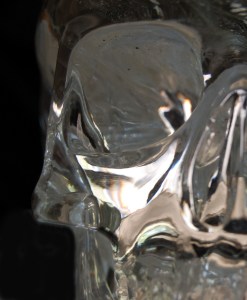
Photo by Alison Carrick

Photo by Alison Carrick

SHE WAS JUST 17

According to Anna’s later version, she discovered the skull at Lubaantun on her 17th birthday, Jan. 1, 1924. “She was told never to go on top of this one pyramid because the rocks were so loose,” Homann says, “but she heard if you got on top of it, you could see the sea. When everybody [else] was taking a siesta in the middle of the afternoon, her and a couple of Mayan kids climbed up on top of it. The sun was just right and it hit the top of the skull and she saw a light in there.”

After he reprimanded Anna for her disobedience, Mitchell-Hedges became curious about her discovery and began excavating the ruins stone by stone, an arduous task that supposedly took months to accomplish.

Anna stuck to this final story until she died last year. She repeated it to a reporter for The Record, a newspaper in Kitchener, as recently as 2005. In that account, she described descending through a narrow passage to retrieve the skull: “They lowered me by two ropes,” she said. “They put towels under the ropes so they wouldn’t hurt me. I was so terrified — there were scorpions and other awful things down there. I saw the skull, picked it up, stuffed it in my shirt and they pulled me out.”

Much to her chagrin, her father promptly gave the crystal skull to the local Mayan priest. A few months later, a Mayan boy found the skull’s missing detachable jawbone. In her revised version, the priest returned the skull to Mitchell-Hedges during the 1926-1927 expedition out of gratitude for supplies and medical assistance he provided to the tribe.

The problem with Anna’s story is there is no way to confirm it. None of the other expedition members reported the find. Moreover, there are no known photographs of her with her father at Lubaantun. Mitchell-Hedges himself didn’t mention the crystal skull until 1954, when he published his autobiography. Even then, he did not indicate that Anna found the skull. Instead, he cryptically commented: “How it came into my possession I have reason for not revealing.”

In his typically hyperbolic manner, Mitchell-Hedges referred to the artifact as the Skull of Doom. “It is at least 3,600 years old and according to legend used by the High Priest of the Maya when performing esoteric rites,” wrote Mitchell-Hedges. “It is said that when he willed death with the skull, death invariably followed. It has been described as the embodiment of evil.”

Archaeologist Jane MacClaren Walsh of the Smithsonian Institution, in Washington, D.C., asserts that the Mitchell-Hedges crystal skull is far more modern and less lethal. “I am fairly certain that the skull was made in the early 20th century, with high-speed lapidary tools,” says Walsh, who analyzed it last November. “We found tool marks left by high-speed diamond-coated rotary cutting tools, which would not have been available to pre-Columbian carvers. There are a number of skulls that have been carved in Europe and in Mexico that are quite similar to the Mitchell-Hedges skull, and there is no mystery about how they were carved. I don’t know of any scientific evidence that quartz [crystal] is imbued with special powers, certainly not supernatural powers.”

A clue to the provenance of the Mitchell-Hedges crystal skull appears in a July 1936 article published in Man, a British anthropological journal. One of the two skulls that were analyzed came from the collection of the British Museum; the other artifact was cited to as being “in the possession of Mr. Sydney Burney,” a London art dealer. In late 1943, Burney is reported to have put the skull up for auction at Sotheby’s, the famed London auction house. The bidding, however, failed to meet Burney’s asking price.

A year later he sold the artifact to Mitchell-Hedges for 400 pounds, according to a note in the files of the British Museum. Anna explained this discrepancy by saying that her father had loaned the skull to Burney to help finance one of his Central American expeditions.  In 2005, she told the Kitchener, Ontario, Record: “My father was livid when he saw the ad in the paper for that auction.” Anna claimed that Mitchell-Hedges quickly bought the skull back.

In the latest issue of Archeology magazine, Walsh describes the Mitchell-Hedges crystal skull as “a veritable copy of the British Museum skull, with stylistic and technical flourishes that only an accomplished faker would devise.” The two skulls are nearly identical in shape, size, weight, and clarity of the quartz. The main difference is that the teeth of the British Museum artifact are etched into the crystal, whereas the Mitchell-Hedges skull has a detachable mandible and its choppers are carved in precise anatomical fashion.

Homann dismisses Walsh’s opinion. He notes that there is no accurate way to judge the age of quartz sculpture. This leaves the origin of the artifact shrouded in uncertainty, he says, adding that the tool marks Walsh found had already been discovered in previous tests conducted at Hewlett-Packard laboratories in Santa Clara, Calif., in late 1970.

“They found more mystery than not,” Homann says of the most recent analysis of the skull by the Smithsonian. “The Mitchell-Hedges skull is an enigma,” he says. “People say this and people say that — but when it really comes down to it, how it really got here is a mystery. Somebody made this. How they did it nobody knows.”

From 1964 to 1970, Anna loaned the skull to Frank Dorland, a San Francisco-based art conservator. Dorland took numerous castings of the skull and examined them under a microscope. His other contributions were less scientific.

He speculated that the Mitchell-Hedges skull would have taken 300 years to carve by hand and that it might date back to ancient Egypt, Babylon, or Tibet. Dorland also reported witnessing paranormal phenomena that he attributed to the skull. “The first time I kept the skull in my home overnight . . . I was awakened by unusual noises in the house,” Dorland told Richard Garvin, author of The Crystal Skull. “It sounded like a large jungle cat was prowling through the house, accompanied by the sound of chimes and bells. When we got up the next morning, our possessions were strewn all about the house. Yet, all the doors and windows were still closed and locked from the inside.”

At Dorland’s urging, scientists at Hewlett-Packard determined that the detachable jawbone and the cranium were cut from the same block of quartz, but the experts couldn’t determine exactly how the skull was created.

Regardless of the findings, Anna apparently became upset when she heard that Dorland had arranged for the skull to undergo laboratory testing without her permission. According to Garvin’s account, she rode a Greyhound bus to California to retrieve the skull and return it to Kitchener, where she then owned and operated a motel.

In the years that followed, a stream of pilgrims visited Anna and the crystal skull in Kitchener, including actors Peter O’Toole, Shirley MacLaine, and William Shatner.

Carol Davis, a Canadian psychic, added to the lore of the Mitchell-Hedges skull by purportedly channeling its message to the world. In one session, Davis began emitting a high-pitched hum after allegedly tuning in to the skull’s transmitting frequency. She then began speaking in a strange staccato voice: “You seek to know the origins of this receptacle, which you call the crystal skull,” she said. “I tell you that it was made, many, many thousands of years ago by beings of a higher intelligence. It was formed by a civilization which existed before those you call the Maya. This receptacle contains the minds of many and minds of one. It was not made using what you call the physical. . . . It was molded into its present form by thought.”

The Mitchell-Hedges crystal skull has not always been cast in such a glowing light. In 1962, Anna implied that the skull was more burden than blessing. “Sometimes I am sorry I did not inter the skull with my father as he wished,” she told Fate magazine. “I think that may have been the best place for it. It is a thing of evil in the wrong hands. . . . I believe that anyone can will another to death through the Skull of Doom. When I sell it, I want it rather to go to a museum or something like that where it can do no harm to anyone.”

But in later years Anna changed her mind. In the 2005 interview, she attributed her longevity to the skull. “I take care of it,” she said, “and it takes care of me.” She also pooh-poohed the idea of institutionalizing the talisman. “It’s not for a museum,” she said. “It’s for someone kind, who has done a lot of good . . . who will do what I did with the skull. At the time, she intimated that the skull would go to Homann on her death.

Since being passed the mantle, Homann has continued to accentuate the positive, referring to the artifact as the Skull of Love. According to its new keeper, the skull possesses the power to open “the heart chakra of man to a universal consciousness of love that goes between all things, all humans, all mineral life, all animal life, realizing that we’re all connected, and all one.”

SKULL-SPLITTING CASE

Good vibrations, however, have not been enough to prevent a court battle over the skull.

As her spouse, Homann is entitled to full ownership of the Chesterton, Ind., residence he held jointly with Anna, but the rights to her other assets — including the crystal skull — are being contested in probate court in Porter County, Ind. Under the terms of the will she signed in Canada on April 4, 2001, Anna bequeathed her estate to a dozen family members, mainly nieces and nephews who live in Ontario. Her holdings include many other objets d’art from the collection of her father. Besides the skull, they include a mirror allegedly owned by Marie Antoinette and a goblet that supposedly dates back to the era of England’s King Henry VIII.

Citing state law, Homann has filed a claim for half of his late wife’s heirlooms. “When Anna died, the only assets she had in her name alone was this long list of artifacts,” says Richard J. Rupcich, the Valparaiso attorney who is representing Anna’s Canadian family members. “The skull is the one with the most notoriety, but it might not even be the one that’s worth the most. The appraiser who appraised it — and it is in the court’s records — says it’s worth $3,000.”

On the other hand, Rupcich reckons that the skull could fetch millions, judging from the publicity it received in the Indiana Jones film and because of its sacred status among true believers. The skull is also valuable because it could generate income through public and private exhibitions or sponsorships.

“It’s hard to find a market value for a [crystal] skull,” Rupcich says. “It’s not like you can go out and list a house based on comparables in the neighborhood. There aren’t a lot of skulls around. It makes it difficult to appraise the value of these things — so who knows what it is worth?”

To its current keeper, however, the skull is priceless. “It could be worth a dollar or a billion dollars, but the thing is, it’s not to be sold,” says Homann. “It’s Mitchell-Hedges’ wish that it is only to be given to the right person to carry on this work that it’s supposed to do.”

Because of the approaching end of the Mayan calendar, on Dec. 21, 2012, Homann believes that it is critical for him to retain guardianship of the skull. His concerns are based loosely on a 19th-century German translation of a Mayan sacred text known as the Dresden Codex, which prophesies that 13 Mayan crystal skulls must be united before that date to avert a cataclysm of global proportions.

“There are people who really believe this stuff,” says Rupcich. “To me, it’s scary.” Despite his skepticism, the attorney does not question Homann’s sincerity. “I think actually he’s a pretty good guy. . . . I don’t think he’s a con man.”

In court filings, Homann never refers to himself as the owner of the crystal skull. Instead, he calls himself its “caretaker” or “keeper.” He declines to talk about his 2002 marriage to Anna, other than to say that the nuptials were performed so Anna, a Canadian citizen, could qualify for health-insurance coverage in Indiana.

In the event of his death, Homann has indicated that custodianship of the skull should pass to his son Brett, who runs the family-owned karate school in Crown Point, Ind. Rupcich doesn’t know when the probate case will be settled or whether the crystal skull will ultimately be sold off by order of the court.

Until the estate is settled or the predicted apocalypse occurs, Homann plans to dutifully protect the crystal skull and continue to promote its alleged mystical powers. As a part of his efforts, he wants to help build a cultural center in Belize to preserve the customs and language of the Mayans.

Last month, he says, he traveled to the Cannes Film Festival with the crystal skull and had a tête-à-tête on a luxury yacht with the French finance minister to discuss some of these issues.

This month, he is scheduled to confer with Hopi and Mayan spiritual leaders in Sedona, Ariz. “I’m finding that, by following in what I believe in, things are falling into place,” Homann says. “It’s just like opening up the doors. I’m just going with where it goes. I’m going to follow that adventure and exploration and myself and the world.

“It’s fun, too.”
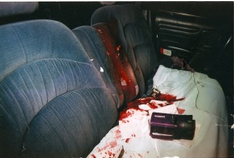
Something in the Water

IMG_3271Long ago, on a busman’s holiday to the Big Easy,  C.D. Stelzer learned that we’re all subjects in an ongoing experiment 

first published in the Riverfront Times (St. Louis), Jan. 27, 1993

NEW ORLEANS, La. — A change in perspective can sometimes cure myopia.

Take the case of the Weldon Spring quarry, where the Department of Energy (DOE) has already begun its pell-mell release of treated radioactive water into the Missouri River.

About 700 miles downstream from the nuclear drain site, William C. Van Buskirk, the dean of Tulane University’s school of engineering here, sees things a little differently than the DOE’s gung-ho officials.

When informed of the situation at Weldon Spring last week, Van Buskirk took an immediate interest. “It’s a fascinating test case,” he says. The quarry offers the research advantage of being small and self contained, according to Van Buskirk.

There is good reason for the dean’s academic curiosity to be aroused over the waste. Van Buskirk is about to receive the first $5 million installment in a five-year, $25 million grant to study extensively the effects of mixed chemical and radioactive wastes on aquatic environments in the Mississippi River basin.  Mixed chemical and radioactive wastes, of course, are the problem at Weldon Spring quarry, upstream on the Missouri River, before it meets the Mississippi.

“This is exactly the kind of research we need done before the DOE dumps anymore radioactive waste into the Missouri River,”says Kay Drey, a St. Louis environmentalist who has opposed releasing the water. Drey wants concerned citizens to ask their elected officials to call for a delay in future discharges of the Weldon Spring water until further studies are done.

A related petition drive to achieve the same end is being coordinated by the Missouri Coalition for the Environment in University City. The petition states: “The lack of field experience in removing this particular combination of radioactive and hazardous wastes, and the lack of equipment capable of detecting and accurately measuring the residual pollutants make this project an experiment, not an engineering achievement.”

“I mean, you don’t dump first and study second,” says Drey.

But dumping first and studying second is exactly what has happened.

Ironically, the Tulane grant was issued by the DOE — the same agency responsible for releasing the treated radioactive water earlier this month into the Missouri River nine miles upstream from two St. Louis area water intakes. A spokesman for the DOE regional headquarters in Oak Ridge, Tenn. tells the RFT that there is a good chance the Tulane grant was issued by a part of the DOE that was unaware of the imminent release of the contaminated water from Weldon Spring. In other words, the DOE’s bureaucratic left hand didn’t know what its partner was doing.

Jerry Van Fossen, the DOE’s deputy project manager at the Weldon Spring site, is unfamiliar with the Tulane grant, but says that the agency normally cooperates with such work. “In this particular case, where you have a university or two universities that have a grant with the DOE, we would be required to coordinate with whoever holds that grant with the agency,” says Van Fossen.

The belated interdisciplinary study will engage between 50 to 100 researchers at Tulane and Xavier universities, Van Buskirk says. The studies may employ not only experts in chemistry and medicine, but also legal scholars and philosophers, who could ponder the effects of public policy and the impact of the media, Van Buskirk says.

Scientists taking part in the research plan to examine the development of new technologies to clean water and soil. Other research will look at how pollutants move through rivers and soil and investigate the effects of pollution on specific aquatic ecosystems. Researchers also intend to study the ways people are exposed to water-borne contaminants and how that exposure effects their health.

“They’ve got a real mess on their hands,” Van Buskirk says,referring to the DOE. “They don’t have the technology to do the cleanup and they don’t have the manpower.” There is a great deal of fear in communities about radioactive and chemical contaminants, according to Van Buskirk, and the university can play a role in allaying public concern by offering scientific data. “Maybe we would be more believable than the EPA or DOE,” he says. U.S. Sen. Bennett J. Johnston, D-La., was instrumental in Tulane receiving the grant, Van Buskirk says.

With this kind of senatorial backing tied to the DOE pursestrings, hope for a truly independent study has to be somewhat tempered. “Sen. Bennett Johnston is one of the most devoted promoters of nuclear power in the Senate,” says Drey. In addition, Drey says the Louisiana senator is a strong supporter of DOE policies. If the DOE chose to allow Tulane to study the Weldon Spring site, “I have to think that they are going to get the results that they want to get — which is there is no problem.

“(But) even raising the question helps. … We have to hope there will be a real scientist who is not paying attention to where his money comes from. Maybe that’s naive, but we have to give them the benefit of the doubt.”

Return to C.D.’s home.

Taking Care of Business

Screen Shot 2015-01-29 at 8.32.55 AM

When the DNR declared an emergency at the smoldering Bridgeton Landfill in 2013, the state agency skirted its formal bidding process, an out-of-state firm scored a sweet deal and the public was left none the wiser.

On March 18, 2013, environmental specialist Dan Norris and his boss Brenda Ardrey of the Missouri Department of Natural Resources quietly submitted a memorandum to Procurement of Services File RFP 3445-001. The memo shows that the department did not receive any bids that complied with the agency’s standards for air sampling services at the Bridgeton Landfill, where an underground fire has been burning near radioactive waste since 2010.

Nevertheless, a six-figure contract was awarded to SWAPE, an environmental firm from Santa Monica, Calif. The acronym stands for Soil Water Air Protection Enterprise. SWAPE, acting as a middle man, then hired a St. Louis-based subcontractor.  The paper trail indicates no complete bids were received even after the DNR extended the deadlines by more than two weeks. The DNR guidelines normally require a minimum of three competitive bids. Two companies ultimately proposed deficient offers. By its own admission, the DNR awarded the plum to one of those companies based on an incomplete proposal. The DNR was able to skirt its normal protocols by invoking an emergency clause in its procurement process.

“Essentially, there was a response to the bid, it just wasn’t complete,” says Norris, who recently left his job with the state regulatory agency.  “It was missing a couple things as far as the response to the actual form,” he adds. “DNR had not dealt with an event quite like this before. It’s not like there was just a playbook to go off of for sampling air around a smoldering landfill, at least not a playbook that Missouri had. “We were told to waste no time whatsoever on getting a contractor and getting boots on the ground out there to begin the air sampling. It was not the kind of thing that we wanted to hold up for administrative purposes. That’s why in early 2013 it was contracted out,” he says.

Finding an environmental company then willing to challenge the interests of waste industry behemoth Republic Services, the landfill owner, appears to have been a difficult task for the DNR, according to public records obtained by StLReporter.  So the agency turned to a trusted consultant to act as its de facto headhunter. The consultant contacted industry sources and ultimately recommended SWAPE. After getting the nod, SWAPE quickly lined up a subcontractor in St. Louis to do part of the work.  Nobody involved in the deal will talk about it openly, citing contractual obligations.

When asked how the DNR first became aware of an environmental firm on the West Coast, Norris says: “I can’t comment on how we came to know SWAPE.” The two-year-old memo he co-signed indicates the firm was recommended by another contractor. Speaking from an undisclosed location by phone he also refused to talk about the price tag of the emergency air-monitoring contract. “I can’t comment on payment or billing or anything like that.”

Following an-age-old American custom, Norris has moved out West. He now lives in the Rocky Mountain Time Zone. He prefers not to divulge exactly where. Norris has exited Jeff City. But questions swirling around his leave-taking still plague his former agency like a bad case of the winter flu.

A Letter from Dan

Dan Norris - DNR State ID card

Dan Norris – MDNR State ID card

Early last month, Norris wrote a broadside, condemning the agency for its cozy relationship with Republic,  the company responsible for the site in North St. Louis County that is the location of a pair defunct landfills: one that’s smoldering and the other that contains radioactive waste dating back to the Manhattan Project.  The two adjacent dumps are both part of a long-delayed  Environmental Protection Agency Superfund clean-up site. In his parting shot, the former DNR staffer alleged that politics unduly influences regulatory decisions within the state agency, and that DNR employees are under the gun not to talk about it. The revelations have caused a stir inside and outside of the DNR.

Activists and community members familiar with the situation tend to agree with the whistleblower’s assessment, seeing Republic–the second largest waste hauler in the United States — as their foe. They point to Bill Gates’ stake in the company as evidence of the power that it wields. They allude to the company’s checkered environmental record elsewhere, including another smoldering landfill fire in Ohio. They also agree with Norris’ contention that Republic’s generous campaign contributions have swayed state lawmakers.                           

In that sense, it is not what Norris revealed that is relevant so much as the act itself. He broke the code of silence inside a department that in recent years has operated more like the CIA than a state environmental regulatory agency. Unfortunately, Norris’ criticisms of the DNR  are vague, and his complaints raise more questions than answers. His account of agency wrongdoing is sketchy. He lays blame but buttons up when asked for details.

Under prevailing rules, DNR has been assigned the responsibility of containing an underground fire and reducing the noxious odors at the Bridgeton Landfill. The state maintains that Republic is liable for the expense of the emergency air sampling costs, but it’s unclear whether the company has ponied up. Reached at his office in Washington, D.C., Republic spokesman Russ Knocke was unaware of the contract and said he would have to do some homework to determine whether the state has been reimbursed.

The radioactively-contaminated West Lake Landfill next door is the bailiwick of the federal EPA. As the two bureaucracies advance their separate agendas at a glacial pace, the fire is heading in the direction of the nuclear materials.

In Norris’ absence, the status of the clean up has become more uncertain than ever. The building of a state mandated barrier to stop the fire from advancing has been indefinitely delayed.  In the interim, doubts mount, finger pointing increases, and nobody seems in control. Missouri Attorney General Chris Koster recently expedited the state’s case against Republic for violations filed two years ago, but there is no sign of a settlement. If anything, the company shows indications of being even more resistant to DNR’s appeals. Meanwhile, the activists are stepping up their calls for Gov. Jay Nixon to take action.

From outside DNR’s closed doors, the scenario seems bleak. There would appear to be no winners. However, department documents and correspondence show one group consistently benefits from the intractable predicament — outside contractors.

A Quiet State of Emergency

Norris says he met DNR contractor Todd Thalhamer in 2008 at a training seminar. For the last several years, Thalhamer has given talks on landfill fires sponsored by Stark Consultants Inc., which is owned by Tim Stark, another DNR contractor. Thalhamer moonlights as a consultant, too, and owns Hammer Consulting Service in El Dorado, Calif. He works full-time as an environmental engineer for the state of California and is a firefighter in the El Dorado Volunteer Fire Department. Thalhamer received a bachelor’s degree in environmental resources engineering from Humboldt State University in Arcata, Calif. in 1992. His five-page resume indicates he worked on his first landfill fire in Sacramento County the same year he graduated from college.  He has been under contract as a landfill fire expert for the DNR for the last four years.

Reached by phone in California, Thalhamer says the reason the DNR retains his services is because he has a unique skill set. “The only other individual that I’m aware of that has my expertise is a colleague of mine in British Columbia, and he’s outside the United States,” says Thalhamer. “I have a very unique background. I’m a fireman [and] a registered civil engineer. I do environmental emergency response in California and with EPA,” he says. “I’m one of the guys who trains the landfill owners and operators throughout the United States. My name is known in the industry.”

“Once DNR got Todd Thalhamer on contract,” says Norris, “Todd was able to inform us about certain things that we needed to be watching as far as the gas extraction well field, [and] additional data that we should be tracking.” Besides Norris, the team included two other DNR staffers, consultants Thalhamer and Stark and, a graduate student. “We tracked the landfill gas data from that well field from month to month. We started plotting it on maps to see what the overall condition was. At some point, we started to see signs that the event was spreading and intensifying.”

Then the odors at the landfill increased.

“By 2012, I was making a push that we really needed to collect some air-monitoring data to get a better handle on what the potential risks were from the landfill smoldering event, as well as just what risk that might be as far as exposing the community,” Norris says.

The increased odors coming off the Bridgeton Landfill in 2012 gave DNR cause for concern as public complaints mounted over the stench. This set the stage for the events that would lead to the emergency procurement contract in early 2013 in which Thalhamer would play a pivotal role.

By this point, the California consultant had the DNR’s ear, and his suggestions  extended beyond the technical aspects of  fighting landfill fires. When odor complaints jumped in early 2013, Thalhamer told the DNR to openly request EPA air testing as a way of calming residents fears.  “We need to ensure the public that the odor is just that — an odor and not a health risk,” advised Thalhamer.  “The quickest way to reduce the environmental worry in the community is to request the US EPA perform community and facility air sampling. Contractor data should be as valid as US EPA but we need to show the community we are concerned enough to make this request.”

A few months earlier in December 2012,  the DNR had held a one-day training session presented by Thalhamer at Republic Service’s headquarters on St. Charles Rock Road. Those in attendance included, DNR staffers, representatives of the Pattonville and Robertson Fire Protection Districts, and officials from the St. Louis County Health Department. Brenda Ardrey of the DNR arranged the meeting and Republic, picked up the lunch tab for the sandwiches from a nearby Jimmy John’s restaurant.

Thalhamer charged $150 an hour for his services. Including various conferences calls, planning and travel expenses, the bill totaled $6,695.49.

His performance impressed Ardrey so much that she arranged for Thalhamer to speak the next summer at the Missouri Waste Control Coalition’s annual conference at the posh Tan-Tar-A resort on the Lake of the Ozarks. The 400-member coalition is comprised of private waste companies, government regulators and consultants.

ozarks

The conference setting had the trappings of a country club, including a golf course, where the MWCC held its annual tournament over the same weekend. The clubby atmosphere between business and government regulators goes beyond  the 18th hole, however.  Ardrey’s boss Chris Nagel, director of DNR’s Solid Waste Management Program, sits on the advisory board of the waste coalition, and Larry Lehman, DNR’s chief enforcement officer, is on its board of directors. Besides Lehman, other board members include Randy Tourville of Republic Services and Lisa Messinger of EPA Region VII.

After DNR decided to fund air sampling at Bridgeton Landfill in early 2013,  Thalhamer put SWAPE on DNR’s radar. Thalhamer and one of the owners of SWAPE had both worked on a case related to another Republic landfill fire in Ohio years earlier. Within a week, SWAPE had secured the DNR’s air-sampling contract without going through the regular bidding process.

That’s because a month earlier, DNR had quietly invoked an emergency clause in the state statutes and allocated more than a half a million dollars for the job. Internal DNR emails show officials carefully researched the matter to make sure the agency followed the letter of the law in declaring the emergency.

Few outside the DNR knew about the emergency. No sirens went off. The governor didn’t issue an evacuation order. Residents were not kept fully in the loop. Instead, agency insiders kept the situation hushed. The only other company that expressed interest in the contract submitted a proposal that was less acceptable than SWAPE’s.

Unlike others wary of consequences, SWAPE showed no fear of rousing the ire of Republic because it had already had a falling out with the waste giant in the past. On March 21, within 48 hours of receiving the contract, Paul Rosenfeld of SWAPE flew to St. Louis for a one-day meeting with DNR officials.

A subcontractor identified in an invoice only as JB also attended the talks. John Blank is the the owner of American Environmental Laboratories, a St. Louis-based firm that SWAPE hired as a subcontractor.  Blank says the terms of his company’s involvement remain confidential, but he does reveal that SWAPE issued the requirements for conducting the air sampling — “the what and the how” — and the St. Louis lab reported the results back to SWAPE and the DNR.

The meeting between SWAPE and the DNR lasted 11 hours, according to public records. Rosenfeld charged $195 an hour. The subcontractor charged $120. SWAPE billed DNR a total of  $5,821.86 for the day.

The terms of the emergency air-monitoring contract approved by DNR on Feb. 15, 2013 stipulated a 60-to-90 day deal valued at $600,000. SWAPE’s incomplete proposal submitted on March 29 totaled $594,060. After the contract was signed, invoices and purchase orders were issued in quick succession.

  • On March 29, 2013, SWAPE submitted an itemized invoice of $15,198.32 for services rendered.
  • On April 2, 2013 the state paid the company another $6,000 for expert testimony.
  • A state purchase order for SWAPE’s products and services dated April 3, 2013, shows a bottom of line of $349,000.

Whereas, SWAPE submitted detailed, line-item accounting of services rendered, the state purchase order only lists itemized expenses as “environmental, ecological and agricultural services: miscel [miscellaneous].”  SWAPE continued its emergency air sampling under the initial arrangement through August 2013.

Ardrey referred all questions about the Bridgeton Landfill to the DNR information officer Gena Terlizzi.  Voice and email messages left for Terlizzi went  unreturned. When contacted, Beth Glickman, office manager for SWAPE, said: “We typically don’t talk to the press. We are still under contract with them (the DNR) and won’t be able to answer any questions.”

When asked  about his role in the process, Thalhamer says: “As you probably know, I’m under contract with DNR so I can’t speak to  issues surrounding that. … I understand your plight. I work for a government agency and I fight the same thing that you’re asking me for. But I also know contract law and know I’d be in jeopardy of breeching the contract.” Toward the end of the conversation, Thalhamer suggests digging deeper, and offers journalistic advise, including filing a state Freedom of Information request.  Speaking about the SWAPE contract, he says: “There’s some interesting information there if you can get that Rubik’s Cube figured out.”

Less enigmatically, Norris concedes that there may be an appearance of  something amiss in the state’s handling of the emergency air-monitoring contract, but he has no doubt that the public’s interest was best served by the decision.

“SWAPE had the expertise, the history of sampling around landfill fires elsewhere” says Norris. “I think that they were probably in the best position at that point and time to do the air sampling whether it was done by them or a subcontractor that was progressing in a fashion that was protective of public health,” Norris says.

“There was additional concerns from the community living around the site in large part due to the increase in odors, Norris says.  Benzene and certain others [chemicals] were elevated in the landfill gas. There were certain chemical compounds that appeared to be elevated downwind versus upwind of the landfill at least slightly.”

Air sampling at the site measured  dioxins, furans, benzene, aldehydes, reduced sulfur compounds and volatile organic compounds, all of which can cause serious health effects through long-term exposure. But  test results at the Bridgeton Landfill analyzed by the Missouri Department of Health and Senior Services found chemicals of concern to be below the threshold of concern for human health over the time frame of the emergency air sampling contract.

Norris doesn’t argue with those findings, but he does assert that politics is influencing science. “Politics seems to be invading the technical work to a greater extent than when I first started that’s for sure, [but] we were able to accomplish quite a bit even within the political confines during this event, especially in 2013,” he says.

Norris makes clear that his resignation and subsequent letter are unrelated to the SWAPE memo or the hiring of outside contractors in general.  “It was really kind of broader issues at the department,” he says. He mentions bureaucratic inefficiencies, the role of politics and lax enforcement as reasons for his discontent and departure, but stops short of placing the onus on anything specific, leaving the listener to turn Rubik’s Cube for himself.

Unit A at 205 Riverview Drive is vacant. A stack of native limestone blocks stands by the entrance, the only vestige remaining of the apartment’s last tenant. A for-rent sign is posted in the front yard and a sodden edition of the Jefferson City News-Tribune lies in the gutter. The brick duplex is located on a residential street in the sleepy Missouri capital, where on a mild January day a woman washes her shiny SUV in a nearby driveway. With a dog barking in the backyard and dinner on the stove in the kitchen, the occupant of Unit B leans against his front door jamb, warily answering questions about Dan Norris’ whereabouts. He is tight-lipped when it comes to the details, but says his neighbor of eight years moved out about three weeks ago and didn’t leave a forwarding address. — C.D. Stelzer

A War of Words

IMG_3440
“It just makes me sick,” say Kay Drey. The 81-year-old dean of the St. Louis environmental movement is sitting at her dining room table, which is scattered with various paperwork, including two dogeared reports issued by the Nuclear Regulatory Agency in the 1980s.

As the sun streams through a window of her University City home on this mild January morning, she bemoans the state of affairs related to the stalled clean up of the radioactively-contaminated West Lake Landfill in Bridgeton, a nearby St. Louis County suburban municipality.

The NRC reports to which she refers both candidly recommend the removal of the radioactively-contaminated materials from the landfill, which is located in the Missouri River flood plain upstream from water intakes for the city of St. Louis.

The waste, a byproduct of decades of uranium processing carried out by Mallinckrodt Chemical Works on behalf of the government’s nuclear weapons program, was illegally dumped at West Lake 40 years ago. Drey has been fighting various regulatory agencies to get it removed for almost as long.

On this day, Drey’s voice is failing. It can’t compete with Moxie, the family’s small dog, who yaps at a visitor’s feet. After the canine commotion subsides and breakfast dishes are cleared, Drey explains what is bothering her.

“They’re not talking about digging it up,” she says.

Removing the radioactively-contaminated materials from the St. Louis area to a federally-licensed nuclear waste depository in the sparsely-populated West has long been her goal.

In 2008, Drey and the Missouri Coalition for the Environment challenged the EPA’s record of decision on West Lake, which would have mandated a relatively cheap fix — capping the landfill with dirt and leaving the nuclear materials in place. Republic Services, the liable landfill owner, favors this remedy, which would allow the contamination to continue migrating into the ground water. The final decision is still up in the air along with noxious landfill fumes that have been the bane of nearby residents for the last four years.

Since 2010, public outrage over the issue has grown due to an underground fire at the adjacent Bridgeton landfill, which is part of the same EPA Superfund site. The Missouri Department of Natural Resources is overseeing efforts to contain the fire, which is moving in the direction of the radioactive waste. To bolster DNR’s authority, the Missouri Attorney General’s office has filed suit against Republic for various infractions. Splitting responsibility for dealing with the problem between the state and federal agencies has led to further bureaucratic snafus. One of the impasses involves a state-mandated barrier wall to stop the fire from advancing.

Screen Shot 2015-01-23 at 12.55.15 PM

Drey and other activists advocate turning the clean up over to the U.S. Army Corps of Engineers, the agency that has remediated other St. Louis radioactive sites under the Formerly Utilized Site Remedial Action Program (FUSRAP), which targets sites contaminated with nuclear weapons waste from World War II. Gaining congressional approval for such a change has not happened, however, despite efforts by the activists to spur the St. Louis congressional delegation to sponsor the requisite federal legislation.

Meanwhile, Republic, the responsible party, keeps pushing the original capping proposal. The company’s public relations efforts have included backing a rural-based front group, the Coalition to Keep Us Safe which is against shipping radioactive material through the state. The Coalition to Keep Us Safe, via their twitter feed, routinely uses the words “capping” and “encapsulation” to mean the same thing. The terms are used interchangeably by the group, but “encapsulation” is not part of the 2008 Record of Decision issued by the EPA. The confusion of terms is not clear to a casual observer or to many members of the Coalition as seen in the tweets they post.

As the debate wears on, Drey sees support for removal of the waste waning. But she’s standing her ground. There is no compromise on this subject when viewed from her eyes. Those who consider capping as an option are abandoning the goal. In her opinion, it is indefensible to leave deadly radioactive waste to drain inevitably into the Missouri and Mississippi Rivers forever.

Drey also sees how language is being used to obfuscate the issue. Supporters of capping the landfill often use the word “encapsulation” to describe the plan to leave the waste in the floodplain, leaking into the aquifer.

To make her point, Drey gets up from the dining room table and retrieves a worn dictionary from a bookshelf. She runs her index finger down the page to the entry and recites the definition: “Encapsulate: to encase in or as if in a capsule.”

“Does a capsule have just a top?” she asks.

C.D. Stelzer

The Juke Box Keeps Playing the Same Sad Song

In retrospect, the 14-year-old missive seems to bear the tone of an old love letter. Stephen Mafood, the spurned lover and then-Director of the Missouri Department of Natural Resources, is essentially begging former EPA Region VII Director Dennis Grams for mercy.

For people who live in North St. Louis County, it’s like a sad ballad that everybody knows by heart. The plea by the state regulatory agency chief went unheeded.

On June 2000, Mahfood asked Grams to reconsider a recently published draft feasibility study that failed to to consider the removal of radioactive waste from the West Lake Landfill in Bridgeton, Mo. The materials were a byproduct of uranium processing carried out by Mallinckrodt Chemical works from 1942 until the mid 1960s.

“This approach seems to be inconsistent with the cleanup levels at other DOE sites across the nation,” wrote Mahfood. “The other radioactive sites in the St. Louis area are targeting cleanup goals several orders of magnitude more protective than what is being proposed to left at the West Lake landfill.”

Mahfood advocated “hot-spot” removal as an alternative, and asked the EPA to consider the recommendations of the St. Louis Remediation Task Force report.

Neither Mahfood or Grams still hold the respective positions that they did in 2000. A new generation of leadership has taken over, but everyone seems to be singing the same old song.Screen Shot 2015-01-22 at 4.18.36 PM Screen Shot 2015-01-22 at 4.19.02 PM

The More Things Change, The More They Stay the Same

When C.D. Stelzer called the Department of Energy’s FUSRAP office back in 1997, a secretary for a private company answered the phone, two corporate managers acted as mouthpieces for the government, and the DOE official in charge had gone elk hunting.

100_1341

First published in The Riverfront Times (St. Louis), Dec. 3, 1997

IT’S SHIFT CHANGE on Friday afternoon at the Boeing Aircraft plant north of Lambert Field, and workers are fleeing in droves, streaming bumper-to-bumper down McDonnell Boulevard, oblivious to the narrow, 21.7-acre piece of real estate next to the thoroughfare. Until recently, this barren stretch of earth offered little to see besides an abundance of weeds surrounded by a rusty cyclone fence topped with barbed wire. In late September, however, the U.S. Department of Energy (DOE) began rearranging the landscape on the property. From the shoulder of the road, where it crosses Coldwater Creek, a yellow bulldozer and backhoe can now be seen parked near a plywood wall extending across the top of the steep embankment leading down to the creek bed.

It’s hard to tell, at a glance, that the work in progress here is part of an overall federal project estimated to cost nearly $800 million. Ordinary building materials — bales of straw, rocks and plastic sheeting — create a setting common to construction sites. But this is no ordinary erosion-control action. Soil at this location, known in regulatory circles as SLAPS (St. Louis airport site), harbors deadly byproducts of the nuclear-weapons industry, which developed during World War II and mushroomed in the Cold War. From 1946 until the mid-1960s, the U.S. Army — and, later, the Atomic Energy Commission (AEC) — dumped hundreds of thousands of cubic yards of radioactive waste, residue from uranium processing at the Mallinckrodt Chemical Works in St. Louis.

As a consequence, the acreage, which is now owned by the St. Louis Airport Authority, has been contaminated with increased levels of uranium-238, radium-226 and thorium-230, according to the DOE. This is no new discovery, of course. Official foot-dragging has been going on for decades. More than 20 years ago the DOE discovered that contaminants had migrated into ditches next to McDonnell Boulevard, where they have settled only inches from the surface. There are still no signs to warn passersby or curious onlookers of this danger.

Failure to inform the public and act in a timely manner has been the hallmark of this case. At the same time, public-health officials have consistently downplayed or ignored the potential health consequences of radiation exposure. After allowing the waste to spread for more than 50 years, the federal government is now belatedly rushing to deal with the problem in a fashion comparable to its past negligence. In the process, rules have been sidestepped and decisions made without a full understanding of their implications. The powers-that-be first attempted to keep the problem a secret, after World War II, for “national-security reasons.” By the late 1970s, however, the festering pollution had become a heated public issue.

The waste itself has proven even more difficult to contain than the controversy over it.

COLDWATER CREEK, which is next to the site, flows through a large section of North St. Louis County and has acted as a convenient vehicle to transport the toxic materials. So far, radioactive contaminants are known to have hitched a ride downstream more than seven miles, according to the DOE. And the migration is continuing. Tests conducted in late 1994 show stormwater runoff at the location still exceeding acceptable radiation levels set by the agency. Drinking-water intakes for the city of St. Louis are located several miles downstream from the site, on the Mississippi River at Chain of Rocks. The radioactive migration by way of groundwater has also been confirmed but is less well understood.

For years, the DOE claimed the waste presented no danger. But the scientific community, which has been moving much more slowly than the waste, has finally concluded that no safe level of radiation exposure exists. By the time this decision was made several years ago, it was also widely accepted that one direct effect of long-term exposure to low-level radiation is cancer.

The $8.3 million cleanup along Coldwater Creek is the first stage of the long-anticipated project. The initial phase involves removing at least 6,000 cubic yards of the contaminated soil to a licensed repository for low-level radioactive waste, located in Utah. The amount is only a small fraction of the contaminated materials that may ultimately be excavated and shipped from the site. The approximate completion date: 2004.

But the entire project now stands in bureaucratic limbo. Less than a month after the DOE started working at the airport site, Congress transferred authority for the cleanup to the U.S. Army Corps of Engineers. The change came about as a part of the latest Energy and Water Appropriations Bill, signed into law by the president in October. Under the legislation, the corps will be handed the remainder of the $5 million already allocated to the DOE for this fiscal year to shore up the small section of Coldwater Creek. The money is in addition to the $140 million appropriation for 1998 that continues funding a nationwide cleanup of low-level radioactive-waste sites. The act also stipulates that the corps must conduct a three-month assessment of the Formerly Utilized Sites Remediation Action Program (FUSRAP), the federal aegis under which the airport site falls.

For the time being, the cleanup of Coldwater Creek is expected to continue uninterrupted, according to David Leake, project manager for the corps. “Congress has made it fairly clear that they do not want the transfer to result in any delay,” says Leake. This pragmatic strategy, however, locks the corps into adopting some of the DOE’s prior policies and practices, many of which have fallen into question in the past.

R. Roger Pryor, executive director of the Missouri Coalition for the Environment, says the corps isn’t carrying the same baggage as the DOE. “I feel the corps doesn’t have the past bias that nuclear waste is somehow good for you,” says Pryor. “However, changing horses in midstream is difficult.”

Even though the airport site is on the U.S. Environmental Protection Agency’s (EPA) National Priorities List (NPL), the DOE, through a regulatory loophole, was allowed to proceed with the Coldwater Creek excavation without formulating any long-range cleanup plan for the entire site. Furthermore, the DOE’s interim plan admits the area now being dug up may have to undergo remediation again sometime in the future. In other words, the current work is at best a stopgap measure. The project may also leave some radioactive contaminants behind because the excavation doesn’t go deep enough. In addition, the DOE started working on the site before a hydrogeological study, which it commissioned, had been completed. A previous hydrogeological study, published last year, cautioned that the groundwater system underneath the site was not clearly understood. The panel of experts concurred that implementation of any excavation work would necessitate further site characterization.

Specifically, the panel, which comprised government and industry scientists, warned of the existence of large volumes of radioactive contamination in the middle of the 21.7-acre site. The location of those contaminants is uphill from the current excavation work. It doesn’t take a nuclear physicist to figure out
that water rolls downhill. By beginning the cleanup at the low end of the site, the DOE hoped to create a buffer that would stop or at least slow the migration of the radioactive pollutants into the creek. But by starting at this point, the department admittedly risks re-contaminating the area it has chosen to clean up. Sheet erosion from rainfall will continue to allow contaminants to move toward the creek. Groundwater will head in the same general direction. Indeed, the subterranean currents may circumvent the DOE’s efforts altogether because, according to the experts, the hydrogeological structure beneath the site pushes groundwater both north and west under McDonnell Boulevard.

“I’m delighted that they are beginning to clean up the airport site,” says Kay Drey, an environmental activist from University City. “But they’re not doing it safely.” Drey, who fought for the cleanup for years, resigned from the project’s oversight committee on Sept. 18 (see accompanying story). In her resignation letter to St. Louis County Executive George “Buzz” Westfall, she expressed disapproval of the DOE’s interim plan, citing what she considers to be inadequate precautions. Before her resignation, she had submitted a detailed eight-page critique of the DOE’s plan. To date, she has received no answers to her questions.

FROM THE MCDONNELL Boulevard bridge, the turbid waters of Coldwater Creek are visible, flowing past chunks of concrete debris and swirling around a white plastic lawn chair marooned midstream. It is a typical suburban scene, a once-pristine waterway relegated to carrying sewage. Coldwater Creek carries other pollutants, too: Jet fuel from nearby Lambert Field has found its way into the watershed, as have salt, oil and automotive antifreeze, according to a DOE assessment. Another pollutant in the surface water is trichloroethylene, a known carcinogen. No one is certain of the long-term effects of such mixed waste on the environment or human health. It is also unknown how the chemical stew affects the migration of radioactive contaminants in surface and groundwater.

In essence, the airport site is a very large experiment with few scientific controls attached.

On the basis of data provided to it by cleanup-site contractors, last year’s hydrogeological panel decided contamination levels at the site would not pose an imminent risk for the next 100 years, an arbitrary figure imposed by the DOE’s guidelines. Yet some radioactive isotopes already discovered in ground and surface water at the site will last for hundreds of thousands of years. Although it downplayed the risks over the next century, the panel nevertheless concluded it would be inappropriate to use the site for long-term storage and repeatedly stated that many questions about the hydrology of the area remain a mystery.

Seepage of radioactivity into groundwater is by no means unique to St. Louis. Last week, the DOE formally admitted that the aquifer underlying the 560-square-mile Hanford nuclear reservation in Washington state has been contaminated. The radioactive waste, which is moving toward the Columbia River, is the result of 40 years of plutonium production at the site. The DOE, which long denied that groundwater contamination existed at Hanford, now claims the Columbia will not be threatened for the proverbial 100 years. However, the independent scientific analysis that forced the DOE to confess to the groundwater contamination calls the DOE’s estimates on risks to the river “unreliable.”

Tom Aley, a hydrologist who sat on the panel that studied the St. Louis airport site, is sure of one thing: The waste should have never been dumped here in the first place. Similar to Hanford, the waste here is situated on top of an aquifer. “It is a very poor site for disposal of that type,” says Aley, who owns Ozark Underground Laboratory Inc. Aley lists population density, groundwater contamination and the proximity of the site to Coldwater Creek as reasons not to store radioactive waste at the airport site.

His tempered approval of the cleanup is based in part on the lack of groundwater use in the area. However, Aley concedes there is much yet to be learned. “We don’t really have a good understanding of the vertical contamination,” he says. “The waste was deposited in a very haphazard manner, which was typical of that era. That has made cleanup very difficult. Another thing is, you can never totally clean up a site. A lot of these cleanups are real bootstrap operations. You have to pull one boot up, and then you have to pull the other up.”

The emperor may have buckled his boots, but he is without clothes. In short, no plan exists as to how to proceed with the remainder of the cleanup. Indeed, according to details of the DOE’s interim action, the current $8.3 million creek cleanup may ultimately have to be redone. The DOE’s engineering evaluation/cost analysis clearly states: “Although final clean-up criteria have not been established for this site, it is anticipated that the majority of the area cleaned up by this action will not require additional effort. However, final clean-up criteria, once selected, could require additional efforts in areas excavated in this removal action.”

Although the DOE acknowledges contamination at the site extends at least 18 feet deep, its interim plan requires digging only “eight to 10 feet below the existing land surface,” according to a Federal Register notice published in September. The DOE also acknowledges that “soil contaminated with radionuclides is present below (the) water table.” If contaminated groundwater is encountered during the dig, the DOE’s interim plan calls for it to be pumped onto high ground, which means it will re-enter the aquifer or run back downhill, toward the creek.

To battle this inevitable gravitational pull, the DOE has built a berm to separate the excavation work from the rest of the site. The interim action also calls for a channel to be constructed to reroute stormwater away from the roadside ditch that drains into the creek. In 1985, the DOE constructed a gabion wall — rocks secured by a wire basket — to hold the bank from sliding into the creek. It is a porous structure that by design allows water to percolate through. Whereas the effectiveness of these measures is subject to debate, there is no argument that radioactive sediments can still move downward into the aquifer and flow northwest under McDonnell Boulevard, thereby entering the creek unimpeded.

The hydrogeological study from last year warned about this possibility. “Groundwater monitoring has shown the migration of radionuclides in the direction of groundwater flow across McDonnell Boulevard and under the formerly used ball fields property to the north,” according to the study. “This factor raises concern over potential shallow discharge of radionuclides to Coldwater Creek to the west and north and potential vertical migration to the lower aquifer system.”

Three thousand people live within a one-mile radius of the airport site, according to DOE estimates. From the airport, Coldwater Creek flows northeast for 15 miles, touching the communities of Berkeley, Hazelwood, Florissant and Black Jack before discharging into the Missouri River. The city of St. Louis drinking-water intakes at Chain of Rocks, which supply water to hundreds of thousands of people, are five miles downstream from where the Missouri joins the Mississippi.

By any standard it is a densely populated watershed. DOE guidelines for thorium and radium concentrations mandate they not exceed 5 picocuries per gram averaged over the first 15 centimeters of soil and 15 picocuries per gram in subsequent soil layers of the same thickness. Analysis conducted for DOE in 1985 indicates that soil next to Coldwater Creek is contaminated with as much as 14,000 picocuries of thorium-230 per gram. The naturally occurring background level for the same radioactive isotope amounts to 0.2 picocuries per gram.

The corresponding guideline for acceptable DOE levels of uranium-238, which is also found at the airport site, is 50 picocuries per gram. In 1981, DOE initiated a two-year groundwater-monitoring program at the site and discovered uranium-238 at concentrations up to 2,230 picocuries per gram. Other evidence shows radioactive waste is spread across the site at levels thousands of times greater than considered acceptable.

A curie is the amount of radiation emitted from one gram of radium, equal to 37 billion decays per second. A picocurie equals a trillionth of a curie. Curies are used to measure the amount of material present; they don’t indicate the amount of radiation given off or its biological hazards.

Such DOE standards ignore potential health consequences, according to a 1991 congressional study. “The present regulatory-driven approach … places far more emphasis on characterizing the contamination than on investigating health impacts and may prove ill-suited to identifying public health concerns, evaluating contamination scenarios according to their potential for adverse health effects, or establishing health-based clean-up priorities,” the Office of Technology Assessment report states.

JOHN W. GOFMAN, a professor emeritus of medical physics at the University of California at Berkeley, has long contended that there is no safe level of radiation exposure. “I concluded it’s impossible for such a level to exist given the evidence on how radiation works,” says Gofman. The term “low-level radiation” is a political term used by the nuclear industry to lull the public into accepting exposure risks, he says. Similar phrases also downplay the consequences. “The terms `tolerance level,’ `allowable level,’ `permissible dose’ — those are all phenomenal words that are supposed to tell Joe Six-Pack, `Nothing to worry about — there ain’t no harm.’ That’s why these terms came into existence,” he asserts.

The 79-year-old Gofman is in a unique position to advise on such matters because he is a physician and holds a doctorate in nuclear physical chemistry. His research at Berkeley during World War II attracted the attention of J. Robert Oppenheimer, lead scientist in the Manhattan Project. After working on the atomic bomb at Oppenheimer’s request, Gofman completed his medical studies. But in 1969, Gofman fell from grace with the atomic establishment when he challenged the “acceptable” levels of radiation exposure then allowed.

After being ostracized by the atomic establishment for years, Gofman’s scientific opinions have been widely accepted of late. In 1990, for instance, after years of debate by U.S. scientists, a report by the fifth conference on the Biological Effects of Ionizing Radiation (BEIR V) concluded that radiation effects are proportional to dose in all cases. More recently, says Gofman, “The United Nations Scientific Committee on the Effects of Atomic Radiation said that the weight of evidence comes down on the side of no safe level. And the British National Radiological Protection Board in 1995 published a document in which they have now said that there can be no safe dose.”

Studies such as these lead Drey, the environmentalist, to question the logic of allowing further radioactive contamination to flow into Coldwater Creek. “Dilution is not the solution to pollution in reality or legally,” says Drey. “When you are dealing with materials that will continue to give off radioactive particles forever into the future, literally billions of years, you have to be very careful with this stuff.”

THIS IS NOT THE FIRST TIME Drey has opposed a DOE project. In 1993, she battled the department’s plans to clean up radioactive waste at nearby Weldon Spring in St. Charles County (“Rushing Water,” RFT,Jan. 6, 1993). Her vigilance then temporarily delayed that project, after she exposed the fact that the DOE was going ahead before receiving critical EPA test results.

Stephen H. McCracken, who headed the Weldon Spring cleanup, took over as St. Louis airport-site manager for the DOE earlier this year. Although the circumstances and nature of the radioactive waste may be different at the airport site, McCracken’s job switch hasn’t seemed to have affected his ability to circumvent government guidelines. If anything, the DOE official’s evasive end-runs appear to have improved over time.

Pryor, of the Coalition for the Environment, recalls that the decision was railroaded past the citizens oversight committee on which he sits. “We had hardly seen this darn thing,” says Pryor of the recommendation to proceed with work along the creek. “When we asked McCracken in September, he admitted it was just a guess,” says Pryor, referring to the point at which the DOE decided to begin excavating. The measure squeaked past the committee on a 4-3 vote. “We thought it was silly to go forward without the geological study,” says Pryor.

On Sept. 18, the day Drey resigned, McCracken signed a memorandum, which was immediately filed away. The memo cites an emergency clause that allowed him to waive the DOE’s standard 15-day public-review period for such actions. Sept. 18 also just happened to be the day DOE issued its “Flood-plain Statement of Findings” in the Federal Register. The purpose of the posting was to notify individuals and other government agencies of the pending action at the airport site so they could scrutinize the plan in advance. The notice clearly states: “DOE will endeavor to allow 15 days of public review after publication of the statement of findings before implementation of the proposed action.”

Four days later, on Sept. 22, work began at the St. Louis airport site.

Every conceivable government agency — local, state and federal — was left out of the loop. Even the DOE official who has oversight into such matters said he was unaware the emergency clause had been invoked. “I suppose you’d have to ask Steve McCracken about that,” drawled James L. Elmore, a National Environmental Policy Act (NEPA) compliance officer for the DOE in Oak Ridge, Tenn. “I don’t have anything to do with that. You’d really have to ask him exactly what his total thought process was.” Despite his ignorance, Elmore’s name appears on the bottom line of the Sept. 18 Federal Register notice.

The RFT could not initially reach McCracken to explore his “thought process,” because, according to the secretary at the DOE site office, he was elk hunting in Colorado. After returning from his expedition, the DOE manager still did not return repeated calls placed to his office for a week. In his Sept. 18 waiver memo, however, McCracken wrote he had expedited the cleanup out of concern that autumn rainfall would make excavating near the creek more difficult. Come hell or high water, McCracken is expected to continue working at the site, at least during the transition period.

The airport site is on the Superfund’s NPL list, according to Dan Wall at the EPA regional headquarters in Kansas City. Because of its priority status, the agency is obliged to oversee the cleanup, he says. But it appears the contractors are more in control of the project than anybody else.

Calls placed to the DOE’s site office in St. Louis are answered by the cheerful voice of Edna, a secretary who works for Bechtel National Inc., one of the DOE’s prime cleanup contractors. She takes messages for McCracken and his assistant. In this case, she took messages for nearly two weeks, and for nearly two weeks the calls went unreturned. Finally, representatives for the DOE’s two prime contractors called back.

A secretary for a private company answers the phone at a government office, two corporate managers act as the mouthpieces for a government project, and the government official who is supposed to be in charge is elk hunting. This gives the appearance that the tail is wagging the dog. That may soon change under the new leadership of the corps. “The corps and the DOE operate somewhat differently,” says Leake. “The DOE will put very few people on a particular program and rely heavily on large national contractors to do a lot of the things that the Corps of Engineers try to do internally.”

The change in management styles will affect all of FUSRAP, which originated in 1974 under the AEC, the predecessor of the DOE. AEC established FUSRAP to deal with radioactive waste produced as a byproduct of nuclear-weapons production. Of the 46 FUSRAP sites across the country, 25 have been cleaned up, according to the DOE. Four remaining radioactive hotbeds are in the St. Louis area, with the airport site the largest.

In St. Louis and elsewhere, the DOE has relied on the expertise of Bechtel and Science Applications International Corp. to carry out its mission.

Wayne Johnson, the deputy project manager for Bechtel in St. Louis, is certain the cleanup next to Coldwater Creek is being carried out safely. “These measures have been monitored by the Missouri Department of Natural Resources, which has had representatives on the site routinely to look at our operations to make sure that we are not affecting the creek. In addition to that, St. Louis County, which has advised us on our plans for the work, has been out to the site,” says Johnson. “So we feel confident, and we are more than halfway done. We have not had any problems or affected the creek in any way.”

Ric Cavanagh of the St. Louis County Health Department, who chairs the citizens oversight commission, agrees with Johnson’s assessment. “I’m not a lawyer, but it is my understanding that they (the DOE) did make use of a provision in the rules to move forward. The majority of the oversight committee voted in favor of proceeding with the work,” says Cavanaugh. “We are purely advisory. We couldn’t have stopped it if we wanted to. The groundwater levels were very low at the time, and this was a very good time to get things going. (St. Louis County’s) goal was to get excavation begun and to get work begun at that site. So we were pleased to have it go from that standpoint.”

The oversight committee currently has 11 members — five from the city of St. Louis and six from St. Louis County. One seat remains vacant at this time. The board replaces an advisory task force that disbanded last year.

AT ONE TIME, workers toiled night and day to dump the radioactive waste at the airport site. The open pile rose to 20 feet above ground level, according to one DOE document. Altogether the accumulated waste at the site and elsewhere nearby is estimated to have once ranged from 283,700 to 474,000 cubic yards, according to the DOE. In additional to open dumping, Mallinckrodt workers were required to hand-pack waste in 30- or 55-gallon drums. The drums were then stacked on top of each other at the airport site. The barrels then began to leak.

In the process of storing the waste, haul routes and adjacent properties became contaminated. Then in 1966, the AEC sold most of the residues to Continental Mining and Milling Co, which promptly transported the waste to 9200 Latty Ave. in Hazelwood and then went bankrupt. The movement resulted in the contamination of more properties. Cotter Corp., a subsidiary of Commonwealth Edison, subsequently acquired the materials, with an eye toward reclaiming some of the minerals. The bulk of it ended up in Canon City, Colo., but not before one of Cotter’s subcontractors dumped thousands of tons of the waste in the West Lake landfill off Old St. Charles Rock Road in North St. Louis County.

More than 50 years after it started, the uranium-processing operation conducted at Mallinckrodt in St. Louis has forced almost $800 million in reparations on U.S. taxpayers — the cost of cleaning up the radioactive vestiges of World War II and the arms race that followed. To the victors go the spoils. It is a small part of the environmental damage wrought by the federal government and the nuclear-weapons industry over the last half-century — damage estimated to cost $200 billion to correct. What can never be measured are the lives cut short because of radiation exposure. Men have been tried for war crimes that did far less.

Doesn’t Anybody Go Dutch Anymore?

A whistleblower defends a colleague and sets the record straight on who pays for whose lunch. lunch-email

I just read your post titled “Who Says There’s No Such Thing as a Free Lunch?” on WordPress.  While I am flattered by your kind words regarding my work on the Bridgeton Landfill, I wanted to ensure you have a better understanding of the role Brenda Ardrey had regarding this project and explain a bit of background context for the information in your 4th paragraph.

Brenda was one of the most supportive people at DNR that I worked with on this project.  She was truly dedicated to making decisions on the basis of what was in the best interest of the community.  Brenda and I likely had more knowledge of the Bridgeton Landfill than any other staff I worked with.  The two of us both worked extremely long hours in order to do what we believed to be right for the community around Bridgeton.  Brenda was even one of the “Few people within DNR [who] have the fortitude to stand up to the political pressures of the system.” that I was thinking of when I wrote that part of my letter.  Were it not for Brenda’s ability to bring other staff back to reality and common sense, it is very likely that the landfill site may have been officially closed by the DNR.  Casting Brenda in the same light with the political problems I mention in my letter is an unfortunate distortion of reality.

I also wanted to clarify the facts regarding the Jimmy John’s meal you mentioned.  At the time of the December 6, 2012 training, we had meetings with the landfill owner approximately once a month.  In the interest of maximizing the meeting time, we normally ate sandwiches that were delivered to all of us (DNR and landfill owner).  Since meetings between DNR and the landfill owner occurred frequently, the way we handled the payment of these was for DNR to pay for everyone’s sandwiches one month and then the landfill owner would pay for everyone’s sandwiches from the same place the following month.  While at first glance this may appear to be a handout from the landfill owner, it is not.  There was no sort of corruption involving these meals that I was aware of, and this is not an example of the kind of coziness I mentioned in my letter.
I would be most appreciative if you would consider amending your article or adding my comments to it.

Thank you,
Dan Norris

Screen Shot 2015-01-14 at 8.34.19 PM