The Cayman Connection

Republic Services claims no environmental woes to snare a billion-dollar-plus loan with the help of its offshore insurer. 

Screen Shot 2016-07-06 at 12.23.31

Republic Services, owner of the radioactively-contaminated West Lake Landfill in St. Louis County, scored a $1.2 billion loan from a consortium of the world’s largest banks in 2014 by assuring its lenders that the company had no environmental problems that would effect its bottom line, StlReporter has learned.

Under the terms of the agreement signed on June 30, 2014, Republic claims that “existing environmental laws and existing environmental claims” could not reasonably be expected to a have a  “material adverse effect” on the company’s operations.  “Material adverse effect” is defined in the agreement as being a change that would negatively impact “operations, business, properties, assets or conditions, financial or otherwise, of the borrower and its subsidiaries taken as a whole.”

“No Problemo”

The assurances that the company has no notable environmental headaches came despite public controversy surrounding the environmental and health hazards posed by the company’s West Lake property, an EPA Superfund site, and corresponding calls for the buyout of nearby homeowners.

To qualify for the 2014 loan, the banks required Republic to assume liability for potential environmental issues and indemnify them against claims. Republic complied to the terms by designating an offshore subsidiary — the Bom Ambiente Insurance Co. of the Cayman Islands — as the company’s insurer. Unlike most of its other subsidiaries Bom Ambiente is exempted from the terms of the loan agreement.

Aon Insurance Management, a leading captive and reinsurance company, represents Bom Ambiente Insurance through its offices in the Cayman Islands, which are located in the same posh office building as a major offshore law firm.

Screen Shot 2016-07-05 at 15.23.15


Spokespersons for Republic and Aon declined to comment.

So-called “captive insurance” companies are set up by their parent corporations as a means of providing affordable risk management services based on the concept of self insurance. Many risk-prone businesses locate their in-house insurance operations in the Cayman Islands to take advantage of favorable governmental regulations and the absence of income and capital gains taxes.

Screen Shot 2016-07-05 at 15.55.50

Republic Services,  one of three parties liable for the EPA-mandated cleanup, opposes removing the West Lake waste. Instead, the company favors the terms of the original 2008 record of decision calling for capping the materials in place. That proposal is being reconsidered due to public opposition.  The cost of removal is estimated at $400 million or ten times the original plan.  But there seems to be more riding on the final decision than the cost of the clean up.

The future of the company may be at stake.

The banks that signed off on the five-year loan are among the most prominent financial institutions in the world. They include: Bank of America, JPMorgan Chase, Wells Fargo, Barclays, BNP Paribas, Union Bank and SunTrust. Bank of the America, the lead lender, has committed $87 million.

The loan agreement spells out how Republic can borrow the money over the course of the agreement through regular loans, advances on credit, or so-called, short-term “swing-line” loans. The agreement does not stipulate the purposes for which the Republic uses the borrowed money. But Bridgeton Landfill and Rock Road Industries, two Republic Services-owned companies connected to the troubled West Lake property, are among the hundreds of Republic subsidiaries that are a party to the loan agreement.

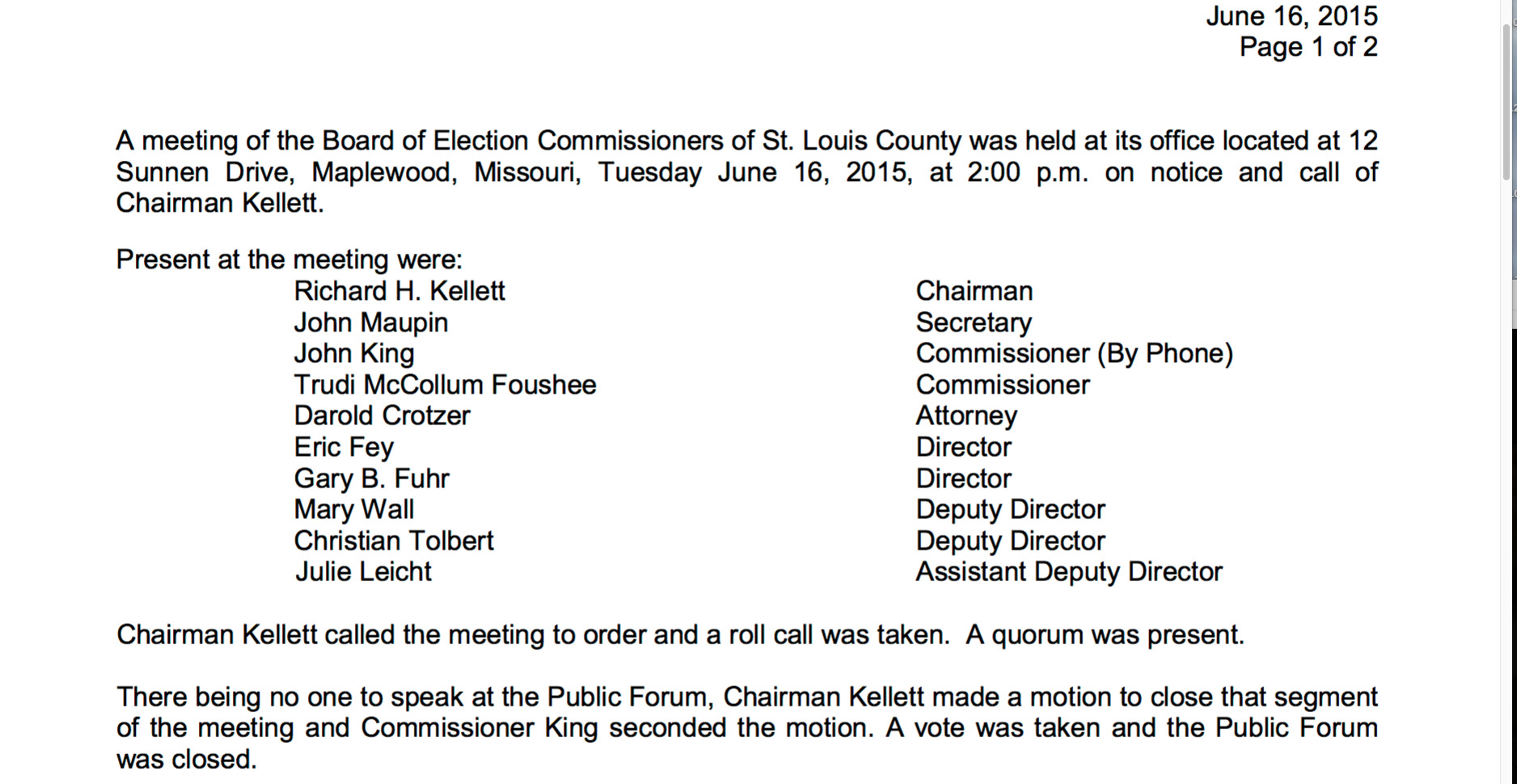
In Schedule 5.12 of the loan agreement, Republic says it has no issues to report related to environmental matters. But the company’s February 2016 Security and Exchange Commission 10-K report discloses that for 2014 Republic accrued more than $227 million in costs coping with environmental matters at its troubled West Lake property.

Screen Shot 2016-06-22 at 10.41.57

In short, the company readily acknowledged the high cost of addressing environmental matters at West Lake to the SEC earlier this year, but denied any problems would have a “material adverse effect” in paying back its debt in the 2014 loan agreement. To do otherwise would be a breach of the loan agreement and could be considered a default.

A Slow-Motion Train Wreck

Republic Services acquired the environmentally-troubled Bridgeton and West Lake Landfills in 2008 when it merged with Allied Waste Services. The impacted landfills are now closed, but Republic continues to operate a transfer station at the same location, which has been an EPA Superfund site since 1990.

The history of radioactive contamination at West Lake dates back to 1973, when the waste was illegally dumped. Federal, state and local regulatory authorities have been aware of the problem for more than 40 years, but failed to act.

The inaction made matters worse.

In December 2010, Republic told the Missouri Department of Natural Resources that an underground fire was burning at the Bridgeton Landfill, which is directly next to the West Lake Landfill and part of the same Superfund site. The stench from the fire raised dormant public concerns.

By February 2013, MDNR had cited Republic for noxious odors. The next month the Missouri Attorney General sued the company for violations of state environmental laws. That case is still pending. A negotiated agreement between the state and Republic Services to build a barrier to stop the fire from advancing closer to the radioactive waste is also stalled, as is federal legislation that would hand the cleanup over to the U.S. Army Corps of Engineers.

During these delays, the fire has moved closer to the radioactive material.

Meantime, the MDNR and the EPA have confirmed that radioactive materials are known to have migrated off site, further contaminating air, soil and water. Private lawsuits have also been filed against the company.

To those unfamiliar with the world of high finance, the reporting discrepancies and ongoing issues at West Lake would seem enough to raise eyebrows among Republic’s individual and institutional investors, including  firms tied to billionaires Bill Gates and Warren Buffett.

But that hasn’t happened.

Apparently, Republic’s word is its bond among stock market traders. From a business perspective, environmental stewardship and standard accounting practices are based on the letter of the law. West Lake be damned. After all, the five-year, $1.2 billion loan is a fraction of  Republic’s long-term debt, which stands at $7.5 billion and counting.

Screen Shot 2016-07-05 at 16.38.57


Shame of the Cities

Low Standards and Ethical Lapses Are Still the Rule More Than a Century After Muckraker Lincoln Steffens Exposed St. Louis’ Politically Corrupt Environment.

Screen Shot 2016-05-27 at 14.36.55

http://bridgetonmo.swagit.com/play/05232014-544

To understand how St. Louis County’s longstanding radioactive waste problem has been covered up, you need knowledge of the political landscape and those who inhabit it. The public often mistakenly identifies politicians exclusively as elected office holders, but it’s   the people working behind the scenes, –those holding obscure appointed positions — who make things happen — or not.

Take for example, zoning attorney John King. King, a private attorney, is the son of the late Bus King, St. Louis County Republican powerbroker. In 2014, John King of the Lathrop and Gage law firm appeared before Bridgeton City Council on behalf of the Metropolitan Sewer District (MSD). He was there to make sure that a right of way was approved for MSD’s leachate pipeline, a project shared by MSD and Republic Services, the owner of the West Lake Landfill, a Superfund site that includes a smolder underground fire, which is headed in the direction of illegally dumped radioactive waste.

After King strode up to the podium and addressed the council in an affable way, a veteran councilman acknowledged with awe the attorney’s presence in the chamber. “We went to the same school together,” said Councilman Ferd Fetsch. “So I get nervous when I see him.”

Obviously, King’s reputation as the penultimate insider had preceded him.

The influential attorney didn’t need to argue his case. He didn’t make a plea or argue fine points of the law.  On the contrary, he coyly questioned why he was even there.

“I didn’t want to be here for this reason,” King told the council. “I know this is a very controversial matter, and I don’t know very much about it — and I don’t want to know very much about it.”

King said he was there because the Missouri Department of Natural Resources was pushing his client, Republic Services, to nail down this detail. One of the things that King apparently didn’t want to know about, however, includes the amount of pollution being monitored at the site by DNR, including elevated levels of radium

Community activist Donna Klocke provided those details in her request that the city not vacate its right of way to the landfill. Her summary of the facts were reasonable and well presented. The council listened to her and dismissed her plea with little fanfare.

King did little more than smile and the motion was tabled for later consideration in closed session.

Screen Shot 2016-05-27 at 13.48.00

Coincidentally, King’s law firm — Lathrop and Gage — also represents Republic Services, the landfill owner, on many other issues.

This cozy relationship is particularly convenient since Terry Briggs became mayor of Bridgeton, the St. Louis County municipality where the West Lake Landfill is located. Briggs is the former chief public affairs for MSD and is also a lobbyist for a business group that includes Republic Services.

Before the pipeline was constructed, Republic had used a St. Louis County permit issued to MSD to truck toxic leachate from the landfill site to a treatment plant on the Mississippi River. The pipeline takes the place of the trucks, allowing for a more efficient but still questionable means of disposal. The zoning issue that brought King before the council is now nearly forgotten. That’s the way it’s supposed to work.

Cutting deals, getting behind-the-scenes approval of various political jurisdictions, and navigating through bureaucratic mazes is what zoning attorneys do. It’s a lucrative, if not transparent, business.

King’s civic participation is not limited to zoning issues, however.

He also sits on the St. Louis County Election Board. The general counsel for the election board is Darold E. Crotzer Jr., another prominent St. Louis attorney. Crotzer wears more than one hat, too. He is a member of the St. Louis Regional Sports Authority. The Sports Authority owns the former St. Louis Rams practice field in Earth City, which is located next to the radioactively-contaminated West Lake Landfill.

Screen Shot 2016-05-27 at 14.42.21 Screen Shot 2016-05-27 at 14.41.33

Under the terms of its agreement with the St. Louis Regional Sports Authority, the newly relocated Los Angeles Rams have the opportunity to buy the football team’s former 27-acre practice facility in Earth City for $1. In March, the sports authority went to court to keep the land grab from happening. The property once had an assessed value of $19 million.

When it comes to real estate deals, the sports authority is no more transparent than municipal governments. They’re both public bodies, but they cut the deals behind closed doors. In this case, it’s apparent that the value of commercial real estate is more important than the lives of  current day St. Louisans and those people who will live here in the future.

The bottomline remains the same. The almighty dollar is king.


Who is Josh Peterson?

Local environmentalists love outside media attention, but they may find embracing the “kindness” of strangers can sometimes hurt more than help. 

Josh-Peterson-Urban-News-Service-300x300

In recent days, the West Lake landfill Facebook page has been graced by two stories by Josh Peterson, a contributing writer for the Urban News Service. The stories are essentially a rehash of old news with a sprinkling of updated quotes from local activists involved in confronting St. Louis’ radioactive waste catastrophe.

Another freelancer piggybacking off previously generated coverage would be of little concern. Pack journalism is nothing new.

But these stories are different.  While they appear to focus on the environmental dilemma at West Lake,  the stories tend to meander into disparate and unrelated issues, including the unrest in Ferguson, the demographics of St. Louis County and even President Obama’s nuclear policy with Iran.

It’s all a bit fuzzy. And perhaps that’s by design.

One thing that is clear about the Urban News Service coverage is that  it’s done long-distance. The reporter, Peterson, lives in Washington, D.C., more than 800 miles from St. Louis. The other undisputed fact is that the reporter lists no prior experience in reporting on environmental issues on his resume.

But it is the credentials that Peterson does list that are most revealing. He credits himself with being associated with the ultra-conservative Heritage Foundation and  contributing to a litany of extreme right-wing, online publications, including The WatchdogThe Daily Caller, Washington Free Beacon, and the Federalist.

The Watchdog, for example, is the product of the Franklin Center for Government and Public Integrity, a neoconservative think tank with a clear anti-union and anti-environmental agenda. The Franklin Center uses its clout to infiltrate and influence state legislative news coverage across the country, according to a Media Matters website.

The Washington Free Beacon, spawned in 2012, was originally connected to the Center for American Freedom, another ideologically-driven, non-profit corporation dedicated to among other things bashing the Obama administration whenever possible.

One of Peterson’s Urban News Service stories dismisses the known ill-health effects caused by radiation exposure by citing the opinion of an alleged expert, Jerry Cuttler.

“Low-level radiation ‘is generally a health benefit,’ said Jerry Cuttler, a scientist with more than 50 years of experience with nuclear radiation and an adviser to the New York-based American Council on Science and Health.

“’The natural radon level in an open area is very low,’ said Cuttler. ‘To find a harmful radon level, you would need to go into a uranium mine that has no forced ventilation.’”

Peterson contacted StlReporter after publication via Twitter to defend and clarify his work.  He says his research for the articles on St. Louis’ radioactive-waste crisis took weeks. Peterson also asserts that he is an experienced environmental reporter. His initial interest in the St. Louis radioactive-waste crisis, however,  was spurred because billionaire businessman Bill Gates is a major shareholder in Republic Services, the trash company that owns the radioactively-contaminated West Lake Landfill in Bridgeton, Mo.

Though Peterson admits he has been associated with neocon think tanks, he is not in lockstep with the policies they promote, he says. He dismisses attempts to tie his work to the political slant of the publications to which he has contributed as a conspiracy theory. He adds that it is hypocritical and unprofessional to have done so.  Peterson objected to not being called beforehand for comment.

“I would rather speak on the phone as colleagues rather than having to defend myself in 140-character bites,” he says.

There is little argument, however, of the political slant of the parent company of the Urban News Service — the American Media Institute (AMI). One of AMI’s directors is Richard Perle, a  founder of the Project for a New American Century, which helped forge the Bush administration’s flawed foreign policies. As the chairman of the Defense Policy Board, a civilian advisory group attached to the Department of Defense, Perle pushed for the invasion of Iraq. He resigned from his position after journalist Seymour Hersh revealed that Perle was a war profiteer in  Lunch with the Chairman, an article that appeared in the New Yorker in 2003.

Earlier in his career, Perle was a staunch supporter of the Reagan administration’s Strategic Defense Initiative, also known as Star Wars. Throughout his long career, Perle has been an unwavering proponent of  the U.S. nuclear weapons program.

The U.S. nuclear weapons program, of course, originated with the Manhattan Project, which built the first atomic bombs. The nuclear waste generated then and subsequently during the Cold War still contaminates St. Louis County today.

This all leads to one question:  Why is Peterson’s slyly neoconservative slant being promulgated by environmental activists on the West Lake Facebook page?


Through the Looking Glass

An online news source with ties to neocon Richard Perle is subverting the efforts of St. Louisans to clean up West Lake Landfill and Coldwater Creek.

Meet The Press

In its latest act of subversion, a story generated by a bogus African-American news service is being shared on Facebook by those who are trying to get radioactive contamination removed from sites in St. Louis County, Mo.

The most recent story has been posted by longtime anti-nuke activist Helen Caldicott. The story was generated by the Urban News Service (UNS), a subsidiary of the American Media Institute (AMI).  The article is mainly a cobbled-together rehash of other media accounts but it does include a quote from Ed Smith, a spokesman for the Missouri Coalition for the Environment.

One of the main thrusts of the story is that the population of St. Louis County has twice the number of African-Americans than the national average, according to the latest census numbers. The proximity of the radioactive waste sites to Ferguson, the site of racial unrest in 2014  is also a focus of the story. The interpretation of the census statistics, however, is misleading, because more than three quarters of the population in St. Louis county is white.

It is unclear why the race issue is being made a part of the narrative. And it becomes even more murky when details of the AMI are more closely examined.

AMI was founded by neocon Richard Mitimer, former editor of the right-wing Washington Times newspaper,  a publication  long owned by the Rev. Sun Myung Moon, the founder of the Unification Chuch. Mitimer is currently the national security columnist for Forbes magazine. Mitimer, an avowed libertarian, is not known to be a civil rights activist.

The inclusion in the story of Smith, the Safe Energy Director at  the Missouri Coalition,  gives the appearance that the UNS is environmentally friendly and anti-nuke.  Moreover, the story has been posted by Caldicott, an anti-nuke icon.

But there is reason to question that image.

That’s because Richard Perle is a director of the American Media Institute, according to the non-profit corporation’s latest available tax returns. And the AMI is the parent company of the Urban News Service.

Screen Shot 2016-05-09 at 11.29.22

Perle is noted for being one of the primary architects of the Iraq war. He was also a founding member of the Project for the New American Century  along with Paul Wolfowitz, which carved out the template for American foreign policy during George W. Bush’s administration. Perle resigned from the influential Defense Policy Board, a Defense Department civilian advisory group, in 2003 after it was revealed that he was engaged in war profiteering by Seymour Hersh of the New Yorker.

More germane to the nuclear waste issue, however, is Perle’s longstanding advocacy of nuclear weapons. During the Reagan era, Perle was a proponent of the Strategic Defense Initiative, also known as Star Wars. The refinement of uranium by Mallinckrodt Chemical Works for the first atomic bombs is responsible for the nuclear waste that still plagues St. Louis County.

It is difficult to conceive that Helen Caldicott and Richard Perle have anything in common, particularly when it comes to cleaning up the nuclear waste in St. Louis County. Nonetheless, they share a common interest in promoting the work of the Urban News Service.

We are through the Looking Glass.


Radiation Exposure Is Good For You!

Screen Shot 2016-05-06 at 14.05.40


A story generated by  the Urban News Service,  the subsidiary of a right-wing “news” outlet,  popped up today on the West Lake Landfill Facebook page. At first glance, the article seems to promote proponents who have been working for years to get the EPA Superfund site in Bridgeton, Mo. cleaned up. But the article is actually a cleverly cobbled together piece of propaganda that advocates the opposite.

The story quotes  “Dr.” Jerry Cuttler an advisor to the New York-based American Council on Science and Health, who posits that chronic exposure to low-level radiation can actually have  beneficial health effects. The scientific community as a whole thinks otherwise, and has long cautioned that there is no safe or permissible levels for radiation exposure. This widely accepted viewpoint is based in part on an awareness and understanding of the cumulative, long-range impact to radiation, which is a known human carcinogen. Chronic low-level radiation exposure is also known to cause auto-immune and reproductive disorders and is also tied to mutations that permanently alter the human genetic code.

Despite these distinct and dire possibilities, the Urban News Service story by correspondent Josh Peterson dismisses the known ill-health effects caused by radiation exposure by citing the opinion of an alleged expert, Jerry Cuttler.

“Low-level radiation ‘is generally a health benefit,’ said Dr. Jerry Cuttler, a scientist with more than 50 years of experience with nuclear radiation and an adviser to the New York-based American Council on Science and Health.

“’The natural radon level in an open area is very low,’ said Cuttler. ‘To find a harmful radon level, you would need to go into a uranium mine that has no forced ventilation.’”

The American Council on Science and Health has long-established history of supporting the petro-chemical industry by claiming that toxic substances  are not dangerous to human health. The council defends fracking, BPA and pesticides. In 2012, Mother Jones magazine reported that the American Council on Science and Health has received funding or applied for support from corporations and foundations such as  Chevron, the Bristol Myers Squibb Foundation, Bayer Cropscience, Procter and Gamble, agribusiness giant Syngenta, 3M, Monsanto, DowAgro, ExxonMobil Foundation, the Koch family-controlled Claude R. Lambe Foundation, the Dow-linked Gerstacker Foundation, and others.

The American Media Institute, the parent company of the Urban News Service, claims to be stacked with former writers and editors for the Wall Street Journal and the Reader’s Digest. AMI was founded by Richard Miniter, a national security columnist for Forbes magazine. His brother Frank Miniter is the editor of the National Rifle Association’s magazine American Hunter. Miniter’s right-wing tilt began when he worked in 1989 as a summer intern for the Institute for Humane Studies, a right-wing think tank funded by the Scaife and Koch Foundations. Miniter also worked as an environmental analyst for the Competitive Enterprise Institute, which opposes government involvement in efforts to curb global warming.


Our Man in Havana

The Inspiring Story of How the Late St. Louis County Detective Pete Vasel Nabbed “Alleged” Commie Terrorist Verne Lyon [first published in the Riverfront Times, 1995.]

$_1

At approximately 7:30 p.m. on Dec. 17, 1966, a shoe box containing two sticks of dynamite wired to a wind-up alarm clock exploded in the waiting area next to the Ozark Airlines ticket counter at Lambert Field in St. Louis. Fortunately, before the bomb went off police cleared the airport terminal and no one was killed or injured. The explosion did, however, do extensive property damage, destroying a bank of seats and a number of large windows. Three days later, a young engineer employed by McDonnell Aircraft was arrested for the bombing. The long-forgotten incident would shape the course of the accused man’s life.

After 27 years, the convicted bomber is asking President Bill Clinton for a presidential pardon. This is his story.

Lyon was born in Boone, Iowa. The time was 50 years ago. Somewhere World War II raged and the Cold War waited. Not in Iowa, though. No, the wake of these events would move at a glacial pace across the plains of the upper Midwest. Seasons turned. Lyon grew. Following high school, he headed east on U.S. Route 30 to the state university at Ames. The nascent Space Age had nurtured an interest in rocketry. He majored in aerospace engineering. But it was Lyon’s extracurricular activities on campus that ended up having more of a lasting effect on his career.

According to Lyon, the CIA recruited him as a student to be a part of Operation Chaos, an illegal domestic espionage network during the Vietnam era. The job of spying on campus anti-war activities paid $300 a month and came with a guaranteed draft deferment, Lyon says. After college Lyon says he decided to sever ties with the CIA, but the agency continued to contact him even after he moved to St. Louis and began working for McDonnell Aircraft. Ultimately, his stint of college intelligence work would lead to being falsely accused of the Dec. 17, 1966 bombing of the St. Louis airport, Lyon says.

After he jumped bail, Lyon eventually went to Cuba, where the story of the bombing was used by the CIA to support his fake identity as an anti-war radical, he says. Lyon’s rearrest and subsequent convictions would be postponed for more than a decade. But he finally served almost six years in Leavenworth, he says. During all this time, Lyon has steadfastly maintained his innocence and claimed that none of this would have transpired had he not been set up by the CIA initially and then later persecuted for breaking agency protocol.

“Everybody in the agency, I think, was watching my situation very closely,” says Lyon. “(I) had resigned, been a hard target, broken several of the agency‘s unwritten rules. Did so very deliberately. Defied them. Evaded them for two years. … So I think they had a long list of reasons why they wanted me back. But I think the primary (reason) was to make an example of me and to show me that they were in control not me.”

On these points, it is difficult, if not impossible to confirm whether Lyon’s life was manipulated by the U.S. government or simply swept up in Cold War politics through his own volition. The truth is likely somewhere in between and still moving into the uncertain political milieu of the 1990s. To some students of the intelligence field, there is no such thing a “former” CIA agent. Other critics of Lyon question whether the agency would risk sending an employee on such a dangerous mission. It is more routine for the CIA to hire contract operatives for such purposes, they say. These caveats must be weighed in this case. But regardless of his veracity or motivations, Lyon’s interpretation of events represents an intriguing pawn’s-eye view of the zeitgeist of the 1960s.

If there is anything that hasn’t changed over the years, it may be Lyon’s voice. His speech is still steeped with the flattened upward inflections peculiar to natives of Northern states. The endemic accent remains despite years spent south of the Tropic of Cancer — Havana to be exact.

From 1968 to 1975, Lyon worked as a scientist for the Cuban government, conducting cloud-seeding experiments in an effort to increase the island’s agricultural production. At the same time, Lyon says he passed an array of information to the CIA.

Since returning to Iowa 11 years ago, Lyon has worked for the Hispanic Ministry of the United Methodist Church, a social services agency that provides support to Latino aliens in the Des Moines area. He is also an active member of the Association of National Security Alumni, an affiliation of former CIA and FBI agents who have become critics of the intelligence community.

Lyon is now seeking a presidential pardon over the St. Louis airport bombing and his subsequent flight. “What I’m doing now has raised enough mitigating circumstances that the government has the capability of saying, `Ok, let’s put the past where it belongs and give you a fresh start. That’s basically what the pardon does,” says Lyon.
One person who believes Lyon was guilty as charged is retired St. Louis County chief of detectives Frederick Jacob “Pete” Vasel.

Vasel, 64 (in 1995), was at the scene in 1966 when the bomb went off. Eleven years later, he testified against Lyon at his trial. According to Vasel’s account, he walked up to the shoe box containing the dynamite and noted its contents. The government’s appellate brief states what happened next: “After walking a matter of 15 to 30 feet away from the device, it exploded, knocking Major Vasel down.” In a recent interview, Vasel recalled that the explosion hurled him back 14 or 15 feet. “It scared the shit out of me,” he says.

When asked whether the CIA had a hand in the bombing, Vasel says: “No goddamn way. He (Lyon) wasn’t set up.” Vasel did say that on occasions he himself had contact with the CIA. His cooperation included providing profiles of individuals to the agency. But in Lyon’s case, there was no CIA interest whatsoever, according to Vasel.

Vasel does say, however, that there’s lot’s of mysterious elements to the case.” In his recollection, Lyon escaped from St. Louis in a limousine, and later traveled to the Soviet Union while in exile. The former detective suggests the bombing may have been an act of communist subversion. But he also has another theory on which to fall back. “He was going through a very upsetting time with his girlfriend,” says Vasel.

Vasel himself is somewhat mysterious. In 1963, he stated on a local public service television program that “secret crime societies” were not operating in St. Louis. The following year, his testimony helped convict mobster John Paul Spica of the contract murder of real estate developer John T. Myszak. Spica later died in a car bombing following his release from prison. Prior to his death, Spica gave closed-door congressional testimony on his knowledge of a St. Louis-based plot to assassinate Martin Luther KIng.

During his controversial 20-year career with the St. Louis County Police Department, Vasel was demoted, promoted, fired, reinstated and finally retired. He reputedly commanded the respect of criminals and had a network of informants.

According to the court record, Lyon became a suspect after a police captain from the City of St. Louis tipped Vasel off to rumors floating around McDonnell Aircraft. Vasel tracked down some of Lyon’s coworkers. One claimed he had overheard a telephone conversation in which Lyon talked about dynamite. Another employee said that Lyon had asked him about getting wires soldered to a pair of flashlight batteries.

When law enforcement authorities searched Lyon’s digs, on Wengler Avenue in suburban Overland, Mo., they found wires, blasting caps and dynamite. At the trial, this circumstantial evidence was bolstered by other testimony and exhibits. A hardware store owner from Troy, Mo. swore Lyon had purchased dynamite from him. Receipts were entered as evidence. Diagrams found in Lyon’s office desk were also offered up. His former landlady and another woman told the court that Lyon had asked them for shoe boxes.

But nobody ever saw Lyon at the airport.

As for the possession of the dynamite, Lyon has a plausible explanation. He says he had an interest in amateur rocketry dating back to ninth grade. Lyon bought the explosives for his hobby, he says. At the time, the young aerospace engineer had visions of being an astronaut and had won a NASA technical essay contest. In a newspaper account following his arrest, his younger brother said Lyon had promise to bring more dynamite back to Iowa for some solid fuel experiments.

He never was afforded that opportunity. At a preliminary hearing before jumping bail, Lyon caught a glimpse of what he suspects transpired. “I saw an FBI agent who had been involved in the … search warrant talking to one of my CIA recruiters. It wasn’t long after that I received a phone call to talk to one of the former recruiters,” says Lyon. Later, the CIA asked Lyon to travel to Washington, D.C. Once there, the agency made him an offer, Lyon says. The deal, according to Lyon, was “ the agency would help clear my name, after a length of time, and things had calmed down.” In return, Lyon agreed to work full time for the agency. The CIA “believed a mistake had been made (over the bombing), which always led me to believe that they had been involved,” he says. “Whether it was on purpose or whether it just developed this way, the fact that I was accused of being involved in that incident was later used to develop a legend for me.”

Lyon subsequently underwent training in Washington, D.C. and in Canada, while waiting for Cuba to grant political asylum, he says. After being accepted, Lyon worked for the Cuban Academy of Sciences, all the while funneling economic data and reports on foreign technicians back to the CIA.

Lyon says he was only scheduled to be in Cuba for two years. But during the course of his stay, he married a Cuban woman. The CIA would not allow him to return to the U.S. with his wife so he extended his tour. Then when the agency asked that he spy on his politically-connected in-laws, he refused, Lyon says. After three years, the self-professed spy had become assimilated into the Cuban culture and his attitude had changed. “I came to my senses,” says Lyon. “What we were doing there was not in the best interest of the United States, (and) they were obviously not in the best interest of Cuba or the people.”

Finally, in 1975 the Cubans caught on and deported him to Jamaica, Lyon says. With the United States having already refused to renew his passport and the bombing charges still pending in the St. Louis, he lived first in Canada and then Peru, where U.S. marshals apprehended him in February 1977.

At the trial, defense attorney Leonard J. Frankel subpoenaed all CIA records pertaining to Lyon. At first, United States District Court Judge John K. Regan ruled to allow the evidence. But when two minions of the CIA arrived at the court. Their meeting with the judge and the defense counsel was held behind closed doors. They claimed Lyon had no association with the agency. According to the court record, the CIA file on Lyon “was opened as a result of information received from sources outside the agency.” The CIA refused to allow even the judge to see the file. Instead, the agency’s representatives summarized its contents. In some instances, the sources of the information were withheld on the grounds that naming them would compromise national security interests.

As a result of the closed hearing, Regan quashed the subpoena issued to the agency. According to Frankel, the judge’s reversal was most unusual from a legal standpoint and personally out of character. Frankel won Lyon’s appeal, but the decision was based on a faulty search warrant not the CIA issue. In the retrial, Lyon again was convicted and Regan meted out the same 15-year sentence.

More curious perhaps than the Regan flip-flop are the unnamed sources in Lyon’s CIA file. The secrecy smacks of star chamber ethics and leaves the Verne Lyon case open to speculation. Since Lyon’s trials, CIA documents released through the Freedom of Information Act indicate that during the 1960s and 1970s the agency had close ties to local police departments. One memo even mentions a 1967 training session “in the types of explosive devices manufactured from readily available commercial material.”

The Scar

A cancer victim asks me for answers to the festering radioactive waste issue in North St. Louis County.

images

Last night before the screening of the First Secret City at Saint Louis University, a woman came up to me and showed me a long, deep scar on her on the bicep of her left arm. Even though her skin was black,  I could clearly see the severe bruising she has from her most recent radiation treatment.

She is 44 years old and has leiomyosarcoma, a rare cancer that I can’t pronounce.

The woman pulled out her I-phone and showed me how to spell the name of the disease that is ravaging her body. I had to borrow a pen and a piece of paper from her so I could jot down the spelling.

One of the causes of leiomyosarcoma is exposure to ionizing radiation. But her doctors won’t say whether that’s the cause of her life-threatening condition.

She has lived in Florissant, Mo. since she was three years old. Her family home is next to Coldwater Creek, which is known to be contaminated with atomic weapons waste dating back to World War II.

She told me that she didn’t sign up for this.

She didn’t volunteer to be a victim of the U.S. military’s secret nuclear weapons program. She asked me for answers.

That’s what I’m looking for, too.

Aero Dynamic

Farhad Azima’s aviation leasing company  in  Kansas City flies under the radar, quietly shuffling airplanes around the world for influential clientele. The Iranian-American businessman is a footnote to the Iran-Contra scandal. But what’s he been up to lately?

Screen Shot 2016-04-07 at 11.32.47


With the release of the Panama Papers this week, a name surfaced that hasn’t been in the news for a generation. In the 1980s and early 1990s, Farhad Azima was  alleged to have aided the illicit arms trading scheme of the Reagan administration that involved selling arms to Iran and using the profits to fund a covert war against the Sandinista government in Nicaragua. Houston Post reporter Pete Brewton also linked Azima to the CIA and Mafia’s involvement in the rip off of the savings and loan industry during the same era.

Azima, a Kansas City-based aviation executive,  was one of many businessmen who reportedly aided the clandestine Iran-Contra operation ran out of the White House by Col. Oliver North.   Azima began his career as the CEO of Global International in the late 1970s.   His other aviation-related businesses have included  Capitol Air, Buffalo Airways, and more recently, HeavyLift, an air cargo company operating out of Azerbaijan.

But the crown jewel of Azima’s high-flying empire remains Aviation Leasing Group or ALG. As denoted in its name, the company leases planes. This sometimes involves purchasing the aircraft, deregistering it and then leasing it to a foreign company or individual. The Federal Aviation Administration duly tracks these transfers. In the past, planes with tail numbers registered to ALG and then deregistered have ended up in the European tax haven of Luxembourg, Azerbaijan and Zaire.


Screen Shot 2016-04-07 at 11.07.56

The most recent international activity tied to an ALG-connected tail number occurred last month, according to FAA records. But the paper trail dates back decades. ALG’s business appears to involve shuffling aircraft worldwide, which involves swapping out the tail numbers of the planes. In this case, a DC-8, with the tail number of N855BC, was taken off the FAA books in 1991 because it was exported by ALG to the west African nation of Ghana. The FAA then reissued the same tail number to a different aircraft, a 1986  BAE 125 turbo prop on March 2, 2016.

Regardless of whether the reassignment of  FAA tail numbers is an anomaly or standard practice, the new owner of the aircraft now identified with N855BC is worth noting. The plane is now registered vaguely to a “Bank of Utah Trustee.” Since its reincarnation in the Western Hemisphere, N855BC has had a busy flight schedule, according to Flight Aware, an online aircraft tracking website.


Screen Shot 2016-04-07 at 11.17.03

The flights jump to and from Florida, the Caribbean and Latin America. On March 25, for example, the newly reborn N855BC flew from Punta Cana International Airport on the east of coast of the Dominican Republic to Opa Locka Executive Airport in Miami. From Opa Locka,  it next flew to another small airport in Orlando. The following day the plane flew from Orlando to a remote airport in eastern Venezuela. Later the same day, the plane took off from Queen Beatrix International Airport in Aruba and landed back back at Opa Locka airport in Miami. On March 27, N855BC flew from Opa Locka to the Simon Bolivar International Airport in Caracas, Venezuela. On March 28, the same plane flew from Punta Cana in the Dominican Republic to Fort Lauderdale. Finally, last week, on April 2, N855BC flew from Fort Lauderdale back to the General Jose Antonio Anzoategui International airport in eastern Venezuela.

Multiple flights from three small airports in Florida to destinations in Venezuela, Aruba, the Dominican Republic, all within less than week.

A plane owned by a  Bank of Utah Trustee, with a  tail number  formerly assigned to a  Kansas leasing company whose owner is an alleged CIA operative, has been hop-scotching between various destinations in the Caribbean and Latin America, logging tens of thousands of air miles.

There’s no way of knowing  for sure why this plane is touching down at these locations. But it’s easy to speculate. The most obvious commerce associated with this region of the world is drugs and mo ney laundering. Aruba is a known for its off-shore banking. Venezuela is next door to Colombia, the world headquarters for the cocaine trade. The Dominican Republic is a trans-shipment point for drug traffickers. On the other hand, maybe the Bank of Utah Trustee is operating tourist charters or humanitarian flights.


Screen Shot 2016-04-07 at 11.13.09


What Nobody is Saying

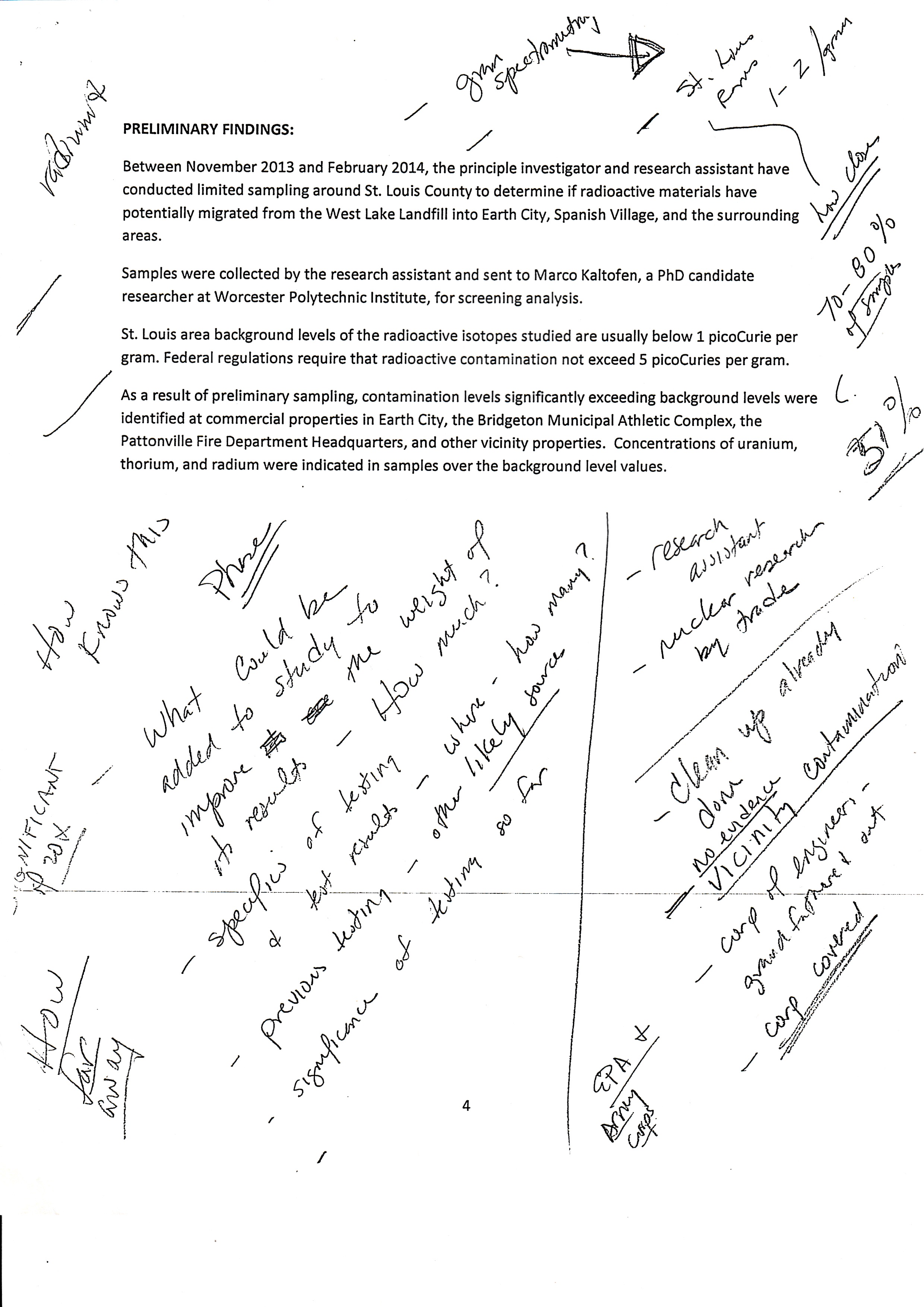
Notes obtained by StlReporter Say West Lake Nuke Waste is Present at Previously Undisclosed Locations.

Notes on the preliminary findings of independent sampling conducted in 2013 and 2014 indicate that above background levels of radioactive contamination were discovered at multiple locations in St. Louis County, including the Bridgeton Fire Protection District.

Neither those involved in the independent testing or the regulatory agencies charged with monitoring the West Lake Superfund site have disclosed the locations of the contamination, leaving the public at large in the dark.

Last week, the EPA did acknowledge that radioactively-contaminated soil had migrated off site at three locations on the northwest perimeter of the Superfund site.

Scan

2004: A NUKE ODYSSEY

The Department of Energy finally promises to clean up the St. Louis areas’s long-neglected radioactive waste in the next 8 years, but leaves many questions unanswered

BY C.D. STELZER

first published in the Riverfront Times (St. Louis), Dec. 11, 1996

It took more than 50 years, but last week the federal government finally pledged to clean up the St. Louis area’s long-neglected radioactive waste sites by 2004.Undersecretary of Energy Thomas P. Grumbly made the historic announcement on Thursday at the Clayton Community Center. The 850,000 cubic yards of radioactive waste — located at scores of sites around the area — are a byproduct of the nuclear weapons manufacturing dating back to World War II. Those attending Grumbly’s speech included public officials and members of a citizens’ task force who submitted recommendations to the Department of Energy (DOE) in September.

“There will never be a bunker in the St. Louis area — at least on my watch.” — DOE undersecretary Thomas P. Grumbly, December 1996.

Grumbly drew applause when he announced “there will never be a bunker in the St. Louis area — at least on my watch.” The applause echoed the results of a 1990 non-binding referendum in which city and county voters overwhelming disapproved of any plan to permanently store the nuclear waste here.

One result of that public outcry has been bi-partisan political support for disposing of the waste outside the area. Republican U.S. Rep. Jim Talent, and Democratic St. Louis Mayor Freeman Bosley Jr. and County Executive Buzz Westfall all attended last week’s meeting to show support for the DOE’s commitment to ship the waste as soon as possible. Some 28,000 cubic yards of contaminated materials from 21 sites have already been sent to a low-level radioactive waste dump in Utah. Moreover, Congress allocated an additional $23 million to continue the clean up in 1997.

But the fate of the remaining nuclear waste is still very much a matter of speculation. “There are some serious issues that remain,” said Talent, after the meeting. “It’s promising, but I don’t want to pretend that it’s all worked out, that it’s to everybody’s satisfaction.”

The congressman’s reservations may be understated. One sticking point in completing the project appears to be the 22-acre airport site — the largest in the area. In his speech, Grumbly emphasized that the DOE remains unconvinced of the need to clean up the airport site to the unrestricted-use level recommended by the local task force, the Sierra Club and the Missouri Department of Natural Resources (DNR).

“He (Grumbly) just doesn’t feel that a site at the end of a runway needs to be cleaned up … the same way you would a residential site,” says Talent. “It’s a legitimate point, but I don’t think that the DOE has looked adequately at the effect on the ground water. The (waste) is sitting on an aquifer.”

Leaving any of the radioactive material at the site would risk further contamination of underground and surface water. But earlier this year, a report by a DOE-appointed panel of geologists declared that the water would miraculously not migrate off the site, and, therefore, it would be safe to leave the waste in place. Two of the six panel members – including one from the DNR — took exception to the findings, however. On Thursday, Grumbly suggested that another hydro-geological study be conducted in the next three months to determine what level of safety would be required.

“We all feel like it needs to be cleaned up so it won’t continue impacting Coldwater Creek,” says environmentalist Kay Drey, a member of the citizens’ task force. The creek is on the long list of remediation sites, which also includes: haul routes, a former athletic field in Berkeley, a landfill in Bridgeton, and parts of the Mallinckrodt chemical plant on North Broadway, where uranium was first purified in 1942.

The DOE, according to Grumbly, would like the entire mess tidied up within eight years, an optimistic goal given the bureaucratic impediments. Aside from the DOE’s lead role, the DNR and the U.S. Environmental Protection Agency (EPA), are mandated by Superfund law must to oversee and approve the project. Grumbly, nevertheless, expects a formal Record of Decision (ROD) for the clean up by the end of the current fiscal year on Sept. 30. That gives the DOE a little more than nine months to work out a myriad of details.

One of those details is prefaced by a dollar sign and has a lot of zeros behind it. “We have no money to do this,” says Drey. The environmentalist points out that the $23 million dollars earmarked for the clean up this year represents a significant increase in past funding for the project, but is still only a fraction of what will be needed to complete the job. The uncertainty over future funding is not expected to abate so long as the Clinton administration and the Republican-led Congress try to out hack each other in deficit reduction. Or as Grumbly puts it, “We’re in a very competitive budget environment.” The effect of the imminent departure of Energy Sec. Hazel O’Leary is also unknown.

As recently as July, the DOE estimated that removal and off-site storage of the waste would cost $778 million. A revised estimate cited last week ranges from $250 to $600 million. The wide difference in the bottom line hinges on, among other things, the choice of technology and the level of clean up specified in the yet to be completed ROD. The contract to carry out the clean up is held by Bechtel National, Inc., a subsidiary of the giant engineering corporation. Potential local sub-contractors that are queuing up include: Sverdrup Evironmental,the National Center of Environmental Information and Technology, Clean Earth Technologies and R.M. Wester and Associates.

Despite the expertise and available alternative technologies, Grumbly gave little indication Thursday that the DOE is seriously considering anything more than digging the irradiated dirt up and hauling it away. If the DOE chooses to clean up the airport site to less stringent levels than recommended locally, it will save money. But the legal and ethical question then becomes whether the scaled-back remedy is protective or human health and the environment.

For many Westerners, who will likely be on the receiving end, there is nothing ethical about any of this. The probable final destination for St. Louis’ radioactive waste seems to be either Utah or Washington state. The Envirocare low-level radioactive waste depository in Clive, Utah has already received some St. Louis shipments. In 1993, before any of the St. Louis waste arrived, state inspectors found Envirocare in violation of a dozen safety regulations.

But the questionable Utah facility now has competition. Last year, the Washington state Department of Health granted a low-level radioactive dump license to the Dawn Mining Co. in Ford, Wash. The majority of Dawn Mining is owned by Denver’s Newmont Mining Co., the largest mineral extractor in North America. Rather than pay for filling a 28-acre, 70-foot-deep, uranium-tailings pond on the Dawn property, Newmont wants to charge the government $5 a cubic foot to accept low level radioactive waste. Although the DOE hasn’t agreed to the proposal yet, representatives of Dawn Mining have tried to solicit the support of the St. Louis citizens’ task force as far back as November 1995.

The Spokane Indian tribe and Dawn Watch, an environmental group, are opposed to shipping the St. Louis waste to their community. “Our position is the site is still an unacceptable location for a commercial waste dump,” says Esther Holmes, a member of Dawn Watch. “(We) have been advocating that the site be cleaned up using clean fill at the company’s expense.” The tailings pond is located near a tributary of the Columbia River and threatens a nearby Indian fish hatchery.