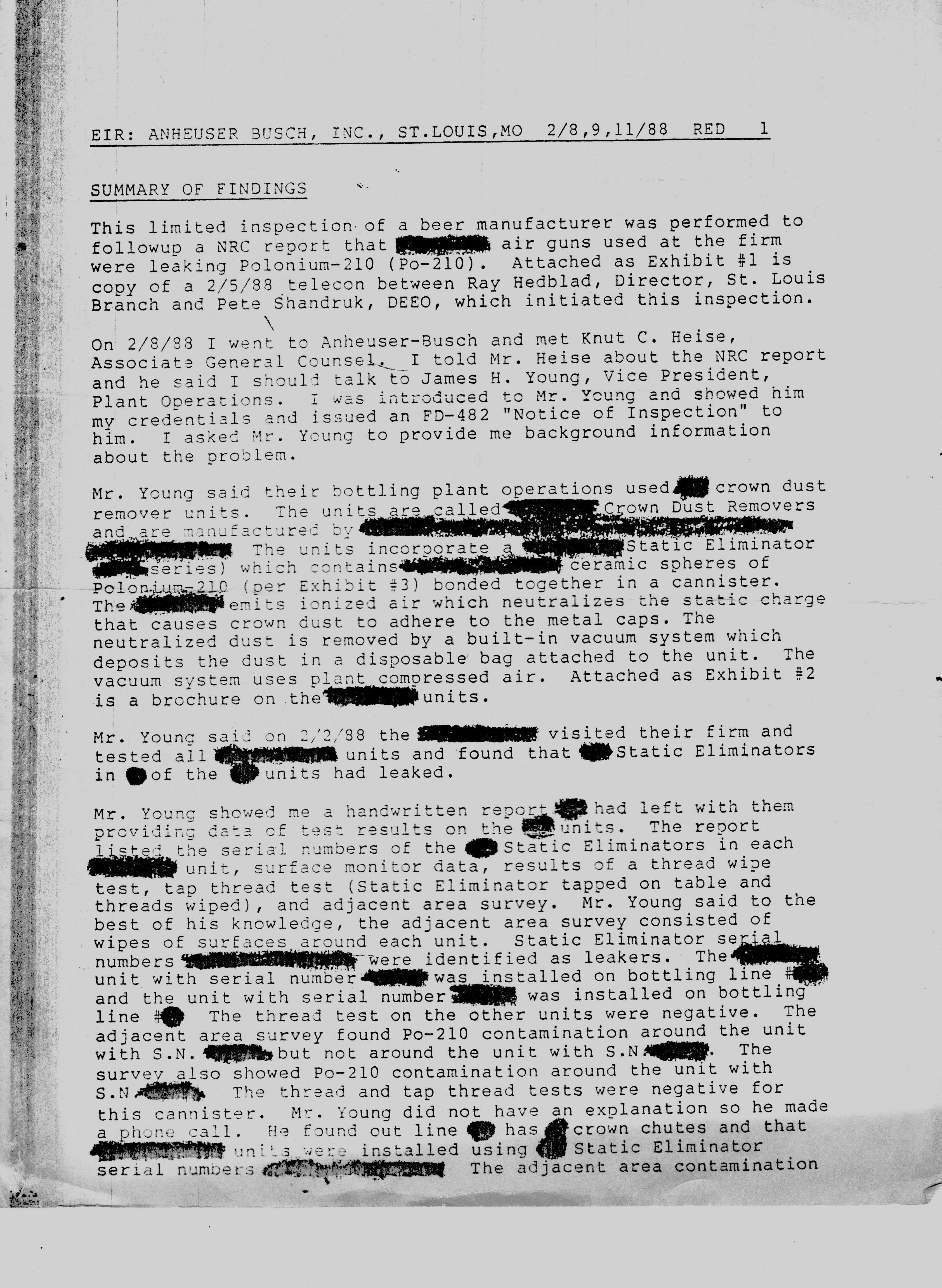
The first page of a 1988 FDA report on the leak of Polonium-210 from static air eliminators at the Anheuser-Busch brewery in St. Louis. The leaks occurred on the bottle lines not in laboratories as reported in the St. Louis Post-Dispatch.
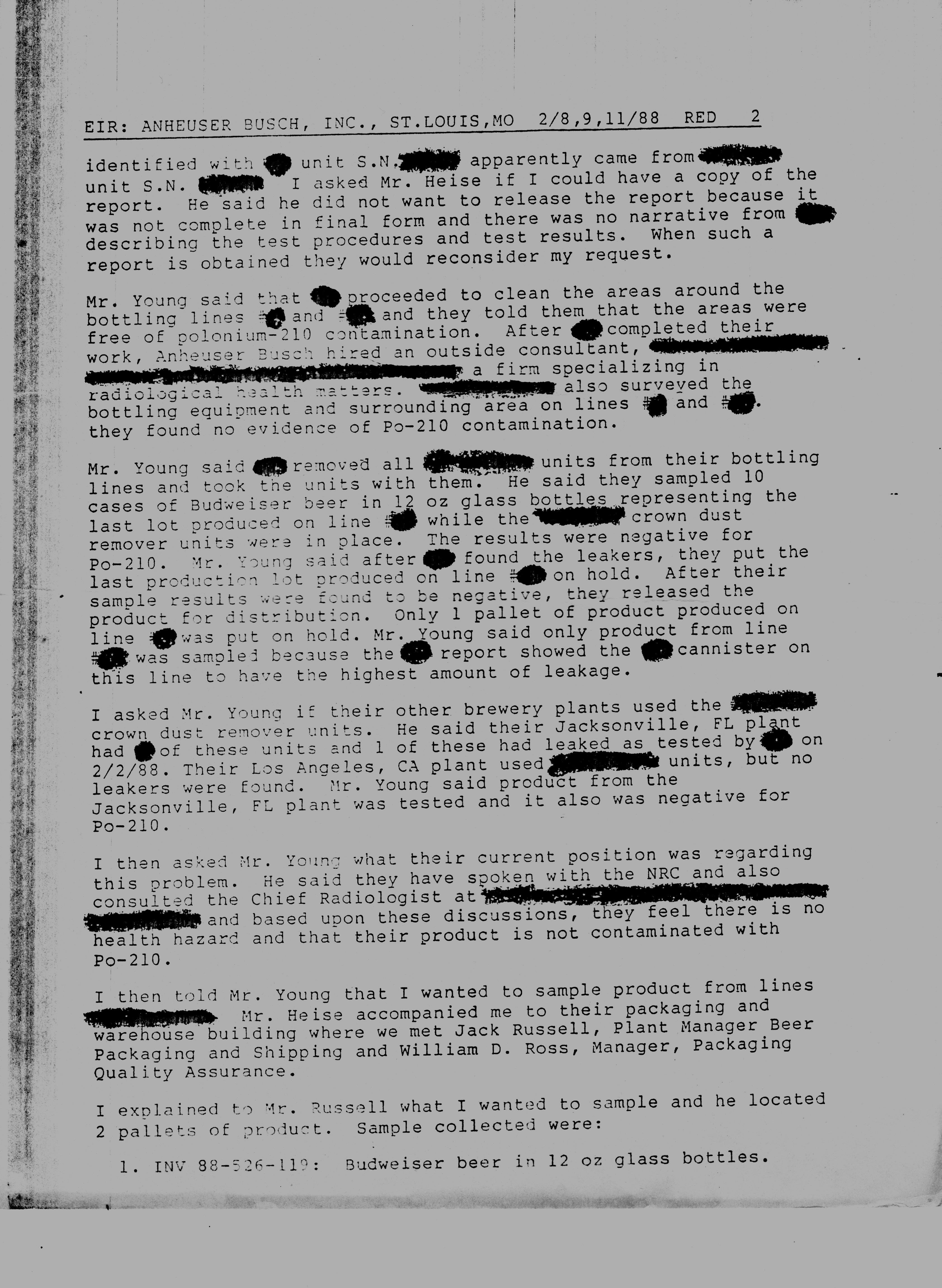
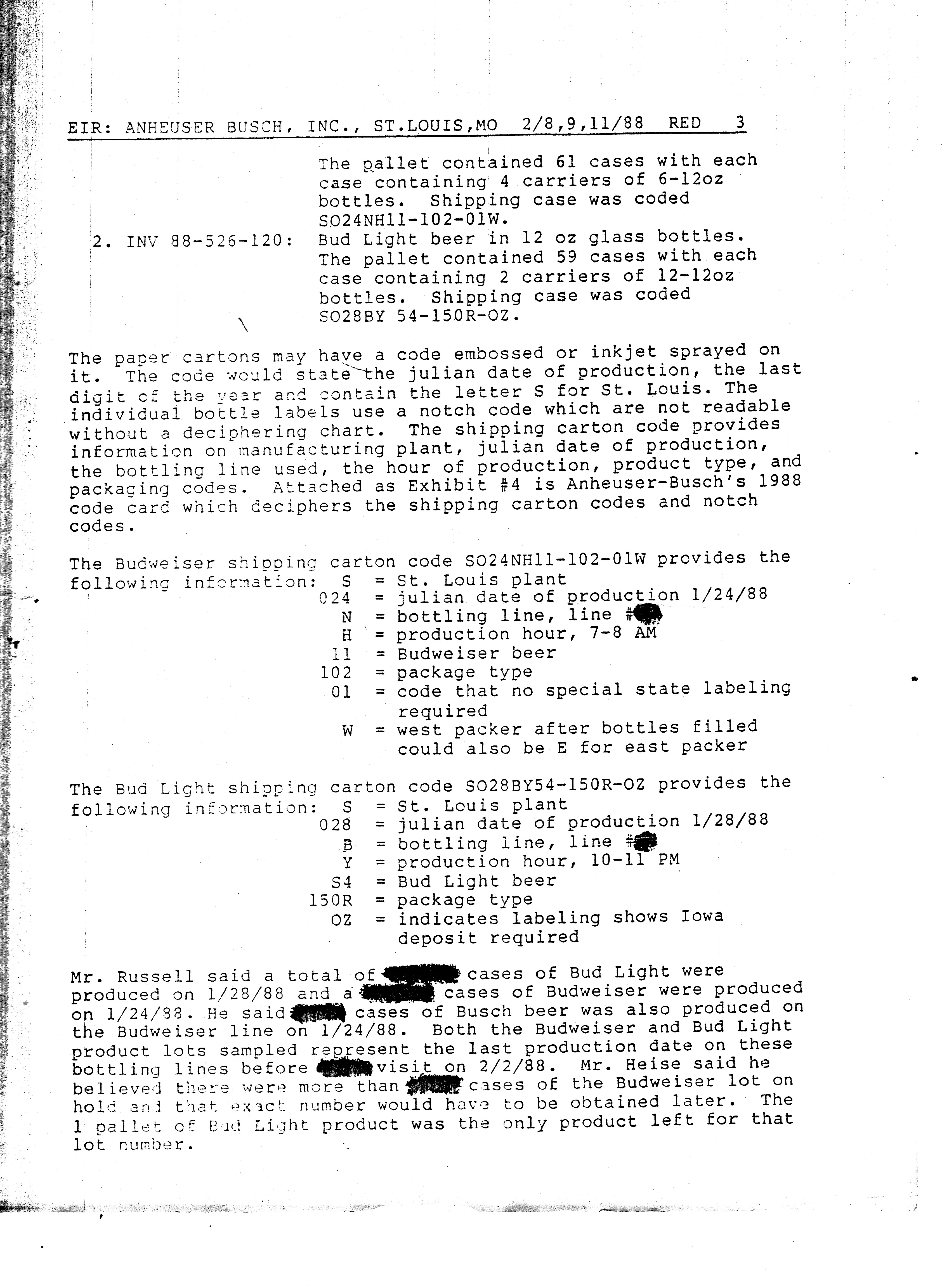
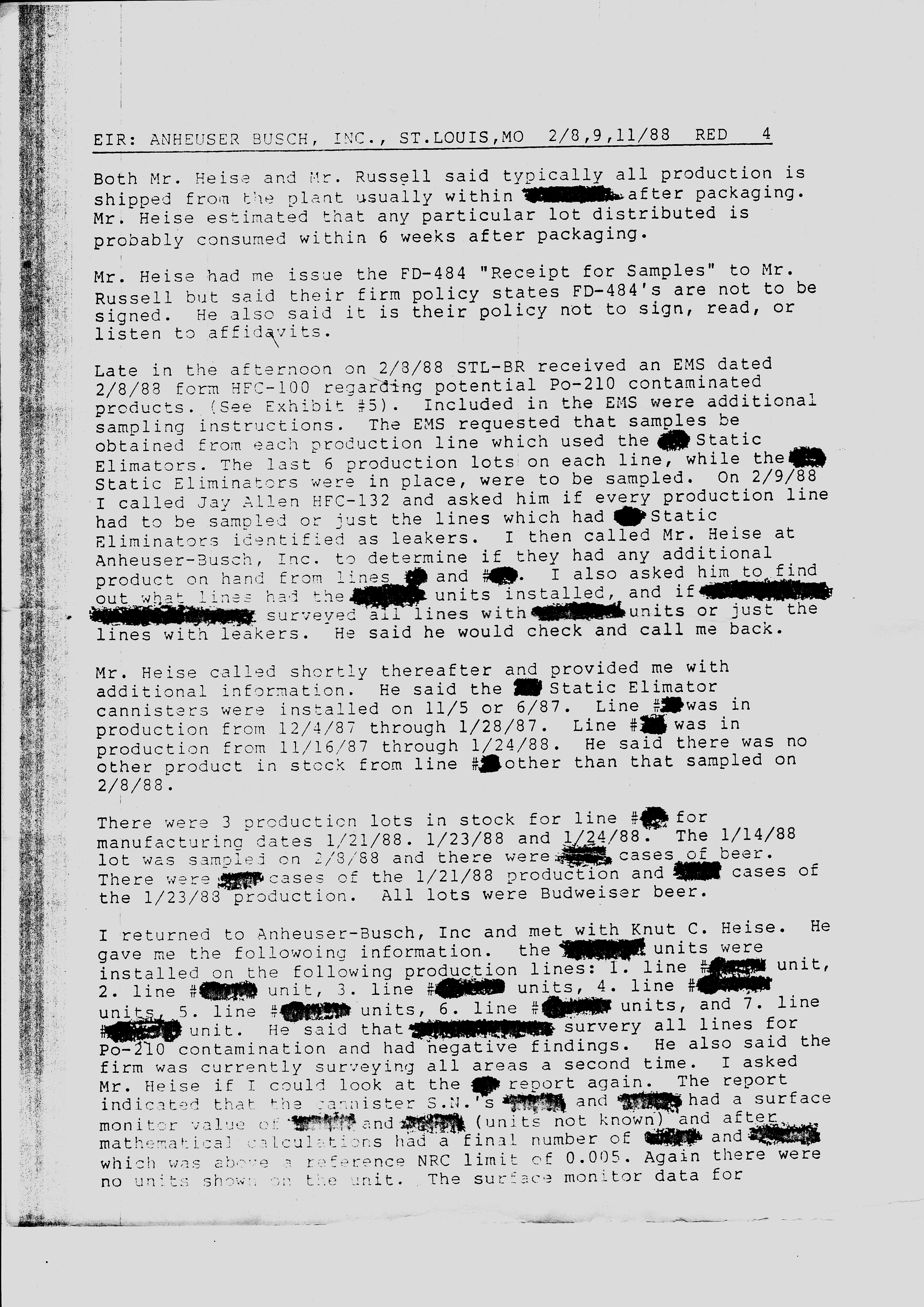
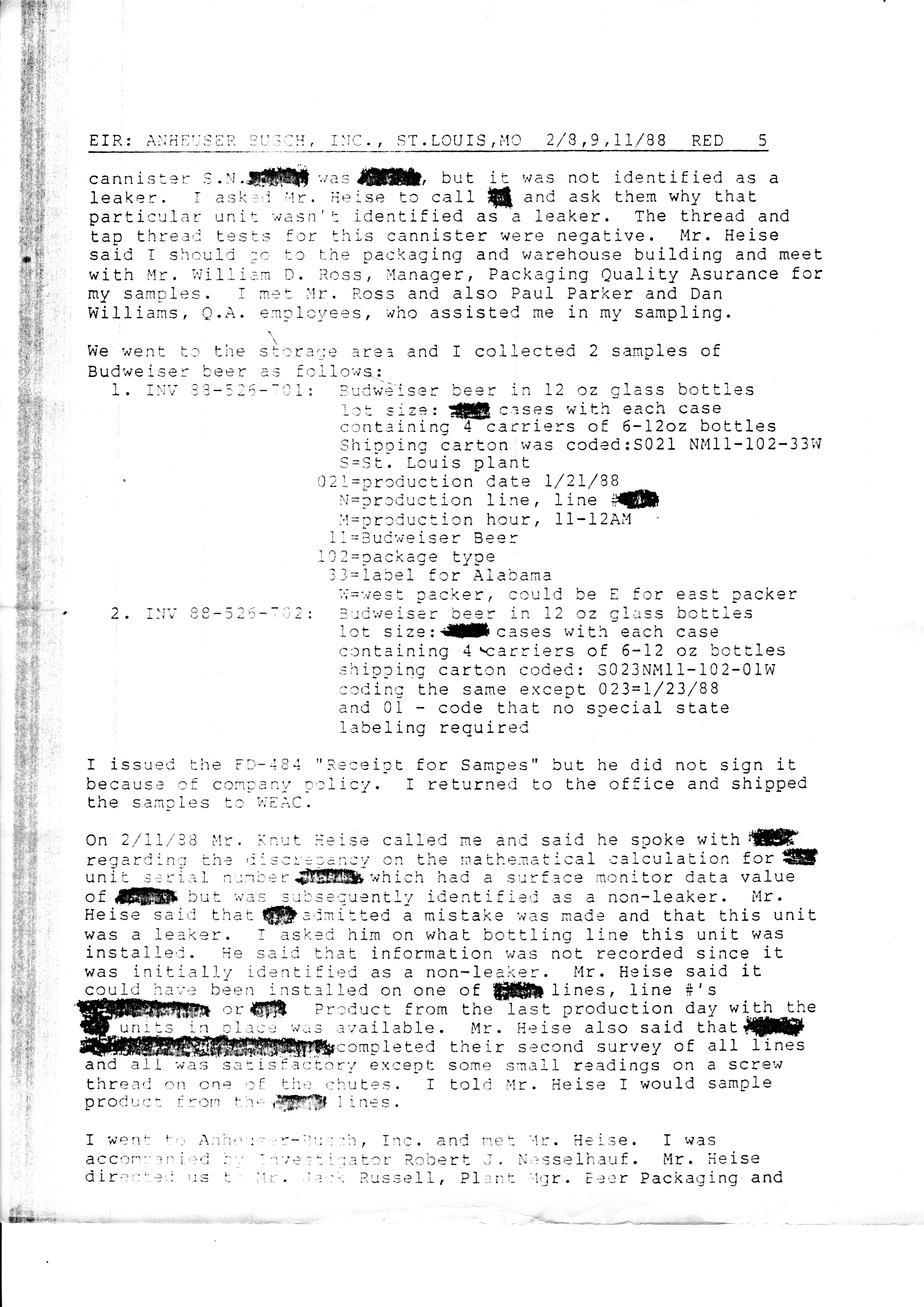

The first page of a 1988 FDA report on the leak of Polonium-210 from static air eliminators at the Anheuser-Busch brewery in St. Louis. The leaks occurred on the bottle lines not in laboratories as reported in the St. Louis Post-Dispatch.
In 1988, a radioactive leak occurred at the Anheuser-Busch brewery in St. Louis, potentially overexposing both brewery workers and consumers. You probably never heard of the incident. You’re not alone.

The first page of a 1988 FDA report on the leak of Polonium-210 from static air eliminators at the Anheuser-Busch brewery in St. Louis. The leaks occurred on the bottle lines not in laboratories as reported in the St. Louis Post-Dispatch.
The media stir several years ago caused by the poisoning death of former Russian spy Alexander Litvinenko in London focused attention on Polonium-210, the radioactive isotope thought to have killed him. The chief suspect in the case is Russian President Vladimir Putin, who Litvinenko accused of orchestrating his assassination shortly before he died.
The story of Litvinenko’s mysterious death has all the ingredients of a bestselling thriller worthy of Ian Fleming or Tom Clancy. The quantity of Polonium-210 used to kill the ex-spy was the size of a grain of sand. The poisoning has made headline worldwide. But the potential radioactive contamination of large volumes of beer at the Anheuser-Busch brewery in St. Louis in 1988 received far less scrutiny.
Polonium-210 was also the subject of concern in that case. Government inspectors determined that static air eliminators used on production lines at the brewery were found to be leaking the nuclear material for an unspecified length of time. But when the St. Louis Post-Dispatch reported the problem it downplayed the health risks to workers and consumers and misrepresented where the contamination took place.
Radioactive leaks also occurred at other St. Louis area companies, including McDonnell Douglas Corp., which sent some of its workers home after the leaks were discovered. 3M Corp. of Minneapolis produced the faulty devices that caused the hazard.
The Post-Dispatch first broached the subject on Saturday Feb. 6, 1988. In its initial story by staffers Peter Hernon and Theresa Tighe, the newspaper reported leaks in laboratories at McDonnell-Douglas. Three days later, a page one story by Christine Bertelsen reported on the radioactive contamination at Anheuser-Busch and elsewhere. The second paragraph of that story said: “Officials at Anheuser-Busch insisted that ‘absolutely no health hazard existed.” The story goes on to quote a brewery spokesman denying any risk: “There was no effect whatsoever on product quality. … No plants were shut down.”
Indeed, work continued uninterrupted at the brewery and unlike McDonnell-Douglas no workers at Anheuser-Busch were sent home or tested.
Bertelsen’s story said that “areas contaminated with low-level emissions were cleaned last week.” But the story gave no indication of where the leaks occurred. After the front-page coverage on Feb. 9, 1988, the story all but died in St. Louis. Three days later, on Feb. 12, 1988, then-Post reporter Joan Bray filed a story buried on page 4-C with the obituaries that reported further recalls of faulty 3M static air eliminators. Bray inaccurately reported that “laboratories where the devices were used at Anheuser-Busch … have been decontaminated.”
The faulty static air eliminators weren’t used in laboratories, however. Instead, the devices were used in the production process to dust the inside of bottle caps before they were placed on the full bottles of beer coming out of the fillers.
Obviously, radioactive isotopes leaking at a point in the assembly lines where the filled beer bottles were capped posed a greater risk to consumers and workers then if the devices had merely leaked in laboratories. Whether the ceramic coating surrounding the radioactive pellets would lessen the risk of exposure wasn’t cited.
I worked as a beer bottler at the Anheuser-Busch brewery in St. Louis in 1988. When I learned that the leaks occurred on the bottling units and not in laboratories as reported by the Post-Dispatch, I called reporter Christine Bertelsen and informed her.
She didn’t follow up on my tip.
More than two years later, Bertelsen did, however, report that the Nuclear Regulatory Commission was seeking to fine 3M $160,000 over the defective devices. Her story wrongly identified the radioactive isotope that had leaked out of the devices as “polonium-20.”
In March 1988, the NRC denied my Freedom of Information request on the radioactive leaks at Anheuser-Busch in St. Louis, but the Food and Drug Administration released a partially redacted report of its limited inspection.
The inspection was categorized by FDA as “limited” because it did not independently test all of the suspected devices but relied largely on information provided by the NRC and Anheuser-Busch. Moreover, by blacking out the unit numbers in its report the FDA made it difficult, if not impossible, to determine which batches of beer may have been contaminated. Nonetheless, it is clear from the report that more than one bottle unit had operated with faulty static air eliminators that spewed Polonium-210. The copy of the report indicates that the FDA uncovered another bottle unit had been contaminated, which was overlooked by the NRC and Anheuser-Busch.
The FDA report says that Knut Heise, then-associate general counsel for Anheuser-Busch, “admitted that a mistake was made,” by the company when it failed to initially identify the other faulty device that leaked Polonium-210. Led by Anheuser-Busch quality assurance employees, the FDA reported that it took samples of the various brands of Anheuser-Busch products for testing. The results of those tests are not contained in the report.
St. Louis-based FDA investigators Robert E. Davis and Robert Nesselhauf signed the report dated Feb. 12, 1988. The random samples taken would only represented a small fraction of the beer that could have potentially been contaminated.
Cleaning crews washed the contaminated surfaces down with water and the walls and columns were repainted. Work went on as usual and beer continued to be bottled, packaged and shipped 24 hours a day, seven days a week.
Since then, of course, many Anheuser-Busch employees have died of cancer, and ingesting or breathing Polonium-210 can cause cancer. But no epidemiological studies have ever been conducted to determine whether a correlation exists that would link the leaks to cancer clusters in the work place.
Looking back on it, it’s almost like the radioactive incident at the St. Louis brewery in 1988 never happened. Almost.
caused by the poisoning death of former Russian spy Alexander Litvinenko in London focused attention on Polonium-210, the radioactive isotope thought to have killed him. The chief suspect in the case is Russian President Vladimir Putin, who Litvinenko accused of orchestrating his assassination shortly before he died.
The story of Litvinenko’s mysterious death has all the ingredients of a bestselling thriller worthy of Ian Fleming or Tom Clancy. The quantity of Polonium-210 used to kill the ex-spy was the size of a grain of sand. The poisoning has made headline worldwide. But the potential radioactive contamination of large volumes of beer at the Anheuser-Busch brewery in St. Louis in 1988 received far less scrutiny.
Polonium-210 was also the subject of concern in that case. Government inspectors determined that static air eliminators used on production lines at the brewery were found to be leaking the nuclear material for an unspecified length of time. But when the St. Louis Post-Dispatch reported the problem it downplayed the health risks to workers and consumers and misrepresented where the contamination took place.
Radioactive leaks also occurred at other St. Louis area companies, including McDonnell Douglas Corp., which sent some of its workers home after the leaks were discovered. 3M Corp. of Minneapolis produced the faulty devices that caused the hazard.
The Post-Dispatch first broached the subject on Saturday Feb. 6, 1988. In its initial story by staffers Peter Hernon and Theresa Tighe, the newspaper reported leaks in laboratories at McDonnell-Douglas. Three days later, a page one story by Christine Bertelsen reported on the radioactive contamination at Anheuser-Busch and elsewhere. The second paragraph of that story said: “Officials at Anheuser-Busch insisted that ‘absolutely no health hazard existed.” The story goes on to quote a brewery spokesman denying any risk: “There was no effect whatsoever on product quality. … No plants were shut down.”
Indeed, work continued uninterrupted at the brewery and unlike McDonnell-Douglas no workers at Anheuser-Busch were sent home or tested.
Bertelsen’s story said that “areas contaminated with low-level emissions were cleaned last week.” But the story gave no indication of where the leaks occurred. After the front-page coverage on Feb. 9, 1988, the story all but died in St. Louis. Three days later, on Feb. 12, 1988, then-Post reporter Joan Bray filed a story buried on page 4-C with the obituaries that reported further recalls of faulty 3M static air eliminators. Bray inaccurately reported that “laboratories where the devices were used at Anheuser-Busch … have been decontaminated.”
The faulty static air eliminators weren’t used in laboratories, however. Instead, the devices were used in the production process to dust the inside of bottle caps before they were placed on the full bottles of beer coming out of the fillers.
Obviously, radioactive isotopes leaking at a point in the assembly lines where the filled beer bottles were capped posed a greater risk to consumers and workers then if the devices had merely leaked in laboratories. Whether the ceramic coating surrounding the radioactive pellets would lessen the risk of exposure wasn’t cited.
I worked as a beer bottler at the Anheuser-Busch brewery in St. Louis in 1988. When I learned that the leaks occurred on the bottling units and not in laboratories as reported by the Post-Dispatch, I called reporter Christine Bertelsen and informed her.
She didn’t follow up on my tip.
More than two years later, Bertelsen did, however, report that the Nuclear Regulatory Commission was seeking to fine 3M $160,000 over the defective devices. Her story wrongly identified the radioactive isotope that had leaked out of the devices as “polonium-20.”
In March 1988, the NRC denied my Freedom of Information request on the radioactive leaks at Anheuser-Busch in St. Louis, but the Food and Drug Administration released a partially redacted report of its limited inspection.
The inspection was categorized by FDA as “limited” because it did not independently test all of the suspected devices but relied largely on information provided by the NRC and Anheuser-Busch. Moreover, by blacking out the unit numbers in its report the FDA made it difficult, if not impossible, to determine which batches of beer may have been contaminated. Nonetheless, it is clear from the report that more than one bottle unit had operated with faulty static air eliminators that spewed Polonium-210. The copy of the report indicates that the FDA uncovered another bottle unit had been contaminated, which was overlooked by the NRC and Anheuser-Busch.
The FDA report says that Knut Heise, then-associate general counsel for Anheuser-Busch, “admitted that a mistake was made,” by the company when it failed to initially identify the other faulty device that leaked Polonium-210. Led by Anheuser-Busch quality assurance employees, the FDA reported that it took samples of the various brands of Anheuser-Busch products for testing. The results of those tests are not contained in the report.
St. Louis-based FDA investigators Robert E. Davis and Robert Nesselhauf signed the report dated Feb. 12, 1988. The random samples taken would only represented a small fraction of the beer that could have potentially been contaminated.
Cleaning crews washed the contaminated surfaces down with water and the walls and columns were repainted. Work went on as usual and beer continued to be bottled, packaged and shipped 24 hours a day, seven days a week.
Since then, of course, many Anheuser-Busch employees have died of cancer, and ingesting or breathing Polonium-210 can cause cancer. But no epidemiological studies have ever been conducted to determine whether a correlation exists that would link the leaks to cancer clusters in the work place.
Looking back on it, it’s almost like the radioactive incident at the St. Louis brewery in 1988 never happened. Almost.

Mallinckrodt radioactive waste generated in St. Louis ended up at the Lake Ontario Ordinance Works in upstate New York
Between 1944 and 1950, radioactive materials produced as part of the Manhattan Project by Mallinckrodt Chemical Works of St. Louis were secretly shipped to a site near Love Canal in New York state, according to a long-forgotten investigative story by the New York Times.
The contaminated site, ten miles north of Niagara Falls, was the original location of the Lake Ontario Ordinance Works. The Times published the details of the environmental quagmire in June 1980, more than 35 years ago.
In its investigative report, the Times revealed that more than 20,000 tons of radioactively contaminated materials were transferred from uranium refining operations in Townawanda, N.Y. and St. Louis. Mallinckrodt purified uranium for the first atomic bombs manufactured in World War II, and continued the operations for 20 years during the Cold War.
Much of the uranium was known as Belgian Congo pitchblende, the purest form of the ore. During World War II, the Congo was still a colony of Belgium. Under an agreement with the U.S. Army Corps of Engineers, the Belgian-government-owned African Metals Corp. retained ownership of the valuable minerals found in the residue after processing.
Radioactive waste from Mallinckrodt is also known to have contaminated sites in St. Louis County, Mo.; Canon City, Col.; Fernald, Ohio and elsewhere. Before Mallinckrodt began its uranium refining operations it, it procured a waiver for all liability from the U.S. government.


Same Old, Same Old: Profiteering and Political Cronyism Presaged the Dumping of Radioactive Waste at West Lake Landfill
In 1969, the city of Bridgeton paid more than $200,000 for a 26-acre tract of land now known as the Bridgeton Athletic Complex (BMAC). The beneficiary of the land deal was an investment group headed by the late Kenneth Davis, co-owner of B&K Construction, the company responsible for later dumping tons of radioactively contaminated dirt at nearby West Lake Landfill.
Foes on the Bridgeton Council then estimated that investors made nearly a 100-percent profit on the deal, according to Bridgeton City Council minutes uncovered by STL Reporter.
Opponents also raised questions as to whether politics played a role in the lucrative transaction. Their suspicions centered on the cozy relationship between then-St. Ann Mayor Clarence Tiemeyer, one of the other investors in the land deal, and his frequent business partner Kenneth Davis, the co-owner of B&K. Tiemeyer was then considered the most powerful municipal leader in North St. Louis County.
The Bridgeton land deal transpired during the scandal-ridden mayoral administration of Earl Davis (no known relation to Kenneth Davis). Mayor Davis was indicted in 1969 by the St. Louis County prosecutor for bribing a land developer in a separate scheme. He was acquitted of that charge.
The BMAC ball fields became a point of controversy again last year, when a group of community activists charged that soil samples indicated the presence of Lead 210, a radioactive isotope at the site.
After the activists announced their findings in May 2014, then-Bridgeton Mayor Conrad Bowers and EPA officials dismissed the evidence as unscientific and assured the public that the athletic fields were safe for use. Subsequent testing by the EPA confirmed the presence of radiation above background levels at the site but not exceeding the agency’s standard of remediation.
Activists countered by disputing the EPA’s methods and protocols.
Despite the recent attention, the history of the property has been largely ignored.
B&K Construction of St. Ann, Mo. dumped the radioactively contaminated materials at the landfill in North St. Louis County in 1973 while working under contract for the Cotter Corp. of Colorado.
Robert and Kenneth Davis, two brothers, formed B&K in 1954. During the long tenure of St. Ann Mayor Clarence Tiemeyer, the company maintained a profitable relationship with the city, receiving a raft of contracts for street repairs. In return, Kenneth Davis helped raise money for the mayor and his political allies.
Tieymeyer and Davis had other close ties, too, including sitting on the board of directors of Cherry Hills Country Club and Colonial Bank. The same bank would later be revealed to be the depository of Bridgeton Park Department funds even though it paid below average interest rates on the money.
A report issued by the Atomic Energy Commission in 1970 indicated that B&K employed off-duty police officers to guard the facility, which raises questions as to the possible complicity of local law enforcement in the illegal dumping, which has never been thoroughly investigated.
Tiemeyer was a political ally of the late Rep. Robert Young, who maintained an office in the same strip mall as B&K’s headquarters on Cypress Road. Young, a Democrat and a member of the politically powerful steamfitters union, served in the state legislature before becoming a U.S. congressman. In the early 1970s, press accounts revealed that Irene Young, the congressman’s wife, received payments from the city of St. Ann for acting as an insurance agent for the city.
During this period, Young’s union — Local 562 — held sway over politics in North St. Louis County, while its leadership was known to have ties to organized crime.

Monsanto Asked Bridgeton to OK Burning Toxic Waste at West Lake Landfill in 1969
When the West Lake Landfill in Bridgeton, Mo. is mentioned nowadays, it is most often associated with radioactive waste produced by Mallinckrodt Chemical of St. Louis, and the underground fire raging nearby. But records uncovered by STL Reporter indicate another locally-based chemical behemoth had earlier burning desires for the West Lake property.
Bridgeton City Council minutes from May 7, 1969 state that representatives of the Monsanto Chemical Co. asked the council to approve an application for a permit to run a pilot plant at the West Lake Quarry. The quarry and the landfill were then two parts of the same operation.
Monsanto spokesmen Evan Robert and Ted Bielski told the council that Monsanto had formed a new business enterprise earlier that year to address an array of pollution problems. The plant would “heat material in enclosed chambers and the residue will come out a sterile product,” according to the council minutes.
At the same meeting, the St. Louis County Health Commissioner told council members that the county had already issued an air pollution permit for the pilot plant, which was expected to operate for the remainder of 1969.
The minutes lack details of the proposed plant, but appear to outline plans for Monsanto to operate an incinerator at the location.
Prior to presenting the proposal to the council, Monsanto would have almost certainly have negotiated an agreement with West Lake’s owners. West Lake’s operation already included a cement kiln, which could also have served as a possible waste incinerator.
Councilman Edward Boenker, the owner of an adjacent farm, asked whether Monsanto intended to use waste from the landfill. The minutes do not indicate whether the company representatives responded to the question.
The Monsanto representatives did say that laboratory tests had already been conducted and field testing was necessary. “The end result will be a totally sterile landfill,” according to the council minutes. They estimated that the pilot plant would treat between 50 and 100 tons daily. Nothing in the document says specifically what kinds of wastes would be treated. But the Monsanto representatives did describe the end product as “sterile,” which suggests that the untreated waste was harmful.
In the late 1960s, Monsanto produced a component of Agent Orange, a defoliant used by the U.S. military during the Vietnam war. Dioxin, is a toxic waste byproduct of Agent Orange. The EPA later discovered that dioxin contamination the town of Times Beach, Mo. and dozens of other sites in Eastern Missouri and incinerated it. The clean-up of those sites took decades to complete.
Monsanto also did work for the Atomic Energy Commission during the Cold War at Clinton Laboratories in Oak Ridge, Tenn. and Mound Laboratories in Miamisburg, Ohio.

The Pattonville Fire Protection District, which is responsible for protecting such diverse properties as the St. Louis Rams’ practice field and Republic Services’ nuclear waste dump, is insured by Arch Insurance Co. based in Bermuda.
At first glance, the Arch Insurance Co. looks like a local firm. After all, it indemnifies the Pattonville Fire Protection District in North St. Louis County and it shares the name with the world’s tallest roadside attraction.
But the name of the company is misleading. It’s not based in St. Louis. It’s not even headquartered in the United States. Instead, it’s located 1,500 miles away in middle of the Atlantic Ocean on the island of Bermuda, a British territory famous for short trousers and skirting taxes.
Arch Insurance is a subsidiary of Arch Capital Group, a multi-billion-dollar financial services firm. Arch Capital, in turn, is joined at the hip with Watford Re Ltd, which also uses the island as a tax haven. Watford’s investments are managed by High Bridge Principle Strategies, which is wholly-owned subsidiary of J.P. Morgan Chase, the global investment giant.
High Bridge was set up in last year following the 2013 crash of J.P. Morgan’s value. The nosedive occurred after the bank’s London branch lost $22 billion.
The influence of such a global powerhouse on a local community and its politics is never directly seen, of course.
It’s not even acknowledged.
Tax records suggest access by a giant trash-hauler to landlocked property inside an EPA Superfund site in Bridgeton may be due to special dispensation granted by the Catholic Church. But nobody is confessing to such a Faustian pact.
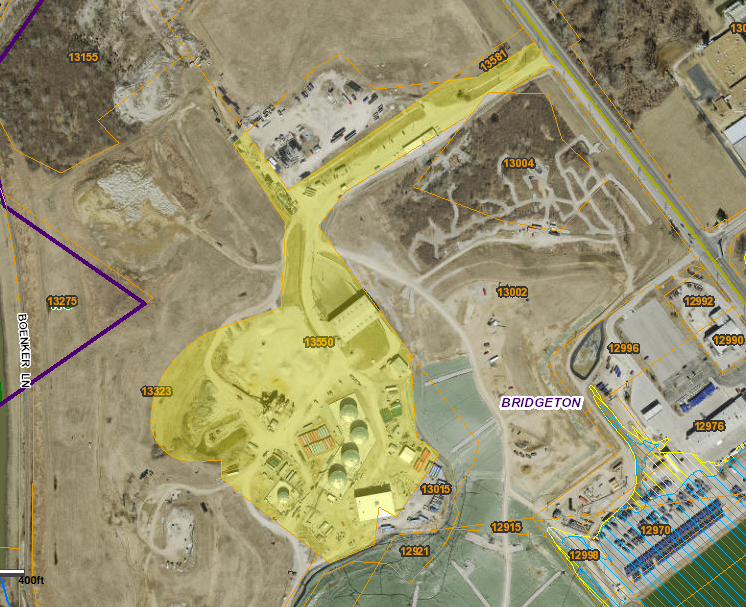
St. Louis County property tax records indicate that the more than 20 acres shaded in yellow inside the West Lake EPA Superfund site are owned by West Lake Quarry & Material Co., which is owned by the Catholic Church.
The EPA website dedicated to the radioactively-contaminated West Lake landfill in Bridgeton offers a vague description of the Superfund site, describing its size as “approximately 200 acres.”
In that sense, the boundaries of the site are as uncertain as the exact location of the nuclear waste itself. On one hand, the uncertainty is due to the failure of the federal regulatory agency to pinpoint the hot spots. That failure comes despite 40 years of oversight.
But there is equal ambiguity related to the history of the impacted properties themselves and their current ownership status. It’s a mystery that the EPA and others, including the St. Louis Archdiocese, don’t seem to want to talk about.
As usual, the devil is in the details, and in this case the details involve the Catholic Church.
St. Louis County land records indicate that the main road leading into the site, as well as more than 20 acres in its interior are still owned by the West Lake Quarry & Material Co. The church took over the quarry operations after the business was bequeathed to it decades ago. Quarry operations ceased years ago, but the corporation itself remains active and charities tied to the church own the company.
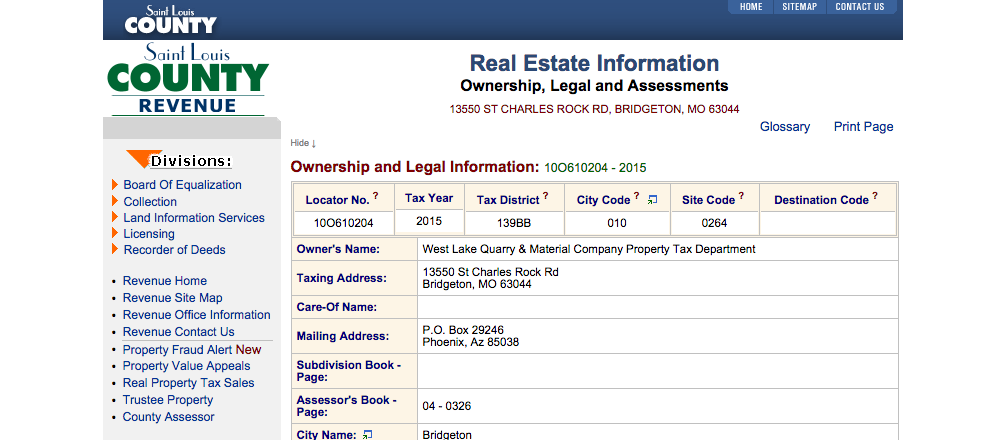
St. Louis County real estate records indicate that the West Lake Quarry & Material Co. is the owner of land inside the EPA West Lake Superfund site in Bridgeton. The quarry company is owned by the St. Louis Archdiocese, but the tax bill is sent to a post office box in Phoenix.
In short, the church in this case holds the keys not to heaven but a radioactive waste dump, according to the county records. But this is where it gets murkier.
Tax records reveal that the tax bill is not sent to the archdiocese or any other identifiable church entity. Instead, the tax bill is sent to an anonymous post office box in Phoenix, Ariz., the headquarters city of site owner Republic Services, a responsible party for the EPA cleanup. Since acquiring the property more than a decade ago, Republic has closed other operations, but continues to use the site as a transfer station.
A corporate registration report filed earlier this year with the Missouri Secretary of State’s office shows the president of West Lake Quarry as William Whitaker, a retired mining engineer who lives in O’Fallon, Mo. St. Louis attorney Bernard C. Huger is listed as the secretary of the corporation. The same two individuals are now the sole members of the board of directors. Both men say they have represent the church’s interests in the company.
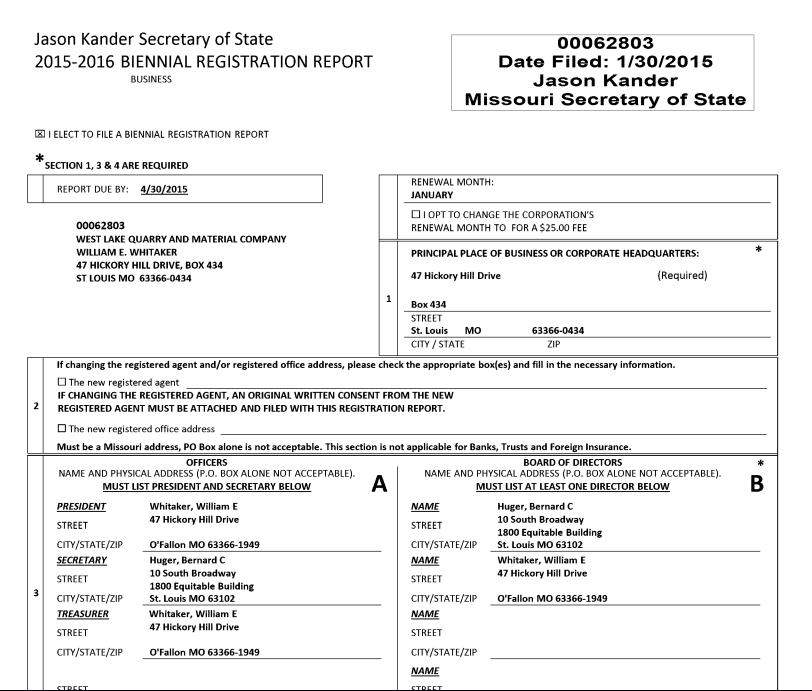
Missouri Secretary of State records from this year show the officers and board members of the West Lake Quarry & Material Co. are longtime representatives of the Catholic Church.
After the church was bequeathed the company, it needed a qualified person to run the business. “They found me 1,200 feet underground,” says Whitaker, who previously supervised a lead mine near Viburnum, Mo. When he took over, the West Lake Quarry was one of a number of holdings owned by the company.
“All of a sudden they (the church) owned a bunch of quarries and they had nobody to run the operation because the owner who was running it had passed away,” recalls Whitaker. “They asked me if I would come up and run the operation. I’ve been in the mining business since 1960, how many years is that?”
When informed that the company was still on the St. Louis County property tax rolls, Huger expressed surprise and attributed it to governmental error. “I think we sold all that and they don’t have the records right. I don’t know. But that’s a long time ago. I think it’s all long since been sold.”
But a clerk for the St. Louis County Recorder of Deeds office told StlReporter that property tax recipients were based on information contained in the property deed, and the quarry company’s name appears on the tax bill.
“The quarry is not operating but we keep it open just in case anything would come up from time to time,” Huger says. “There might be some workmen’s comp case come up. Someone might make a claim that (was) an employee. We had one of those a couple years ago. We just keep it open. But it’s really not active. It’s not doing any active business. Let’s put it that way.”
The current shareholders “are several Catholic institutions,” says Huger. He estimates that the business has been dormant 20 years. “I don’t know the exact date. But it’s been a very long time,” he says. At the time the previous owners willed the business to the church, it was a thriving concern. “West Lake Quarry and Material Co. was a big quarry operator with quarries up and down the Missouri and Mississippi Rivers,” says Huger. “The company had towboats and barges.” Incorporation records show that the company’s barge fleeting operations extended southward to states bordering the Mississippi from St. Louis to New Orleans.
Spokespersons for the St. Louis Archdiocese, the EPA and Republic Services refused to comment.
Why Republic Services, a responsible party for the cleanup, is allowed to conduct a profit-making business inside the site remains a matter of debate. While church and state remain mum on the issue, the question elicited a series of responses at a recent monthly meeting of the West Lake Community Advisory Group (CAG), which acts as a liaison with the EPA.
“I don’t know if the actual road that goes to the transfer station is (part of) the Superfund,” says Ed Smith of the Missouri Coalition for the Environment. “That’s not something I’ve thought about before. So it’s possible that the road is not a Superfund (site).”
Matt LaVanchy, an assistant chief of the Pattonville Fire Protection District, expressed little doubt where the lines are drawn. “It’s my understanding that the areas that are impacted by the radiological material are under the oversight of the EPA,” says LaVanchy.
One thing is for sure: While the public remains confused over the issue, Republic trash trucks continue to roll in and out of the site as if they have God on their side.

first published in the Journal of Decomposition, Aug. 8, 2012
Attorney Joseph V. Neill, a member of the St. Louis police pension board appointed by Mayor Francis Slay, will receive up to a 10-year tax abatement for rehabbing his law office on Hampton Avenue, according to a bill filed in the Board of Aldermen.

On May 22, an ordinance introduced by16th-Ward Ald. Donna Baringer blighted Neill’s property, thereby creating a redevelopment area. Under the law, blighting the property for redevelopment is in the “interest of the public health, safety, morals and general welfare of the people of the city.”
In this case, blighting is also in the interest of the property owner, JVN & Company, a limited liability corporation set up by Neill in 2009, which also includes four other attorneys that practice law at 5201 Hampton.
Baringer defends her legislation by saying that it is for the common good.
“The 16th Ward’s business district is 50 years old and in need of assistance for the deteriorating buildings,” Baringer told the Journal of Decomposition. “Joe Neill has been active in our neighborhood for many years and is liked and respected. I took this piece of legislation before the St. Louis [Hills] Neighborhood Association before introducing it, and they had voted in favor of it.”
Records on file with the St. Louis Assessor’s Office show JVN & Company paid $7,440.33 in annual property taxes in November 2011. Under the terms of the proposed abatement, the commercial property will be frozen at its pre-improved assessed value of $84,100 for the next decade.
“It’s not like we’re not paying anything,” says Neill. “We’ll be paying, a substantial amount of taxes, whatever the real estate taxes were before. We did a gut rehab on the place. We made substantial improvements to it. Basically, we took what was an eyesore and it’s now going to be a nice looking building. That’s the purpose of tax abatement – not to penalize somebody for taking something that’s an eyesore and making it into a better product.”
To accomplish their goal, Neill says he and the other lawyers pooled their money to buy the building through JVN & Company, the limited liability corporation he formed. When finished, the plan is to lease the office space back to themselves from the corporation. Neill estimates that the exterior work could possibly be completed within two weeks.
The expanded law offices will replace a hodgepodge of storefronts in the 5200 block of Hampton. “There were four or five different storefronts,” says Neill. “There was stucco, there was tile, there was brick, there was wood. When we’re done, it’s going to be a uniform front of brick.”
Neill says he considers his trusteeship of the police pension a civic duty. Moreover, he sees no conflict of interest between his serving at the behest of the mayor on the pension board since 2006, and being granted a tax abatement by City Hall. “I’ve never talked to the mayor about this abatement and I don’t think the mayor has any input on it,” says Neill. “It’s an aldermanic thing.”

Besides Neill, the mayor also appointed Tom Stoff to the board of trustees of the St. Louis Police Retirement System. Stoff has worked as an aide to incumbent city treasurer Larry Williams, who is bowing out after more than 30 years in office. William’s leave-taking comes in the wake of federal charges issued last year against Fred W. Robinson, a city Treasury employee accused of having a no-show job.
The seven-member police pension board also includes the president of the St. Louis Board of Police Commissioners, the assistant city comptroller, and three representatives from the police department.
Control of the police pension fund has long been a contentious issue between Slay and the St. Louis Police Officers Association, the labor organization that represents the majority of city cops. Voters will likely decide in November on whether to take control of the St. Louis Metropolitan Police Department away from the state and give it to the city. In the past, the police union has opposed the change. The push to get the measure on the ballot was spearheaded by an A Safer Missouri, an advocacy group bankrolled by right-wing billionaire Rex Sinquefield.
Neill is no stranger to public service or the controversy that sometimes accompanies it. The late Gov. Mel Carnahan appointed him to the St. Louis Election Board in 1994. He held the post until 2001, when he resigned in the midst of an investigation into voter fraud. Neill was not a subject of the investigation.
Prior to his election board duties, Neill served on the judicial panel that picks finalists applying for open seats on the St. Louis Circuit Court bench. Two of Neill’s siblings,Margaret and Mark Neill, who are twins, are currently judges in the city circuit court. Joseph V. Neill did not sit on the judicial panel when either of them were nominated.
Before taking the bench, Mark Neill also practiced law at the Hampton Avenue address that his brother Joseph V. Neill still shares with four other attorneys.
Earlier this year, one of those attorneys — John Bouhasin — appealed a municipal court decision in Judge Mark Neill’s courtroom. Judge Neill ruled in favor of Bouhasin’s client, overturning the lower court’s ruling that had revoked the liquor license of Washington Avenue nightclub owner by Aprille Trupiano, daughter of the late mafia boss Matthew Trupiano. Mayor Slay’s administration favored the revocation.

In 2003, Bouhasin, a former assistant city counselor, was one of the subjects of a police internal affairs investigation, according to the St. Louis Post-Dispatch. The inquiry centered on allegations of a high-ranking police officer interceding to fix a DUI ticket of a longtime drug informant.
Another attorney with his name painted on the door at 5201 Hampton — Thomas R. Carnes — was placed on one-year probation and ordered to pay a $1,000 fine in June 2011 by the Office of Chief Disciplinary Counsel of the Missouri Supreme Court for violations of professional conduct. Carnes had previously been reprimanded in Missouri and Illinois for misconduct in 2006.
first published in the Journal of Decomposition, Aug. 20, 2012
“They need to get them cans out of the alley,” said the city worker, who sat behind the wheel of the big orange trash truck. The “cans” to which he referred are the blue dumpsters that now compete not only for space but also business with the St. Louis Refuse Division.

Two years ago, the city began charging property owners for trash pick up. The fee is $11 a month per unit. That amounts to $462 a year in additional expenses for the owners of four-family apartments. Under the ordinance, property owners can cancel the service if they show proof that they are having a private company haul the trash instead of using the city service.
After permitting private trash pick up, the law stipulates that the city will “inspect the property thereafter to confirm that the waste in fact is being collected.” But that’s not what’s happening in the 6300 block of Sutherland Avenue in the St. Louis Hills neighborhood, where trash has been accumulating for months. Plastic bags of rotting garbage have been festering all summer. The trash is now overflowing and spilling into the alley.
When contacted on Wednesday, Aug. 15, 16th-Ward Alderwoman Donna Baringer advised Chris Howard, the city’s neighborhood stabilization officer, to contact Allied Waste about emptying the neglected dumpsters. Allied Waste is owned by Republic Services.
In response to a constituent’s email, Howard promised to act swiftly. “This appears to be a serious problem and I will do my best to rectify this asap,” wrote Howard.
Since the issue was brought to the attention of Baringer and Howard, the city refuse division has emptied its dumpsters twice, according to its regular schedule. But the Allied dumpsters remain full. The continued neglect of Allied Waste to collect the trash is attracting rodents and creating a public health problem in the immediate vicinity of the dumpsters.
Spokespersons for the mayor’s office and the Street Department could not be reached for comment. Allied Waste also could not be reached for comment. The introduction of competing privatized trash services without sufficient oversight or regulation has thrown a monkey wrench into the city’s otherwise efficient trash disposal service.
The overloaded dumpsters are located behind 6325-6327 Sutherland Avenue. That building is owned by a trust in the name of G. David Voges. Voges, 64, is the heir to a St. Louis real estate fortune. He lives at 20 Log Cabin Lane in Ladue. Voges has participated in the past in a real estate awards program sponsored with the Regional Commerce and Growth Association. The program was implemented to spur positive publicity for the St. Louis real estate market. Voges’ late father, George F. Voges, was a longtime member of the Missouri Athletic Club, the exclusive businessmen’s organization.
No one answered the phone at Voges’ Ladue residence when an effort was made to contact him.
In 1998, the city cited a rental property owned by Voges because one of his tenants was living with 56 cats. The stench from the cat feces prompted neighbors to alert the city to the problem. Voges was quoted in the St. Louis Post-Dispatch as saying that the renter was a good tenant.

Voges also owns an a four-unit apartment at 6445 Nottingham Avenue, a few blocks from his building on Sutherland. Allied Waste has a dumpster at that location, too. The alley is shared with single-family homeowners on adjacent Murdoch Avenue, including Ald. Barginer. Unlike the mess over on Sutherland, however, Allied Waste appears to pick up the trash regularly at the Nottingham address.
Back in the alley on Sutherland, the city trash man used the controls inside the truck to grab a city recycling bin, hoist it in the air and dump it into the back of the trash truck. He then vowed to tell his supervisor about Allied Waste’s neglected dumpsters. But he expressed little confidence that the issue would be resolved in a timely manner.
“The city isn’t going to do anything,” he said. Then he drove slowly away.
 stlreporter