Month: April 2021

Cover Story

A deep dive into the 1978 House Committee on Assassinations’ conspiracy theory on the murder of the Rev. Martin Luther King Jr.
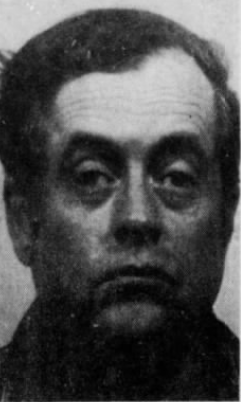
In 1978, Russell G. Byers was fingered as a suspect in a St. Louis Art Museum heist before becoming a witness before the House Select Committee on Assassination’s probe into the murder of the Rev. Martin Luther King.

BY C.D. STELZER
(first published in the Riverfront Times April 8, 1992)

In 1979, the House Select Committee on Assassinations (HSCA) concluded there was a St. Louis-based conspiracy to murder the Rev. Martin Luther King Jr. Evidence gathered by the HSCA has been sealed until 2027. James Earl Ray, the convicted murderer of King, claims the congressional investigation itself was a cover-up.

Ray pleaded guilty to the crime in 1969, but immediately recanted. There has never been a trial. He is now a prisoner at River Bend Penitentiary in Nashville, Tenn. In the preface to Ray’s book, “Who Killed Martin Luther King,” published in 1992, the Rev. Jesse Jackson demands a special prosecutor be named and the case reopened.

The following story centers on the HSCA’s St. Louis-based conspiracy theory and is comprised of information gleaned from Ray’s book, congressional testimony and newspaper accounts.

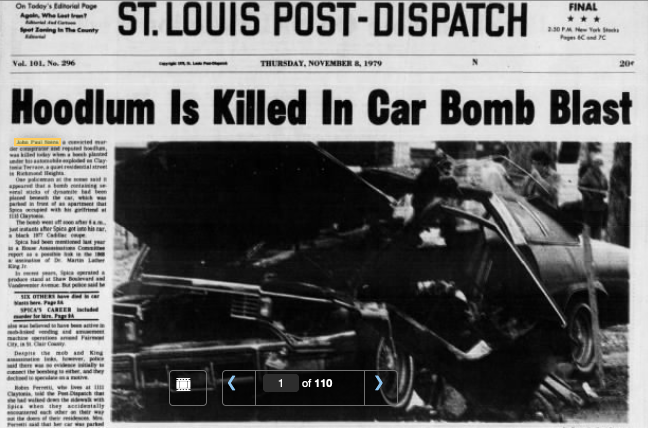
At 7:55 a.m. Nov. 8, 1979, produce man John Paul Spica said goodbye to his girlfriend Dina Bachelier for the last time. He walked out of the two family flat at 1115 Claytonia Terrace in Richmond Heights and stepped into his 1977 black Cadillac. When Spica touched the break pedal, he detonated five to eight sticks of dynamite. The explosion blew both of Spica’s legs off. The driver’s door of the vehicle landed 30 yards away.

Moments later, Wellston police officer Nick Sturghill, saw a bearded white male in a yellow pickup truck speeding away. Spica, who had a speech impediment, mumbled a few unintelligible words to Sturghill before he died.

Spica’s violent death a year after his closed-door testimony before the House Select Committee on Assassinations (HSCA) has long been attributed to a war between competing organized crime elements. for the control of a St. But Spica served time in Missouri Penitentiary with James Earl Ray, and was also the brother-in-law of Russell G. Byers, the committee’s star witness, who testified that there was a St. Louis-based conspiracy to kill the civil rights leader. The HSCA final report concluded that Byers’ allegations were credible.

The HSCA findings suggest that Ray, the convicted assassin, did not act alone, but its findings raise more questions than answers. The doubt begin with the HSCA’s chief witness and Spica’s brother-in law. That’s because in 1978 Byers was the suspected mastermind of a St. Louis Art Museum burglary. He was arrested but never charged with the crime.

Sometime after his arrest, the FBI in St. Louis provided HSCA investigators with Byers’ name after a misfiled 1974 report surfaced, which stated that, according to a confidential informant, Byers had boasted of receiving an offer to kill King.

In 1978, Byers told the HSCA that the offer came from two prominent deceased St. Louisans: former stockbroker John R. Kauffmann and patent lawyer John H. Sutherland, who founded “whites rights” groups locally.

Spica, Byers’ brother-in-law, was a convicted murder contractor himself. Spica had served 10 years of a life sentence for negotiating the 1962 killing of John T. Myszak, a North St. Louis County realtor. Upon parole, Spica opened the Corner Produce, a vegetable stand at Shaw and Vandevanter, which may have been an organized crime front. Spica was known to have ties to the late Anthony Giordano, leader of the St. Louis mafia.

Police believe Spica’s slaying, and subsequent car bombings during the early 80s, began as a power struggle within then-mob-dominated Laborers’ Union Local 42. In a 1987 federal trial here, Raymond H. Flynn, the local’s business manager, was implicated in Spica’s bombing and found guilty of multiple racketeering and conspiracy charges.

But Spica had other interesting associations besides his brother-in law and the mafia: While in a Missouri prison, Spica shared the same cell block with James Earl Ray.

In 1978, after being subpoenaed and granted immunity by the HSCA, Byers publicly testified that in late 1966 or early 1967 he was approached by Kauffmann, a retired stockbroker and former aircraft company owner active in St. Louis County Democratic politics. Byers had been a friend of the elder Kauffmann’s late brother Gil, an assistant St. Louis County coroner. According to Byers’ account, Kauffmann introduced him to a neighbor, John H. Sutherland, an avowed racist who made the $50,000 contract offer to kill King.

At this time, Kauffmann lived in Jefferson County and operated the Bluff Acres Motel on Highway 67 in Barnhart. Byers claimed the motel was actually a front for illegal activities and told the committee he used the premises for his stolen car operations. When asked by the committee whether he had informed Spica of the contract offer to kill King, Byers said he had not, but said that his brother-in-law, who was in state prison at the time, may have learned of the offer through other sources. Also in the same prison at the same time, was James Earl Ray, who was serving a sentence for the robbery of a Kroger’s supermarket on Ohio Avenue in South St. Louis. Both he and Spica, for a brief period, worked in the prison hospital together. Newspaper accounts cite rumors that Spica and Ray were dealing drugs inside.

Interestingly, the prison doctor, with the keys to the medicine chest, was Hugh W. Maxey — an old friend of Kauffmann’s. One shady business Kauffmann operated out of his motel was Fixaco, Inc., a pharmaceutical company. Seven people connected with Fixaco, including Kauffmann, were arrested on April 4, 1967 for conspiracy to illegally sell 725,000 amphetamines pills. Among those charged were two New Yorkers: Bernard Chubet, a former stockbroker and Anthony K. Chang, a Chinese Nationalist (Taiwanese) exchange student. Also arrested was Sgt. Henry Geerdes, a Jefferson County deputy. Former Jefferson County Sheriff Walter “Buck” Buerger claimed his deputy was acting as an undercover agent when arrested by the U.S. Bureau of Drug Abuse Control. However, the HSCA testimony of one of Byers’ former lawyers, the late Murray Randall, indicates the Jefferson County sheriff — not a deputy — purchased drugs from Kauffmann.

Within weeks of Kauffmann’s speed bust, Ray, with another inmate’s help, smuggled himself out of prison in a bread box. Inexplicably, charges against one of his earlier failed escape efforts were dropped not long before the breakout, allowing Ray back into the main prison population.

Fred Wilkinson, the Missouri director of corrections at the time, was a former federal prison official with ties to the CIA. In 1962, Wilkinson helped exchange a Russian spy for Gary Powers, the U-2 pilot shot down over the Soviet Union.

Ray wasn’t the only one taking leave of the prison in those days. Maxey, the prison physician, released at least one inmate to work at Kauffmann’s motel as part of a “rehabilitation program.” And in a 1978 interview, Kauffmann’s widow said that in 1966, Spica visited the motel with Byers, while Spica was serving his life sentence. According to prison records, Spica received his first official prison furlough in 1972.

The other St. Louis businessman implicated by Byers, in the alleged assassination plot, was the late John H. Sutherland, a neighbor of Kauffmann’s and a patent attorney who had offices in the Shell Building on Locust Street where The Riverfront Times is now located. The firm of Sutherland Polster and Taylor represented clients such as Monsanto. When he died in 1970, Sutherland left a portfolio of mainly oil and chemical stocks worth more than $300,000, including investments in Rhodesia, now Zimbabwe.

In 1978, another St. Louisan was linked to a local firm — Hydro-Air Engineering, Inc. — which was being investigated for illegal trade with the same white-supremacist nation. The allegations came soon after federal Judge William Webster was confirmed as FBI chief. While the African business may be unrelated, Webster had a closer tie to the case, which is harder to dismiss.

Richard O’Hara, an art restorer, was the FBI informant who purportedly reported Byers’ assassination claims in 1974 to the FBI. O’Hara had been arrested in 1972 for his knowledge of a Maryland Plaza jewel robbery. Two suspects in that case were murdered, another was acquitted here in a federal trial racked with improprieties. Judge Webster presided over the questionable judicial proceedings.

Webster and Sutherland also both belonged to the then-all-white Veiled Prophet society. Sutherland’s membership in the organization was posthumously investigated the HSCA the same year Webster’s VP connection was questioned during his Senate confirmation hearings. The reason the HSCA showed interest in the VP was because of Byers’ testimony that Sutherland represented a “secret Southern society,” with a lot of money. The wealthy Veiled Prophet organization was founded in the post Civil War era by Southern sympathizers.

However, the HSCA gave more credence to the theory that one of three overtly racist political groups may have been involved in the conspiracy. The HSCA theorized that word may have been passed to Ray through his family. In 1968, Ray’s brother, John, operated the Grapevine tavern at 1982 Arsenal Street adjacent to Benton Park. The saloon was the gathering place for American Party workers who had a campaign office nearby. The third-party movement was created to support the George Wallace’s presidential bid. Sutherland was a Wallace supporter. Another possibility mentioned by the HSCA was the St. Louis Metropolitan Area Citizens Council, a “whites’ rights” group. Sutherland had been the group’s first president. But the outfit the HSCA took most seriously was the Nashville-based Southern States Industrial Council to which Sutherland belonged. A position paper published by the council quotes FBI chief J. Edgar Hoover’s belief that the “Negro movement” was being subverted by communists.

Making a Killing

Author Gerald Posner scores another bestseller, at the expense of historical accuracy

The wreckage of John Paul Spica’s Cadillac outside his Richmond Heights apartment on Nov. 8, 1979. The previous year Spica gave closed-door testimony to the House committee inquiry into the murder of the Rev. Martin Luther King Jr. Spica’s testimony remains sealed until 2027.( Photo by Jim Rackwitz.)

first published in the Riverfront Times (St. Louis) May 20, 1998

BY C.D. STELZER

In the final chapter of Killing the Dream, Gerald Posner takes the reader inside of the mind of James Earl Ray, the convicted assassin of the Rev. Martin Luther King Jr. This is no small trick considering the author never interviewed Ray, who died shortly after publication of the book in April.

Nevertheless, reviewers have lauded the tome. Anthony Lewis of the New York Times calls it “a model of investigation, meticulous in its discovery and presentation of evidence, unbiased in its exploration of every claim.” The august newspaper columnist is too kind.

In his acknowledgments, Posner himself confesses to succumbing to deadline pressure, spurred no doubt by the publisher, Random House, which opportunely released the book on April 4, the 30th anniversary of the assassination.

To finish his assignment on time, Posner relied heavily on the works of two other authors who have previously written books on the King assassination: William Bradford Huie and George McMillan. Both writers assumed Ray’s guilt. Posner sews their narratives together, patching tatters and frayed edges with suppositions, taking verbal potshots at the convicted murderer whenever possible, repeatedly condemning him for being an ignorant, genetically inferior racist from “the backwaters of Missouri.”

In between personal attacks, Posner refutes, with seeming aplomb, Ray’s alibi, which revolves around being a patsy for Rauol, a mysterious smuggler. Posner then sets about trashing the credibility of all other conspiracy theories concerning the murder of the civil rights leader. He ends by reiterating his foregone conclusion: “There is no doubt that James Earl Ray shot and killed Martin Luther King.”

It is a formula that has proven successful for the author in the past. Case Closed , his 1993 best-seller, sided with the Warren Commission’s questionable conclusion that Lee Harvey Oswald acted alone in the assassination of President John F. Kennedy.

But under scrutiny, Posner’s case against Ray is marred by factual errors and omissions. For instance, he refers to the car-bombing death of John Paul Spica as occurring in the “St. Louis suburb of Richmond.” He further states that the “possibility of learning more from Spica ended” with the explosion.

Posner is wrong on both counts. In reality, Spica, a St. Louis Mafioso, was killed outside his Claytonia Terrace apartment in Richmond Heights. His murder has been attributed to feuding underworld factions vying for control of a labor union here. Before his death, however, he testified in executive session before the House Select Committee on Assassinations (HSCA) in 1978. Spica’s testimony remains sealed under the terms of a congressional edict until 2027. Unsealing these transcripts could yet provide information relevant to the case.

In another instance, Posner refers to the Phoenix Program as a “government campaign against the anti-war movement.” In reality, the Phoenix Program was a CIA-sponsored operation that hunted down and killed suspected communist sympathizers in South Vietnam, during the Vietnam War. After the war, congressional investigators conservatively estimated that more than 20,000 civilians were murdered as a part of the pogrom, which used a computer database to track its targets. Some conspiracy theorists have postulated that a similar operation could have been employed domestically.

Of course, Posner pooh-poohs the possibility of any military or intelligence involvement in the assassination of King. Instead, he holds to a simpler conspiracy theory advanced by the HSCA in 1978. According to the HSCA’s final report, Ray may have received word of an alleged $50,000 bounty on King’s life offered by two St. Louis supporters of segregationist George Wallace.

The problem with confirming this convenient theory is that both men were dead by 1978. Moreover, Russell G. Byers, the HSCA witness, who claimed he received the murder contract, was a suspect in a notorious St. Louis Art Museum burglary that year. Posner conveniently leaves this last detail out of his book, choosing instead to accept the HSCA findings without qualification.

If there is indeed a connection to be made, the motive behind these shadowy associations may have more to do with drug dealing than racist politics. During the mid-1960s, Byers busied himself chopping stolen cars at the Bluff Acres Motel in the burg of Barnhart in then-rural Jefferson County, Mo. While Byers ran the car theft ring, John R. Kauffmann, the motel owner, engaged in other illegal activities. On April 4, 1967, Kauffmann and six others who frequented the site were arrested for the sale of 725,000 pharmaceutical-grade amphetamines pills. Kauffmann just happened to be one of the two men who Byers’ claimed had asked him to kill King.

Meanwhile, Spica — Byers’ brother-in-law — shared the same cell block with Ray at the Missouri Penitentiary. For a while, they worked in the prison hospital together. Hugh W. Maxey, the prison doctor, even granted Spica weekend furloughs to visit a mutual acquaintance — Kauffmann — in Jefferson County. Spica, a convicted murderer, was released on his own recognizance. More curious is the fact that within a couple of weeks of Kauffmann’s drug bust, Ray managed to escape.

Ray’s escape was engineered with the help of a guard, who was part of another drug smuggling ring at the prison, according to John Ray, the brother of James Earl Ray. In an interview last year, John Ray told me that he had acted as an outside drug courier for inmate Carl Drake, during his brother’s incarceration. After James Earl Ray’s prison break, John Ray says he drove his brother back to St. Louis. When they arrived, the two brothers didn’t meet with any George Wallace supporters. Instead, John Ray says they immediately contacted Joe Burnett, a hitman and heroin addict.

Posner fails to report any of this.

Case Not Closed

James Earl Ray’s attorney points his finger at the FBI

Mark Lane and his client James Earl Ray appearing before the House Select Committee on Assassinations in 1978. Lane died in 2016.

first published in The Riverfront Times (St. Louis), April 2, 1997

Mark Lane, former attorney for James Earl Ray, has spent much of his career questioning the official version of events concerning the assassinations of President John F. Kennedy and the Rev. Martin Luther King Jr. He is the author of “Rush to Judgment,”the seminal critique of the Warren Commission., published in 1966. In 1977, he co-wrote, with Dick Gregory ,”Code Name Zorro: The Murder of Martin Luther King Jr.” A revised edition of the latter book was reissued in 1993 under the title ,”Murder in Memphis.”

As founder of the Citizens Commission on Inquiry in the mid 1970s, Lane lobbied Congress to form the House Select Committee on Assassinations (HSCA) . He later, however, became one of the harshest critics of the HSCA’ s findings. Now 70 years old, Lane maintains a private law practice in Washington, D.C. He spoke to The Riverfront Times by telephone about the assassination of the Rev. Martin Luther King Jr. from his office in the nation’s capital.

RFT: Why do you believe the political establishment is so intent upon covering up the evidence in the Martin Luther King murder case?

Lane: Because I think all the evidence points to the FBI. All the black leaders in America have been saying that from the very beginning. Everybody — Ralph Abernathy, Jesse Jackson, Dick Gregory. …

If that is true, why did the FBI want King assassinated?

People can say that the removal of one person doesn’t change history, but the civil rights movement ended with his death. We had riots in cities all around the country, and have never gotten back on track in terms on any serious leadership in that movement. Killing King was very effective in that regard.

We know Hoover hated him. … He hated the idea that King was given the Nobel Prize. Hoover thought he should have gotten one. That was nuts.

We also know Hoover wanted King dead. He sent a tape (recording) to King with the suggestion that he `do the appropriate thing.’ Everybody agreed that what Hoover was saying was, `kill yourself.’ You don’t tell someone to kill himself unless you want him dead. If you have that kind of power, and you want him dead, you might (also) be able to put some wheels in motion.

You represented James Earl before the HSCA in 1978, correct?

I didn’t represent him at the time of the non-trial (in 1969). He was (then) represented by (Arthur) Hanes and then Percy Foreman. But after he was convicted and sentenced to 99 years he then asked me to represent him.
The civil rights movement and black activists wanted a trial, too, because they never believed the story that Ray did it. They believed that it was much more involved. So when Ray heard that I was writing about the assassination, and looking into it, he asked me to represent him. …

I myself was part of the civil rights movement. In fact, as a member of the (New York) state legislature, I was arrested as a Freedom Rider in Jackson, Miss in 1961. I’m the only public official, I think, ever arrested as a Freedom Rider.

Of course, we couldn’t get a trial, although he was entitled to one by Tennessee law. The law says that if you make an application for a new trial and it’s pending and the judge dies or becomes permanently insane, you’re entitled to a trial. That’s what happened in this case. Judge (Preston W.) Battle died, after he got the application from James Earl Ray asking for a trial.

When was that?

Just a couple of days after the plea (in 1969). James wrote a letter (recanting his admission of guilt) at that time.
James was in that cell in Memphis 24-hours a day with lights on him, the room bugged completely the entire time. He was under surveillance for eight months. Finally, when he entered the plea, they put out the lights. He had one night’s sleep, and (then) wrote a letter to Judge Battle saying, `I was coerced into pleading guilty, I’m innocent and I want a trial.’

Battle went away on vacation, came back and dropped dead. That’s when the Tennessee annotated code should have came into play. He was entitled to a trial, but the state court said no in this case. It wasn’t possible because the law has nothing to do with justice when there are big political considerations. We could never get a trial.
Now Ray has asked me again to get information from the (government) under the Freedom of Information Act. His current lawyer Bill Pepper refused to because the King family doesn’t want him to do it.

Why was the HSCA trying to discredit you in 1978?

Because I was representing Ray. It’s kind of ironic since I wrote the legislation that set up the House Committee on Assassinations. I moved to Washington to do that. I got more than a hundred members of Congress to sign the petition to form that committee. I worked closely with Andy Young, then the chairman of the black caucus and his successor Yvonne Burke.

But the pressure was on them. I’ll tell you an example.
Dick Gregory is very well respected by the black leadership in this country. He called me after the Select Committee had been set up, and asked to meet with (U.S. Rep.) Walter Fauntroy at my house. Fauntroy was the delegate from Washington, D.C., and then the chairman of the subcommittee on the King assassination. He had worked with King.

I called Walter and said, `Greg wants to see you tonight at 8, can you come here?’ So they were here in the very same room from which I am in now talking to you. It’s my library on the second floor right across the street from the Supreme Court.

Fauntroy is a minister. … They’re sitting on the coach next to each other and Gregory says, `Let’s pray Walter.’ They both got down on their knees. I was sitting behind my desk watching this moment in history.
Gregory says: `This is the most important man in America — not the most important black man. Give him the courage, the ability to find out who killed Dr. King, and tell the truth to the American people.’ They both said amen and sat back down on the coach.

Walter, the chairman of the investigating committee, looks at Gregory, and says, `We know who did it.’

Gregory says, `Well, good.’

(Fauntroy says,) `We’ve discovered that already.’

Gregory replies, `Well, good. … All you have to do is tell everyone.’
Fauntroy says, `But, Dick, the FBI did it. The FBI is bugging my church, they’re bugging my home, they’re bugging my office. You can’t say what’s on your mind.’

Gregory says, `What do we love about Martin, Walter? He didn’t take private positions and public positions that were different.’

Fauntroy says, `Yeah, and they killed him, and I don’t want to be killed. I’m not going to say it.’

Gregory then looked at me like why did we do all this work to get this committee set up. … So that was the end of the investigation, just as soon as it began.

Didn’t the HSCA fire or dismiss the original head counsel Richard Sprague?

I got Dick Sprague as counsel. They were offering me the job as counsel to investigate the Kennedy assassination. I said, `I don’t think that would be useful because everybody knows my position. … I think you want to start with somebody who is tough and really doesn’t have a set position.’ I suggested Dick Sprague. I didn’t know Sprague, but he had just finished prosecuting Tony Boyle, the head of the United Mine Workers who murdered (dissident union leader) Joseph Yablonski.

So I went down to Philadelphia and spent hours with Sprague, and told him what I thought could be done. … (Then) I went back and I told that to the members of the committee, and they were very excited. … Then I returned to Philadelphia and met with Sprague. We took the train back into Washington, and I introduced him to members of the committee. That day they hired him.

Representatives from the FBI and the CIA (soon) came to see Sprague. They said, `Tell us who you’re thinking about having for your staff, we’ll do background searches. Furthermore, we’ll give you some documents that might help you.’

(Sprague replied:) `You guys are suspects at least in the coverup. You’re not clearing anybody for me. I’m going to back up trucks to your buildings and get all the documents that I want. I’m going to subpoena them. So don’t tell me you’re going to give me some selected documents.’

That started the campaign led by The New York Times and the Washington Post to get rid of Dick Sprague. They finally bounced him out.

The new head counsel Robert Blakey had subpoena power, but never subpoenaed a document. He closed down the investigation.That’s when everything went sour.

The committee decided that it was going to clear everybody. But there were enough members on that committee who had to go back to their districts and try to get re-elected. So while Blakey wanted the position to be that Oswald and Ray did it alone, no one would buy that. Instead, they took the position that there was a conspiracy in each case. But they didn’t know who did it (only that) Oswald and Ray were involved.

They then cleared the FBI and the CIA in a bizarre conclusion in which they said, We don’t know what group did it, but these groups didn’t do it. …

All the HSCA did was eliminate the FBI and CIA as suspects.

The Secret Life of Gunther Russbacher

The convicted felon claims he was a Navy captain, a CIA operative and George Bush’s pilot in the infamous October Surprise Scandal

first published in the Riverfront Times (St. Louis), August 5, 1992

by C.D. Stelzer

JEFFERSON CITY, Mo. — North, south, east and west. The lines in Gunther Karl Russbacher’s brow run in all directions. There appears to be a crease for every one of his 50 years. Deep undulating furrows that register emotional changes across a craggy facial landscape.

I’m trying to catch my breath, I’m not quite with it yet,” says Russbacher, after entering the Control Unit of the Missouri Correctional Facility here. He is carrying a foot-thick binder of court briefs, depositions, memos, diary entries,bills of lading, letters of credit and loading manifests. And while not gasping for air, the heavy paper load makes it easy to believe this man is under stress.

To reach inmate 184306, a visitor must be escorted through three check points and five clanging sets of iron bars. Gunther Karl Russbacher is a prisoner– and not just any ordinary prisoner. But beyond that, no one is sure who he really is. So far, those interested in finding out have included Texas billionaire Ross Perot, the United States Congress and Geraldo Rivera.

In the past, Russbacher has admittedly used aliases such as Emory Joseph Peden,Robert Andrew Walker and Robert Behler. He has also allegedly been known as “The Raven.” The last pseudonym could be classified a nom de guerre, because Russbacher claims to be a Navy captain — and not just any ordinary Navy captain.

Federal authorities arrested him in July 1990 for impersonating a military officer at Castle Air Force Base in Atwater, Calif. The charge led to Russbacher’s probation revocation in St. Charles Co., where he had a 1989 conviction for stealing through deceit. Russbacher pleaded guilty in that case to defrauding clients of the St. Louis-based National Brokerage Companies, which he headed. He received a 21-year sentence. In both of these instances, Russbacher now claims he was carrying out covert duties for the United States government.

By his own account, he is a CIA operative with knowledge of the agency’s involvement in financial fraud, drug trafficking, and illicit arms trading.

Russbacher established National Brokerage and other proprietary companies, including a failed savings and loan in Pennsylvania, at the behest of the CIA, he alleges. He further charges that his military and criminal records — ostensibly altered to infiltrate terrorists and narcotic rings — are now being used against him.

In addition, Russbacher claims his 1990 arrest followed a secret flight to inform Soviet President Mikhail S. Gorbachev of the pending war with Iraq. This would be fantastic enough, but it’s not all. As an aviator attached to the Office of Naval Intelligence, Russbacher says he piloted a BAC-111 aircraft — with George Bush on board — to Paris in 1980. Perhaps more importantly, Russbacher claims to have shuttled Bush back to the United States a few hours later in an SR-71 spy plane — and he professes to have proof.

His knowledge of these events is the real reason he is in prison, Russbacher says. Bush’s French rendezvous purportedly finalized earlier negotiations between the Reagan-Bush campaign and Islamic revolutionaries. Those talks supposedly centered on delaying the release of 52 American hostages then being held by Iran until after the November presidential elections. In exchange for prolonging their captivity, the Iranians were allegedly promised arms and spare parts to supply their burgeoning war with Iraq. According to Russbacher, the Reaganites also forked over $40 million up front to seal the deal.

The move was meant to assure a Republican victory over then-President Jimmy Carter and preempt any “October surprise,” or last-minute administration plan to gain the hostages release.

Russbacher is not the first nor most credible person to make these allegations. Reagan administration member Barbara Honegger published the initial October Surprise book in 1989. In 1990, Gary Sick, a National Security Council member in the Carter administration, renewed interest in the subject through a New York Times op-ed article. Sick followed it up last year with a volume of his own.

Although there seems to be substance to these claims, there is uncertainty as to Bush’s presence at the Paris meetings. Citing Secret Service logs and interviews, the House October Surprise Task Force, a congressional inquiry now under way, dismissed the possibility of president’s participation in an interim report issued June 30. In February, a lengthy analysis by writer Frank Snepp of the Village Voice similarly refuted the premise.

Another writer delving into related scandals didn’t get a chance to jump to any conclusions. Journalist Danny Casolaro was found dead in a Martinsburg, W. Va. motel room last August. The local coroner ruled it a suicide. But Casolaro’s investigation into the BCCI banking debacle and Inslaw computer software case has left doubt as to the actual cause of his death. Within this context, and given his alleged association with such shadowy figures as arms merchant Richard Brenneke and self-proclaimed CIA contract agent Michael Riconosciuto, Russbacher’s incredible story teeters on the verge of plausibility.

Inside the Control Unit of the Missouri Correctional Facility at Jefferson City,the air conditioning isn’t working in one of the two visiting rooms. The four by four closet-sized space is furnished with two metal folding chairs and divided in the middle by a narrow counter top. Windows and a concave mirror allow prison guards to keep watch. The cubbyhole is thick with humidity as Russbacher, dressed in a sky blue sweat suit, begins to divulge the trump that he believes will set him free, and, ultimately, lead to either President Bush’s impeachment or resignation.

“It’s actually quite a simple thing,” says Russbacher. “Every (SR) 71 flight– be it a training session or actual mission — is documented through a voice cockpit and video cockpit recorder,” he explains. According to Russbacher, the plane’s recording devices “document each and every facial expression, every movement of your hands and every turn of the instruments.” After the video is transmitted in six-second bites to one of three satellites positioned at “keyhole 11, 12 or 13” a signature is superimposed at the bottom of the screen, which includes: the exact time, aircraft of origin and its location.

“It’s beamed back down to the NSA (National Security Agency) station at Fort Meade,Md. There is no way to tamper with it. If you try to make a secondary copy from the original, bar codes jump up,” says Russbacher.”

This tape is in our possession,” he adds. Once the tape is turned over to congressional investigators and authenticated, he has been promised a release from prison and immunity from prosecution, Russbacher claims. His supporters, those who purloined the recording, form a cadre of disgruntled covert operatives, according to Russbacher. The way he explains it, there is a war going on within the intelligence community that involves three groups. “Faction one is the pro-Bush or the loyal faction within the agency,” says Russbacher. “Faction two (is) comprised mainly out of ONI (Office of Naval Intelligence) handlers.” These are the good guys, according to Russbacher. “Faction two is loyal, basically, to the Constitution and to the concept of military law and order.” Russbacher indicates the third bunch is in league with the second. “They’re called rouge elephants.They’re stationed overseas, they’re stringers, they’re cutouts, they’re low-level agents.” Be it an act or the bonafide portrayal, Russbacher’s stance hasn’t gone unreviewed.

Back in February — days after announcing an interest in the presidency — Ross Perot sent his top lawyer, David Bryant, and two pilots to interview the Missouri inmate. Perot also contacted Rep. Richard A. Gephardt in regard to Russbacher’s treatment at the Fulton Correctional Facility. Gephardt’s office in turn requested Missouri House Speaker Bob Griffin inquire about Russbacher’s condition. Griffin then spoke to George Lombardi, a state prison official. This flurry of concern came after Perot’s delegation was refused the right to interview Russbacher. At the time, Russbacher, who claims a heart condition, was being cloistered at the University Hospital in Columbia, Mo. News accounts have implied Russbacher feigned illness to dodge the investigators. Russbacher denies this, but says he still can’t state what transpired out of fear for himself and his family.

When The RFT asked why he had been admitted, a hospital spokeswoman said the information was confidential. Since being moved to Jefferson City, Russbacher has been placed in protective custody. Because of the delay, Bryant and both pilots departed before speaking to Russbacher. To determine his familiarity with the SR-71, the remaining investigator, Bob Peck, asked a specific question about TEB, a jet fuel additive, according to Russbacher. The question came despite agreeing in advance not to discuss the aircraft, he says. With a prison official monitoring the interview, the self-professed spy plane pilot either couldn’t answer the questioner was unwilling to do so under the circumstances.

Russbacher’s reticence became one more reason for the press to label him a charlatan. Russbacher has no compunction about discussing the SR-71 now, however. “You know what TEB stands for?” he asks. “That’s for tetra ethyl-borane, which is like the stuff you squirt into a car on a cold morning.”

Such details and jargon add credibility to Russbacher’s story. There is also the stubble of beard that contrasts with his bald pate, and a subtle comportment that projects a military air. The combination seems almost enough to transform “Capt.”Russbacher’s prison garb into a flight suit. More startling is his missing fingernails, the result, Russbacher claims, of having been tortured by the enemy after he crashed over Laos during the Vietnam War. Eyeglasses offer the finishing touch to his persona.

If this were a movie, Robert Duvall would be cast in the role. Indeed, Russbacher’s alleged exploits have already piqued an interest within the entertainment industry.He is quick to cite Gorby Leon, of Coumbia Picture’s story department, as one of his contacts. He also granted Geraldo Rivera’s “Now it Can be Told” a five-and-a-half hour interview recently. The segment never ran, and since then the TV show has been cancelled. True to character, Russbacher attributes its demise to forces more nefarious than low ratings. Likewise, members of the House October Surprise Task Force aren’t tuning in the “Gunther Russbacher Show,” or so they would have it seem. Richard Lewis, a spokesman for the task force in Washington, D.C., cannot comment on specifics, but says all individuals who claim participation or knowledge of events surrounding the October Surprise are being interviewed.

However, as mentioned earlier, the task force has already refuted Russbacher’s allegation that Bush attended the 1980 Paris meetings. To explain this premature judgment, Lewis notes that task force chairman, Rep. Lee Hamilton (D-Ind.), “is intent upon not having this seen as a partisan investigation.” Russbacher sees just that. “Hamilton entertained thoughts that he would become Mr. Clinton’s running mate.

You will find that Mr. Hamilton will be more at ease now with the situation, … and I think you will see a retraction quite soon,” he says. “Lee Hamilton doesn’t play little games like that,” responds Lewis. The spokesman concedes Hamilton was”very wary” of accusations against Bush from the beginning. The committee chairman wanted to “show good faith” and give the perception of professionalism by refuting the allegations as soon as possible, Lewis says.

Presidents always seem to garner “good faith” from the pols and the press. Russbacher hasn’t been nearly as fortunate. Mainstream media, if they refer to him at all, they often don’t mention his name. The best reporting on the subject has been by small independent newspapers like the Jefferson City News Tribune and the Napa(Calif.) Sentinel. The St. Louis Post Dispatch, by contrast, calls Russbacher “the great pretender,” but seems more fawning to Bush administration officials. In reporting a visit by U.S. ambassador Donald Gregg on June 8, the newspaper failed to mention that the former CIA official has been implicated in the October Surprise. And only in the photo caption is there word that Gregg conferred with Missouri Gov. John Ashcroft before speaking to the World Affairs Council. Interestingly, this was the first time Ashcroft attended such a seminar, according to a council spokeswoman.

In St. Charles, assistant prosecutor Phillip W. Groenweghe appears no more eager to talk about the Russbacher case. Repeated calls to his office went unreturned last week. Robert Fleming, a court-appointed public defender, provided the following background on his client. Russbacher acquired a record for passing bad checks in the Army as a teenager. Then in the 70s, he was placed on probation after being convicted on federal charges in Louisiana of carrying bearer bonds, while dressed in a Army major’s uniform. Before now, Russbacher “doesn’t seem to have served anytime in any penitentiary,” says Fleming. This dovetails with his contention that he has been “sheepdipped,” Fleming says. The espionage term describes a spy whose identity has been changed.

Fleming is challenging Russbacher’s conviction on grounds that the statute of limitations had expired and that his client previously received inadequate legal counsel. National Brokerage Companies, the alleged CIA proprietary, was registered with the state in January 1986. The names connected to the company are Emory Joseph Peden, Russbacher’s alias, and Peggy Russbacher, his former wife. A Florissant firm now using the title appears to be unrelated, Fleming says. Russbacher and his wife also incorporated other companies, according to Fleming, but investigators have been unable to find records of any National Brokerage spin-offs, which Russbacher asserts were part of the CIA operation. Russbacher says he ran the CIA proprietary at 7711 Bonhomme in Clayton and shared an office with the Connecticut Mutual Insurance Company.

There may even be a more secretive organization behind Russbacher’s activities. As the interview concludes, he shows off a the wide gold band he wears on one finger. There are enigmatic symbols inscribed on the ring. “The pyramid is also the symbol for delta,” Russbacher cryptically explains. Other symbols, shaped like asterisks, represent the eight points of the earth, he says. “I’m just telling you very few people wear this ring. My wife has one, I have one. All other married couples wear them. They’re handmade. It signifies the ability to strike as a unit for the sake of humanity,” says Russbacher.

“It’s a very long story.”